|
 The FWC Employee eNewsletter
March 2021
Having trouble viewing this email? View it as a website.
 We have completed our selection process for the two vacant Regional Director positions. Because of COVID-19 complications and the holiday season, this process has taken longer than usual, especially for the Northeast RD position. Greg Workman has been serving as Acting RD for the Northeast Region and Maj. Roger Young has been serving as the Acting RD for the Southwest Region. We thank both of them for their service in these interim capacities.
We had an excellent applicant pool with many talented individuals applying for these jobs. It was a challenge to winnow them down to a smaller set of folks to interview and even harder to pick just two for the final selections. We are blessed with many gifted staff and look forward to seeing even more folks move into leadership positions as they become available.
For the Northeast Region, we have selected Greg Workman to be the new Regional Director. Greg has a long history with FWC and most recently has served as our Public Information Coordinator for the Northeast Region. He has been doing double duty as Acting RD and PIC for the better part of the last year. Greg is already in his new position.
For the Southwest Region, we have selected Allie McCue to be the new Regional Director. Allie has worked within the Division of Habitat and Species Conservation for over a decade, first within Florida’s Wildlife Legacy Initiative and currently as the Permitting and Incentives Administrator for the Wildlife Diversity Conservation Section. Allie begins her new position on Friday, March 19.
Congratulations Greg and Allie! Please help me in welcoming them to their new roles.
 The Commission’s last meeting was held virtually on Feb. 25 and 26 (see the agenda) and the next meeting will be May 12-13. Some of the highlights included:
FWC approves regulations changes related to chronic wasting disease
FWC protects multi-species fish spawning aggregations near Western Dry Rocks
FWC wants your input on snook, redfish and spotted seatrout in SW Florida
FWC approves rule changes to help protect Florida from 16 high-risk invasive reptiles
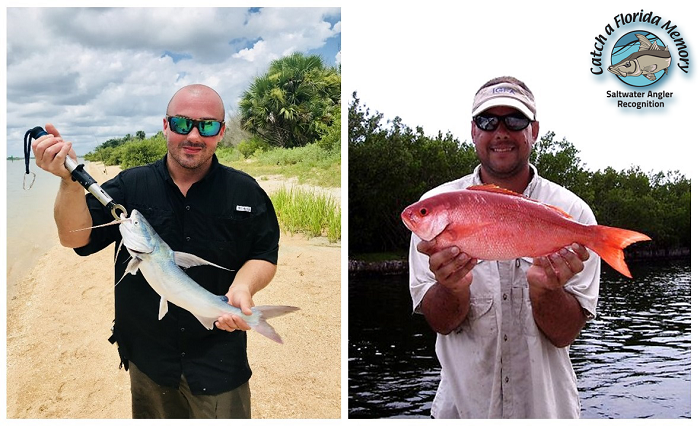 Catch a Florida Memory anglers Anthony Carta (with a gafftopsail catfish) and Dennis Triana (with a vermillion snapper).
FWC’s saltwater angler recognition program, Catch a Florida Memory, has added vermilion snapper and saltwater catfish as new qualifying Reel Big Fish. To qualify for a Reel Big Fish achievement, a fish must reach or exceed the qualifying length listed for each species in youth (under age 16) or adult categories. The qualifying length for vermilion snapper is 17 inches for adults and 13 inches for youth, while the qualifying length for saltwater catfish (gafftopsail or hardhead) is 22 inches for adults and 16 inches for youth. All Reel Big Fish catches must be photographed over a qualifying measuring device clearly showing the exact full length of the fish. A photo of the fish with the angler submitting the catch is also required.
Catch a Florida Memory received almost 6,000 submissions in 2020 and these additions will undoubtably contribute to even more participation in 2021. These additions give both inshore and offshore anglers new goals to keep them on the water targeting a variety of fish species. Vermilion snapper and saltwater catfish are also great table fare and are worth taking home to try out a new fish recipe. Stay tuned to see what MFM is cooking up to entice anglers to catch, clean and cook a variety of saltwater catches.
Learn more at CatchaFloridaMemory.com. Check out the latest catches and see angler achievements by following the Catch a Florida Memory Facebook page, Facebook.com/CatchaFLMemory, and view angler catches and much more on Instagram by following @MyFWC. Contact AnglerRecogntion@MyFWC.com with questions or visit the Frequently Asked Questions section of our website.
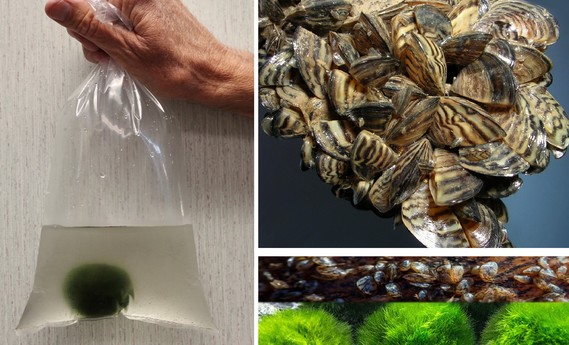 The invasive zebra mussel can cause devastating impacts by rendering beaches unusable, damaging boats, clogging pipelines and negatively impacting native aquatic organisms. Now this destructive species has been reported in aquarium “moss balls” being sold across the U.S. -- including Florida! If you have one of these plants, please properly dispose of it and learn how to disinfect aquarium water. Help stop these invasive mussels from gaining a foothold in the Sunshine State. Your actions can make a BIG difference for Florida’s ecosystems!
U.S. Fish and Wildlife Service Disposal Instructions: fws.gov/fisheries/ANS/zebra-mussel-disposal.pdf
More info:MyFWC.com/wildlifehabitats/profiles/invertebrates/zebra-mussel
|
|
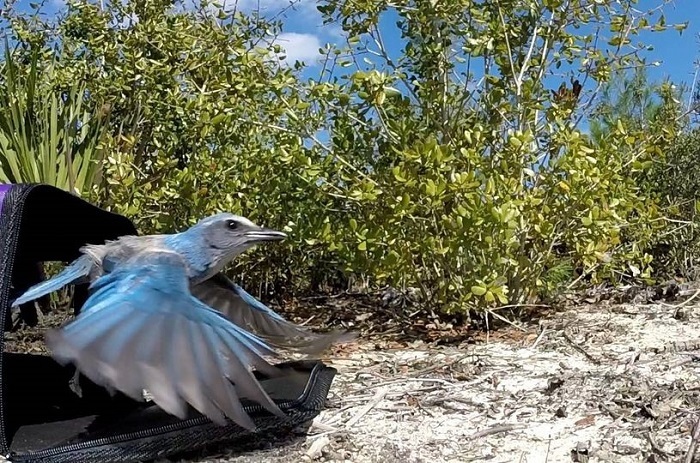 FWRI biologists have resumed winter translocations of the threatened Florida Scrub-Jay. Three 1-year-old jays were moved from Ocala National Forest to Rock Springs Run Reserve State Park during the last week of January as part of an ongoing effort to increase the size of Florida Scrub-Jay populations on important conservation lands in north and central Florida.
|
|
 By Carol Lyn Parrish, South Region PIC
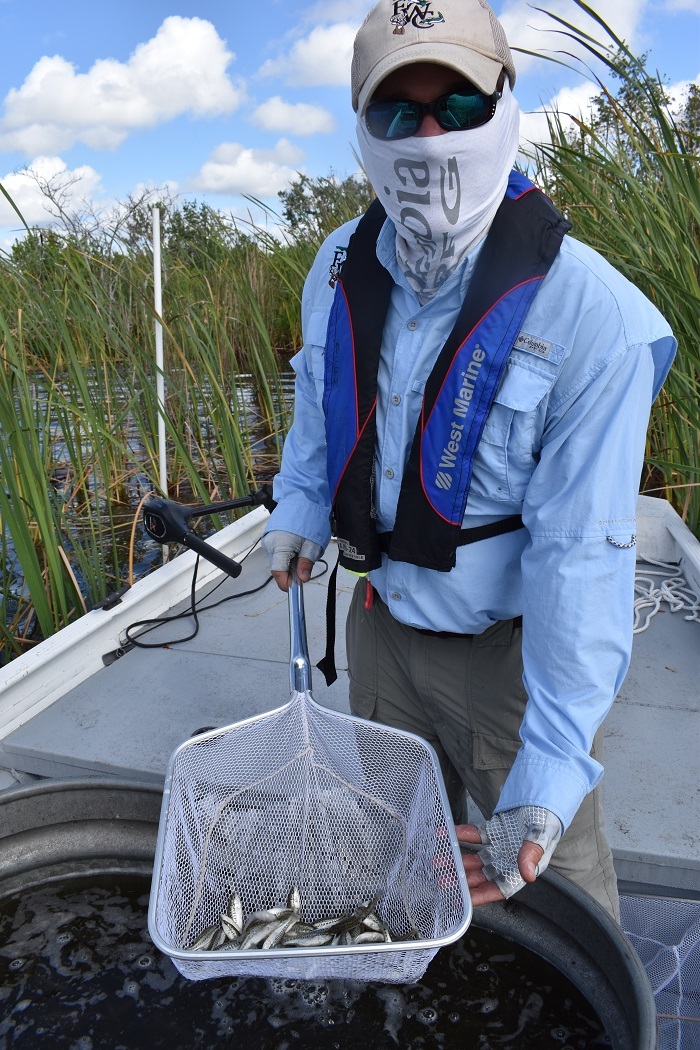
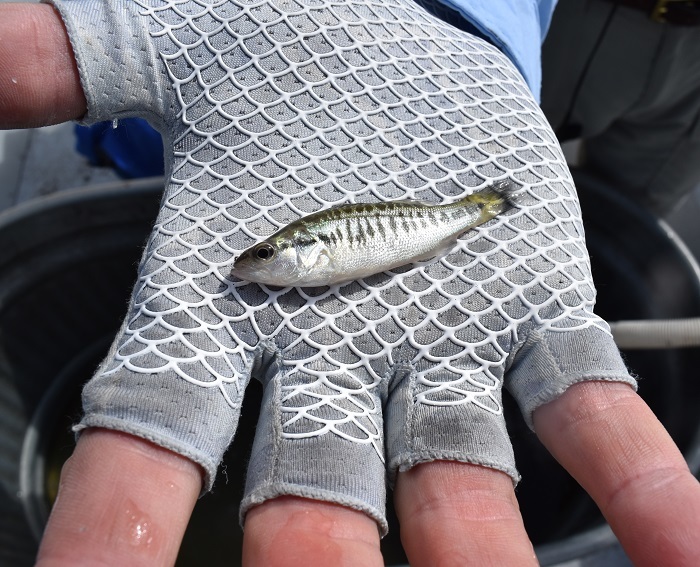
At Lake Trafford in Collier County, South Region, FWC conducts annual monitoring under the Sportfish Restoration-funded Long-term Monitoring Program. Using an electrofishing process and a standardized protocol, the sampling produces data allowing staff to compare the catch per unit effort, also known as relative abundance. Staff member Lee Grove, a Fish and Wildlife Biologist III with the Division of Freshwater Fisheries Management, targeted largemouth bass for this specific monitoring project. To conduct the monitoring event, electrofishing is done in the littoral, or shallow, shoreline of the lake. The shoreline is divided into segments, or transects, which are then randomly selected. Typically, our fisheries biologists sample 20-25 transects on a water body. During this annual event, Lee detected a sharp drop in relative abundance of bass less than 12 inches in length.
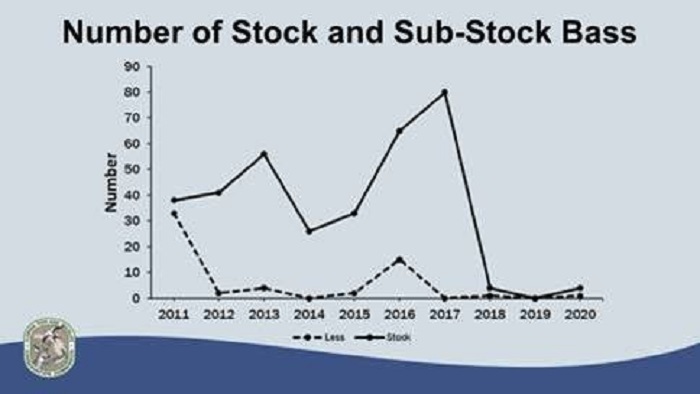 These findings suggested a recruitment problem, meaning the presence of suspected year-old fish showed a decline over the past several years. Staff determined this decline was likely related to Hurricane Irma habitat damage and a loss of submerged vegetation. This vegetation is important for largemouth bass as it provides cover for fish as well as a substrate for the colonization of minute organisms eaten by small fish. Based on these findings, FFM staff worked closely with our Aquatic Habitat Restoration (AHRES) team to plant and maintain vegetation, such as eel grass and bullrush. Many times, fishing success is used to document the success of habitat restoration.
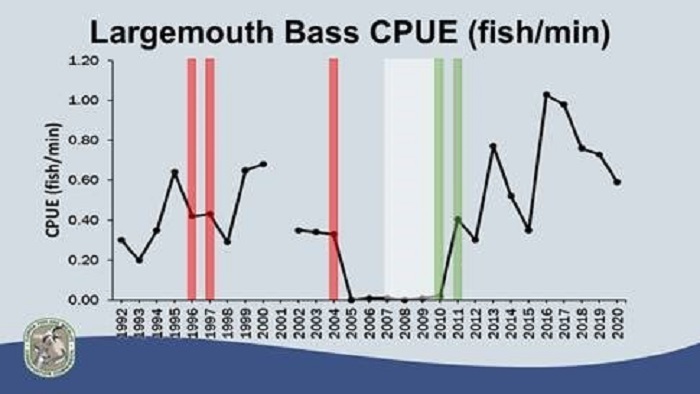 While habitat enhancement projects were planned, a request was made to the Florida Bass Conservation Center at the Richloam State Fish Hatchery for 50,000 fingerling largemouth bass to supplement natural recruitment or spawning. In the fall of each year, typically in the months of September and October, the Regional Freshwater Fisheries Administrator (RFA), Barron Moody in the South Region, assembles the necessary data and submits a stocking request to the hatchery. Requests for largemouth bass are typically planned two years in advance of stocking to ensure adequate brood stock and pond space. Using advanced techniques and technology, the FBCC was able to increase production on short notice to produce a larger than normal fingerling earlier than the natural spawn to meet this request.
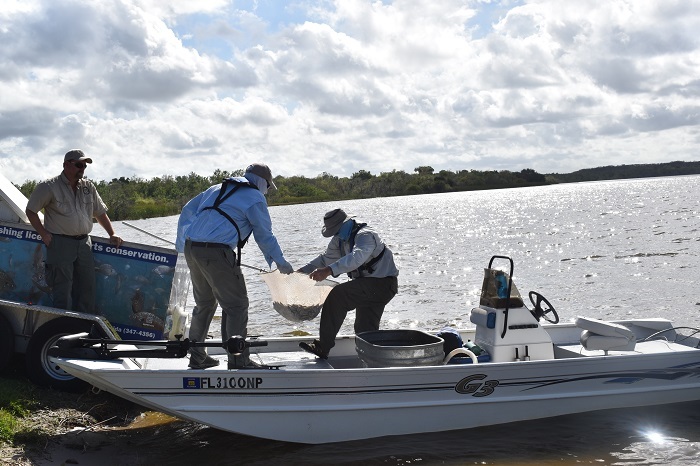 The FBCC has developed a unique technique that allows bass to be spawned out of season in the fall of the year, yielding a larger than normal fingerling that can be stocked in the spring. By manipulating water temperature and light exposure, hatchery staff can entice the bass to spawn two times per year in a controlled environment. In the wild, largemouth bass would normally only spawn once a year in the spring months. There are several advantages to spawning largemouth bass in the fall, including 1) it allows the hatchery to produce twice as many largemouth bass per year, 2) by spawning in the fall, bass can be raised through the winter months and released at a larger size in the spring, and 3) the larger size also means the chances of survival are greater because the bass would be large enough to forage on minnows and other large forage earlier in the natural growing season
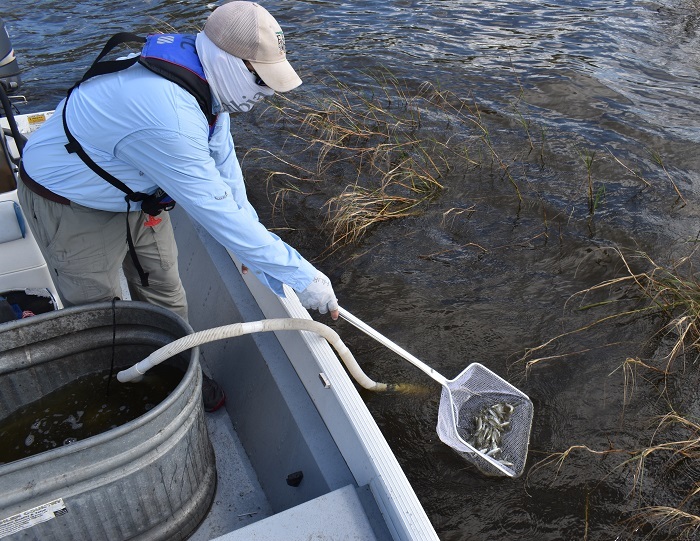
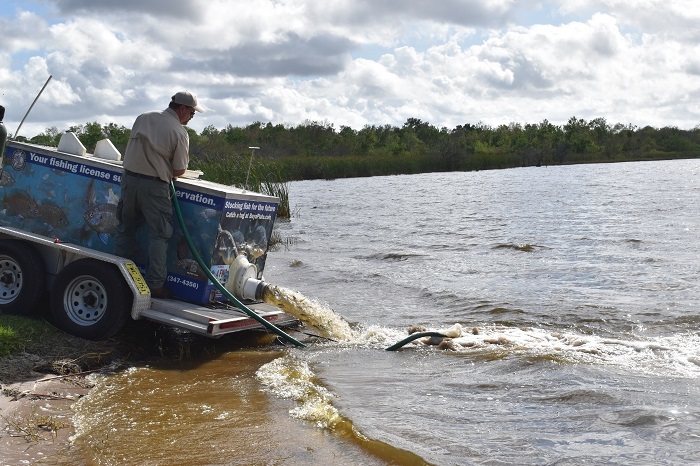 The stocked largemouth bass, from this year and a planned stocking next year, should help sustain the Lake Trafford bass fishery while habitat enhancement projects take hold to restore natural recruitment.
 For more information, check out these links:
Freshwater Fisheries Research pages/programs: https://myfwc.com/research/freshwater/freshwater-projects/long-term-monitoring/
Electrofishing: https://myfwc.com/research/freshwater/freshwater-projects/long-term-monitoring/electrofishing
Long Term Monitoring: https://myfwc.com/research/freshwater/freshwater-projects/long-term-monitoring/project/
Florida Bass Conservation Center: https://myfwc.com/get-involved/volunteer/regional-programs/fbcc/
Volunteer at the Florida Bass Conservation Center: https://myfwc.com/get-involved/volunteer/regional-programs/fbcc/
|
|
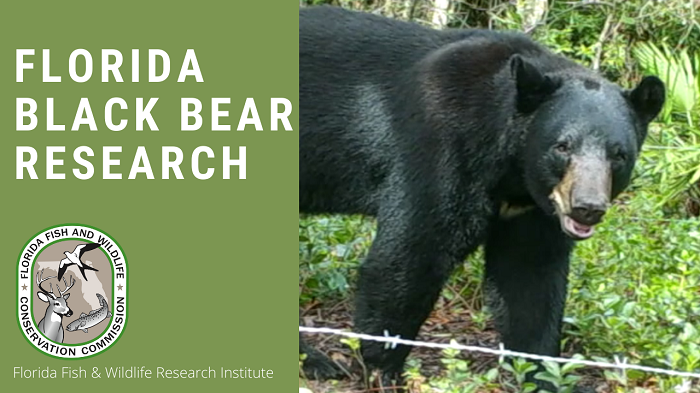 Last summer, FWRI bear researchers conducted a survey of bears throughout the Big Bend Bear Management Unit. The last Big Bend BMU survey in 2010 showed these bears were the most genetically isolated and had the smallest estimated abundance of Florida’s seven bear subpopulations. Since then, sightings of bears in the Big Bend BMU have expanded from the Chassahowitzka region to nearby Goethe State Forest and Lower Suwannee National Wildlife Refuge. Researchers use hair snag corrals to estimate bear abundance and genetic diversity. The corrals are formed with two separated strands of barbed wire strung around three or four trees to create an enclosed area. Bears are lured into the corral with bait (doughnuts) and scent; as they pass through the barbed wire, hair and genetic material is left behind on the barbed wire. During the 10-week survey in Big Bend BMU, hairs were collected each week and fence barbs burned to remove residual DNA in preparation for new samples to be collected. The hair samples are now being genotyped to identify the individual, sex and subpopulation of origin of each sample. Statistical analyses of the samples will reveal the abundance and genetic diversity of bears in the Big Bend BMU.
|
|
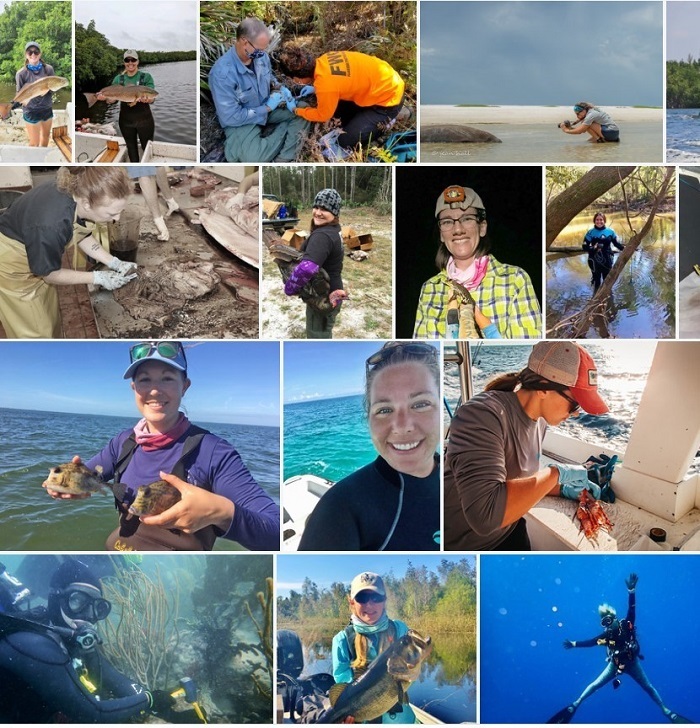 Worldwide, less than 30% of scientific and technological researchers are women. FWRI continues striving to set the standard and is proud that 45% of our research staff are women! Get inspired, find out more about FWRI’s women scientists.
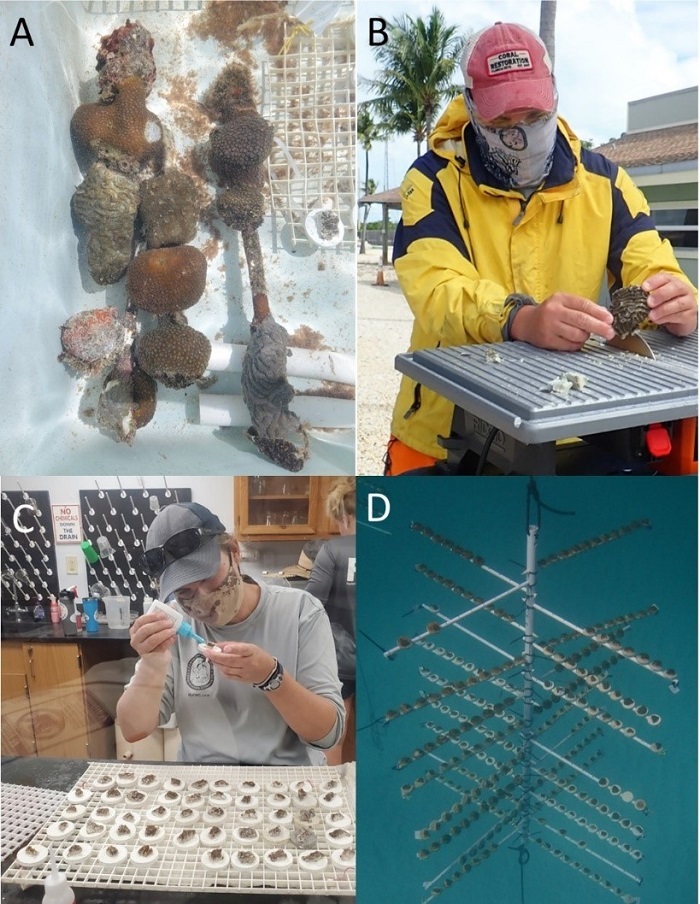 This spring, the FWC will coordinate, along with partners, a coral transplantation research project to transplant thousands of coral colonies on south Florida’s coral reef. The project will assess when and where restoration efforts along south Florida’s coral reef can resume without subjecting the transplanted coral colonies to stony tissue loss disease and/or spreading it to the surrounding natural coral colonies. In preparation, FWC researchers are propagating new coral colonies from species being maintained in our in-water nursery. The coral colonies will be transplanted on reefs from Martin county to the lower Florida Keys. Once transplanted, they will be monitored for evidence of SCTLD for two years.
|
|
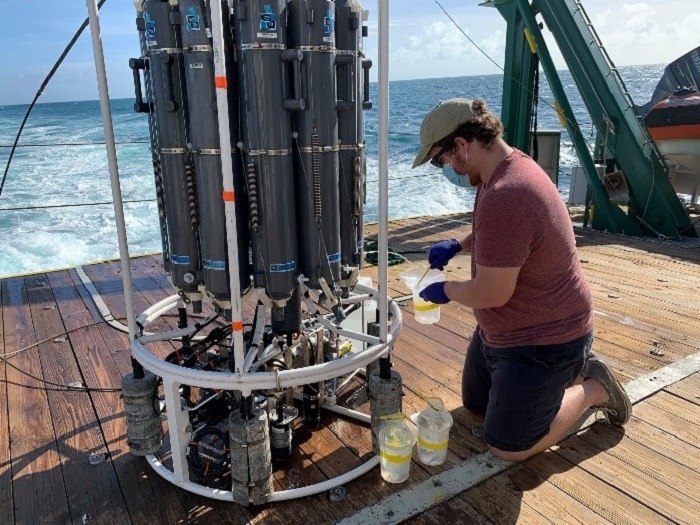
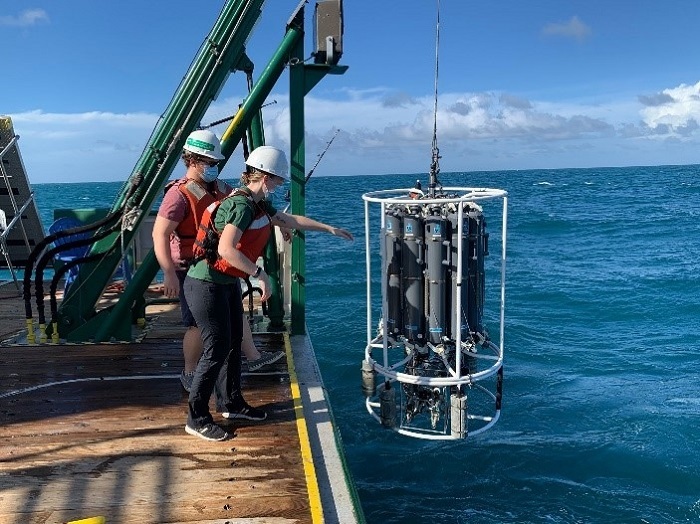 FWRI is involved with collaborative routine red tide monitoring on the West Florida Shelf. Researchers are conducting a 7-day research survey to map current bloom conditions and collect water quality samples.
|
|
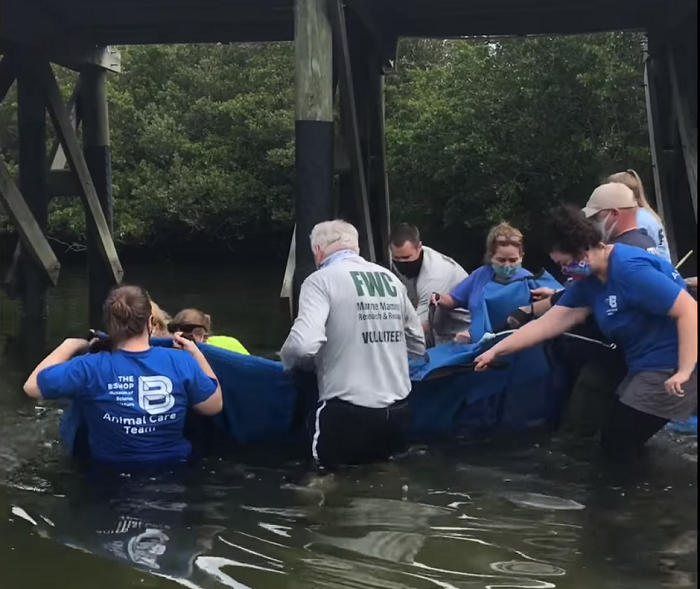 In the past few weeks FWC and partners successfully released 23 manatees back into the wild after full rehabilitation at critical care facilities. Many of the released manatees were rescued as calves with limited or no experience in the wild. Biologists use days surrounding cold fronts to release the manatees at a warm water sites where they join other overwintering wild manatees. The new releases are tagged with satellite trackers so researchers can monitor their progress.
|
|
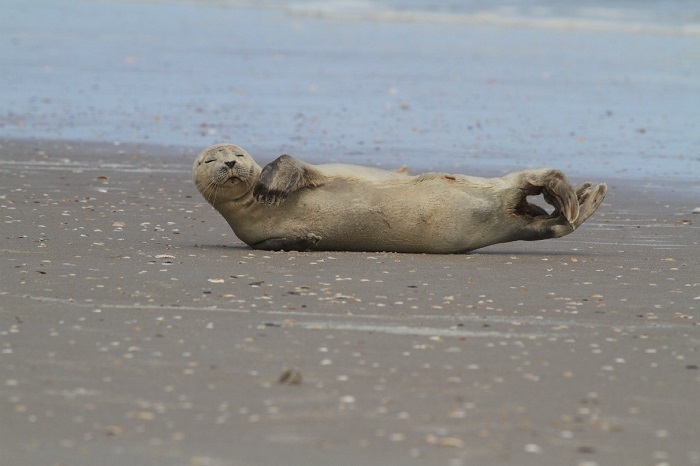 A Harbor Seal in Florida? Yes! Occasionally we may have a seal visit our coastal waters. In February, FWRI biologists responded to a harbor seal on Ponte Vedra Beach. People are often concerned when they see these young animals alone but these animals are independent, solitary creatures at this stage of life. Juvenile seals often have a few cuts and scrapes but resting on the beach is part of their normal behavior.
|
|
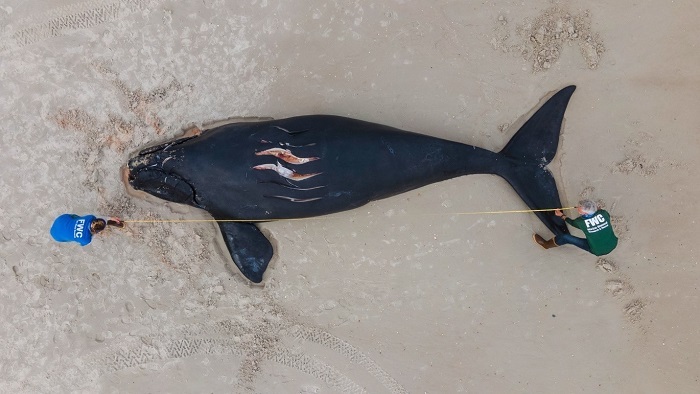 On the evening of Feb. 12, a 54-foot sportfishing vessel captain reported hitting a whale near the entrance to St. Augustine Inlet. The vessel began taking on water and was quickly grounded to prevent it from sinking. The occupants were all safe. The Captain’s near real-time report is vital to increasing our understanding of vessel strike events and alerted researchers to be on the lookout for an injured or dead whale. The following morning a North Atlantic Right Whale calf was found dead on the beach in Anastasia State Park.
Biologists responded to conduct a necropsy (animal autopsy) of the 22-foot-long, male calf to examine the cause of death and collect biological samples. Fresh cuts on the whale’s back and head are indicative of being struck by a vessel propeller. The whale also had injuries consistent with impact trauma, including broken ribs and bruising. The final results of the exam are pending additional analysis.
|
|
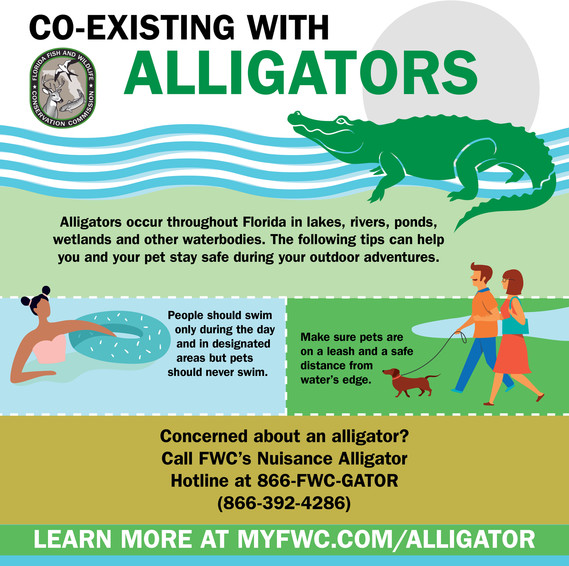
 Tips to help people and pets safely co-exist with alligators
Warm spring weather means Florida’s state reptile - the American alligator - becomes more active and visible. It’s also a popular time of year for people to enjoy the outdoors with their pets. To help keep people and pets safer when spending time near the water, the Florida Fish and Wildlife Conservation Commission (FWC) is introducing a new graphic outlining important safety tips
Serious injuries caused by alligators are rare in Florida. The FWC places the highest priority on public safety and administers a Statewide Nuisance Alligator Program to proactively address alligator threats in developed areas, while conserving alligators in areas where they naturally occur. SNAP uses contracted nuisance alligator trappers throughout the state to remove alligators believed to be a concern. The FWC also works to keep Floridians and visitors informed, including providing safety information in a video and brochure.
  Gone Coastal: How to start your fishing adventure
FWC asks public to help stop the spread of invasive zebra mussels
FWC celebrates 12 years of out-of-season largemouth bass spawning
Last call for Florida Fish Art Contest entries
FWC: You can help Florida’s nesting waterbirds.
Find wildlife management areas where a quota permit isn’t needed for spring turkey hunting
New species added to FWC Catch a Florida Memory - Saltwater Reel Big Fish Program
FWC Division of Law Enforcement achieves reaccreditation
Ocala Outdoor Adventure Camp awarded $7,000 grant
 February is recognized and observed as Black History Month, also known as African American History Month. It has received recognition throughout the United States and in other countries. It began in recognition of the contribution of the African diaspora. FWC continues to celebrate and recognize African American and Black colleagues within our agency not only in February but throughout the year. Below are some of our co-workers who help make this agency one of the best in the country!
 |
|
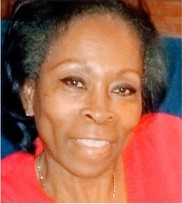
Josephine “Jo” Barnhart, Administrative Assistance, HSC
My duties consist of purchasing supplies, maintaining agency records, communicating internally and externally with customers and subject matter experts, drafting permits and letters as required. These duties play an important role in assisting our permitting staff in performing their daily duties, which is preserving and protecting our wildlife resources. One year with the FWC.
|
 |
|
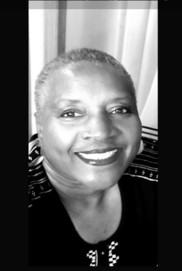
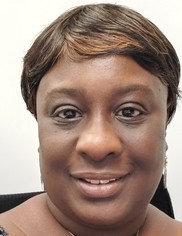
Dr. Rosezetta Bobo, Director, Diversity Office in Tallahassee
Dr. Rosezetta Bobo is the FWC’s Diversity Director. She is a nationally recognized expert with over 20 years of experience in mediation, cultural competence, diversity and inclusion, conflict resolution, restorative justice, and community engagement for a diverse range of organizations throughout the country. Her driving force is to assist in the agency in becoming more diverse inside and educate the public and community of conservation contribution to the society and general public. Two years with the FWC.
|
 |
|
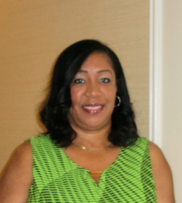
Beverly Butler, PCard Administrator, FBO
Manage Pcard usage, training, audit and PCard Works. Protect and serve the state of Florida fish and wildlife, and park recreations. Three years with the FWC. |
 |
|
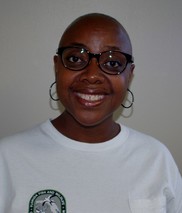
Vivian Carroll, Accountant III, FBO
Provide accounting services for the agency. Three years with the FWC. |
 |
|
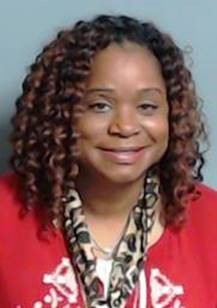
Jessica Cotton, Call Center Agent, Northeast Region
Answers calls coming into the NE Region Call Center. These calls come in for all divisions and are handled by the call center staff (hunting, fishing, boating, WMAs, conflict wildlife and the list goes on). In February, became part of our Statewide Call Center and is answering calls from all over the state. Five years with the FWC. |
 |
|
Deneen Crawford, Grant Specialist V, Grant Management/liaison; Deepwater Horizon Oil Spill Grants, FWRI in St. Petersburg
Keeps grant processes between the granting agencies and our scientists flowing smoothly. Three years with the FWC. |
 |
|
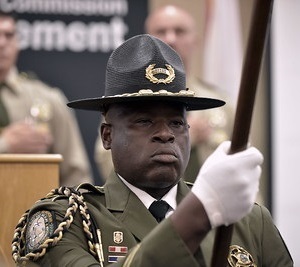
Lt. Adonious Duhart, Training Academy, LE
Develop and coordinate advanced and in-service training for LE. Statewide Firearms Training Coordinator, Lead Firearms Instructor for Recruit training, LE Master Taser Instructor, Honor Guard member, property custodian for the Academy, Veterans Affairs School Certifying Officer for academy training. 16 years with the FWC. |
 |
|
Tachea Evans, Duty Officer, NE Region LE, Technology and Communication Services Section
My duty is to ensure officer safety. Take calls from complainants. Dispatch officers to those complainants. Communicate with other law enforcement agencies. And many other things to ensure FWC is represented in a positive manner. Eight years with the FWC. |
Allen Hamilton, Exotic Species Hotline Coordinator, Wildlife Impact Management Section HSC in Fort Myers
I take calls from the public and answer any questions they might have about nonnative species. I also record sightings of nonnative species and help coordinate the removal of nonnative species, such as tegus, monitors and pythons, that might be on a constituent’s property. Four years with the FWC.
 |
|
Barbara Howell, OPS Accountant IV, FBO
My duties include completing financial statements, schedule 1s, reports (daily, monthly, quarterly, year-end, RDS, MRE, information warehouse and some natural programming), as well as trial balance reconciliation, trust fund analysis, working on the Florida PALM Team, back-up for trust fund cash liquidation, review and approve monthly revolving fund reconciliation and quarterly FCO analysis. Four years with the FWC.
|
Moses King Jr, Senior Clerk Supervisor, Mail Room, Bryant Building in Tallahassee
Supervise FEDEX, USPS, UPS mailing shipping and mailroom services, motor pool vehicles for travel reservations, repairs and maintenance, responsible for accounts with several vendor that maintain function to mail service department and equipment such Pitney Bowes Grainger USPS and several local vendors. Purchases supplies and verifies check transmittals. Five years with the FWC.
Joseph Munyandorero (PhD), Research Scientist, FWRI
Conduct stock assessments (sheepshead, common snook, Atlantic croaker, spot, bluefish); complete annual ASMFC compliance reports; conduct research. When I Joined FWC in 2005, I found a welcoming group at FWRI (St. Petersburg); this working environment created self-confidence in me and helped me to adequately do my job. 16 years with the FWC.
 |
|
Gale Smith-Johnson, Acting Accounting Services Section Leader, FBO
Responsibilities include managing disbursements, reconciliation, cash management, financial statements and PCard Works functions for the agency. Five years with the FWC. |
 |
|
LaTosha Thompson, Environmental Specialist/GIS Technician, Center for Spatial Analysis in the Information Science & Management Section, FWRI in St. Petersburg.
As a member of the GIS Data Management Team, I am responsible for geospatial data management, data acquisition, metadata creation and maintenance, mapmaking, and responding to requests for information relating to our data inventory. I am also involved in the creation and maintenance of geospatial web applications and dashboards. Six years with the FWC. |
Lora Lee-Turner, Administrative Assistant II, HSC
Administrative support to Wildlife Diversity Conservation section staff. Primary duties include monthly vehicle logs, public record requests, property inventory, process invoices in MFMP, purchase orders, office supplies, and assist staff with WORKS transactions. Two years with the FWC.
 |
|
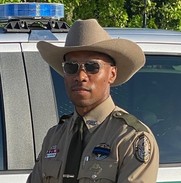
Officer Ronald Washington, Public Information Officer, LE
Responsibilities: Assist with community outreach, public relations/communications for law enforcement matters within the agency as well as media outlets. Seven years with the FWC. |
 |
|
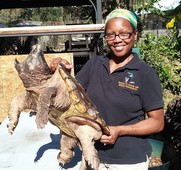
Angela T. Williams, Protected Species Permit Coordinator, HSC
Coordinate agency review of permits that impact avian and terrestrial species. My work plays a vital role in helping the agency monitor implementation of long-term conservation actions for the benefit of Florida’s species. 27 years with the GFC/FWC. |
 |
|
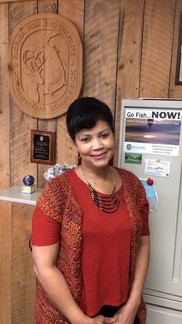
Charmaine Williams, Staff Assistant, Blackwater Hatchery, FFM
Responsible for the administrative office duties at the Blackwater Hatchery. Assists with scheduling and planning. Assists with purchasing of products/commodities/services for the facility. Nine years with the FWC. |
 |
|
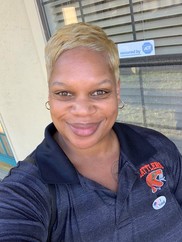
Kisha Wright, OMC I, Unit Habitat/Species Conservation Business Section in Tallahassee
I provide budget support for Wildlife Impact Management and Imperiled Species Management. I also process purchase requisitions for the majority of HSC as well as HGM. 17 years with the FWC |
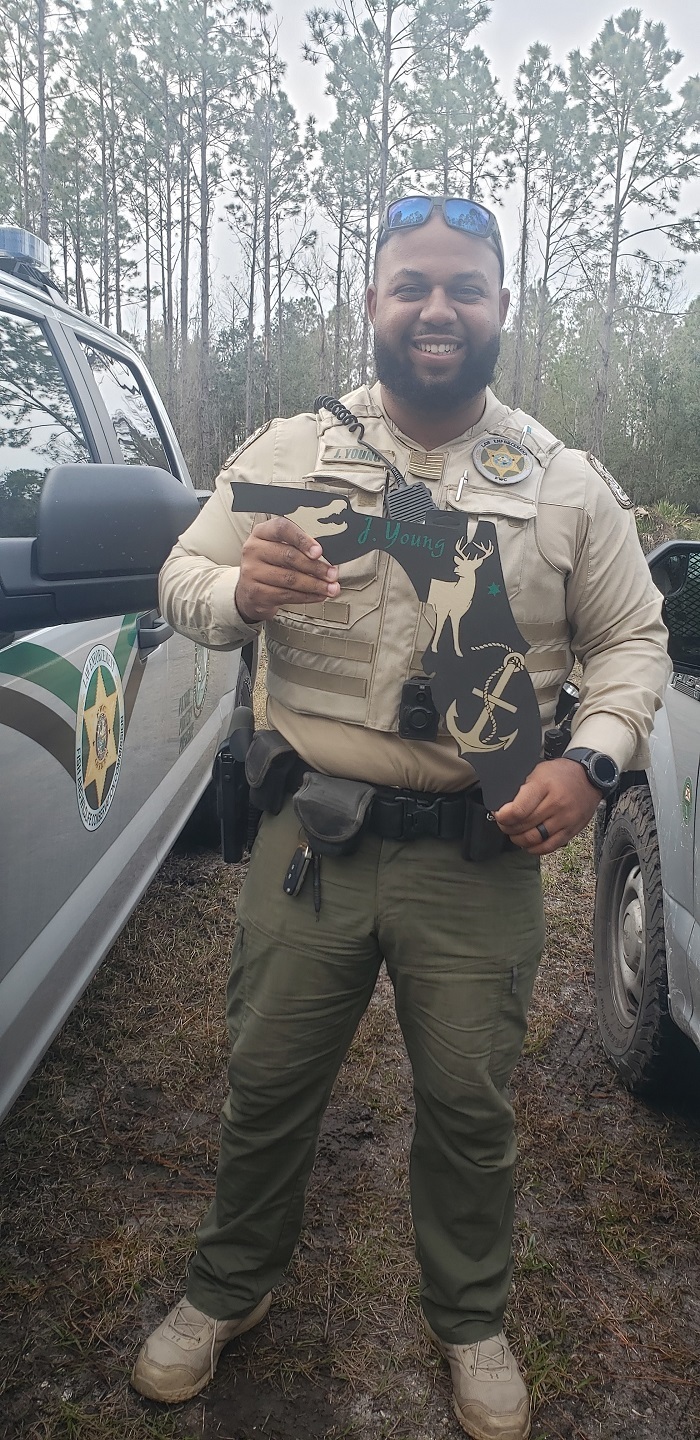
Officer Johnathan Young, State Wildlife Law Enforcement Officer
Protect Florida’s natural resources by patrolling via vessel and patrol vehicle in rural wilderness areas, inshore and offshore waters of the Atlantic Ocean and inland lakes while enforcing all hunting, fishing, boating and government public safety regulations and U.S. Coast Guard laws. Six years with the FWC.
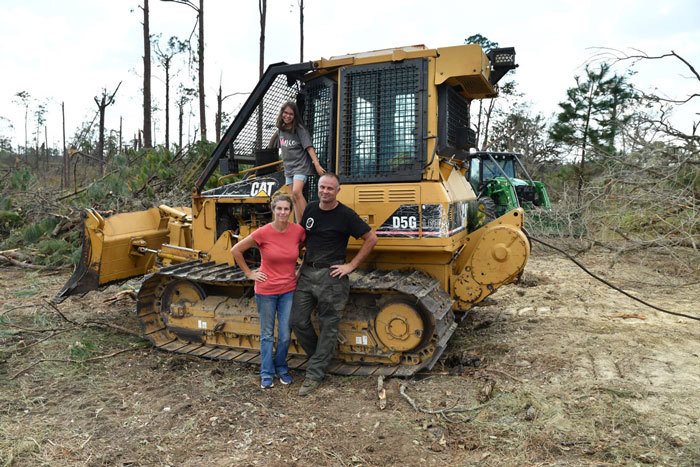
  Nathan Bunting named Resource Manager of the Year
Gov. Ron DeSantis has recognized Nathan “Nate” Bunting, a biologist with the FWC, with the Jim Stevenson Resource Manager of the Year award, one of Florida’s highest environmental honors. Bunting has served for over 15 years at the Apalachee Wildlife Management Area in the Florida Panhandle and has worked tirelessly to restore the WMA after it was devastated by Hurricane Michael in October 2018.
The award, presented to Bunting by FWC Executive Director Eric Sutton in a virtual ceremony on Feb. 22, recognizes outstanding resource management achievements by resource managers who protect state properties.
Glenda Atkinson Receives 2020 Rodney Barreto FWC Employee of the Year Award
The Fish & Wildlife Foundation awarded FWC Chief Information Officer Glenda Atkinson the 2020 Rodney Barreto FWC Employee of the Year Award. Atkinson is known for her success at improving effectiveness within her department, placing major emphasis on IT security and improved technologies such as Cloud migration.
Her team won a Davis Productivity award in 2020.
Thanks to Atkinson’s leadership, technology and resources remained available to the public and to staff during initial work transitions due to COVID-19.
|
Col. Curtis Brown Given the 2020 Louise Ireland Humphrey Award
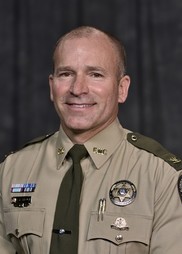
At the February Commission meeting, Col. Curtis Brown was given the 2020 Louise Ireland Humphrey Award by the Fish & Wildlfife Foundation of Florida. The Humphrey Award recognizes FWC employees for outstanding service over their entire careers.
At the February Commission meeting, Col. Curtis Brown was given the 2020 Louise Ireland Humphrey Award by the Fish & Wildlfife Foundation of Florida. The Humphrey Award recognizes FWC employees for outstanding service over their entire careers. In his almost 30 years as a law enforcement officer, Col. Brown has worked a multitude of positions. In addition to leadership positions in multiple conservation law enforcement organizations, he has served as the Vice Chairman of the Law Enforcement Committee for the Association of Fish and Wildlife Agencies for the past five years. While serving in this role, he played a role in establishing the annual AFWA Investigations and Intelligence Summit where states and other partner agencies come together to work on combatting illegal trafficking of wildlife. Congratulations, Col. Brown!
|
 Citizens and FWC customers were so impressed by the following employees, they told us about it through email on the "Praise an Employee" page of MyFWC.com/Contact. When your coworkers receive kudos, help share the good news by contacting Kelly.Broderick@MyFWC.com.
Justin Bingham, HGM
I contacted the local area offices to plan my hunt in Big Cypress WMA. The woman informed me Justin was the one to speak with due to his knowledge. Boy, was she right. In the 25 years of my hunting career I have never encountered a more knowledgeable, professional and pleasant government employee. And I've met tons of fine government employees. I felt like he really represents the people and has a true passion to share the outdoors and its vast biological world. He is extremely knowledgeable of the WMA and its logistics, biology, and rules and regulations. Georgia could learn a lot from the FWC. Keep giving the by-the-book conservationist hunters like me great service. We are your eyes and ears between patrols.
Lt. Whitney Chase
We would like to heartfully thank and recognize Lt. Whitney Chase. She came to our property recently and advised us regarding agricultural properties. Working with our young agriculture students, she was respectful, soft-hearted and full of advice and praise for these youth. The boys learned so much from her. She treated them with respect, kindness and dignity. Thank you so much for your support. My husband and I really appreciate the FWC for all their advice as well as the great example of leadership for our children.
April Edmonds, IT
On Feb. 4, I realized I had accidently deleted thousands of documents on our SharePoint site that we are using for a complex criminal investigation involving a large international wildlife smuggling ring. I emailed April Edmonds for help. Within minutes she responded back. She helped me navigate the SharePoint system as well as help me restore the deleted items. She is always such a pleasure to work with and goes above and beyond to provide the best customer service I have ever experienced. Not only did she help fix the problem, she also took the time to send screen shots with instructions and taught me how to understand and resolve these types of problems in the future. This is not the first time she has stopped whatever it was she was doing and offered to help us. She is great and I just wanted to praise her effort.
Madeline Fernandez, FFM
I called to get as much info on fishing in the Destin area as I could. Madeline went above and beyond in getting my questions answered (there were a lot) and sent a wonderful package of extremely helpful pamphlets and magazines which i am enjoying going through. We go to Destin two to three times a year and I have been enjoying fishing every time. This spring I plan on fishing every day and she has provided me with the info needed to do this safely and legally.
Lt. John Jones
We were fishing at Homosassa Springs and two pelicans came close to the boat, as they often do. I noticed both had hooks and one was tangled up with line. We were trying to catch them but not doing so good when John showed up out of nowhere and climbed on my boat. I got my net at his request. I had a fish and lured them close to the boat and John netted them one at a time and cut the fishing line off and got the hooks out of them. Thanks Officer John for showing me how to net them safely.
Meghan Koperski and Robbin Trindell, HSC
Turtles Fly Too (TF2) would like to formally recognize and thank the FWC, with special recognition to Meghan Koperski and Robbin Trindell, for allowing our organization and its “Turtle Fliers” — our pilots who contribute their time, talents and aircraft — the opportunity to transport critically endangered and threatened sea turtles to the Canaveral National Seashore for release at Playalinda Beach.
TF2 has been transporting these and other endangered species on behalf of NOAA Fisheries and U.S. Fish & Wildlife Service since 2014. We flew our first mission at the request of these agencies and Dr. Terry Norton, from Georgia Sea Turtle Center in Jekyll Island. Dr. Norton understood the benefits of collaborating as he helped enlist general aviation contacts to transport endangered sea turtles, reducing the time involved previously in ground transport, thereby reducing stress on the sea turtles and significantly increasing their chances of survival. TF2 now manages a database of over 360 Turtle Fliers who are available for endangered species transport. TF2 conducts flight missions nationwide and continues to develop methods to improve processes for sea turtle transport and rehabilitation. TF2 has brought together partners in private industry and academia to use their talents to develop improved, stronger transport containers; to manufacture specialty metal cutting tools for disentanglement of whales; to organize necropsy education programs for veterinarians and universities; as well as seeking out new centers for rehabilitation. It is through a desire to find the most efficient way to make each sea turtle’s journey comfortable quick and stress-free that the search for another landing location with closer proximity to a beach in Florida was initiated. We would like to thank FWC for supporting this most recent transport and release in Florida, in cooperation with NASA Kennedy Space Center, USFWS and the National Park Service at the Canaveral National Seashore. The ability to release the sea turtles within 30 minutes of arrival at a close beach with natural habitat; with support of collaborative partners; and approved by the FWC provided the perfect backdrop to the day. TF2 is extremely proud to have been introduced to retired NASA Astronaut Nicole Stott, who championed (beyond our wildest dreams) to open the doors to NASA’s Kennedy Space Center and provide TF2 landing support and the coordination and cooperation of multiple agencies for release opportunities. We sincerely appreciate FWC’s approval to allow this inaugural release event to occur and for NASA’s landing permissions and clearances, proving that when we work together, incredible things happen.
Officer Shawn Polly
As a prior long-term state employee, I understand the work done is often overlooked or not complimented. I wanted to take a moment and commend your team, led by Officer Polly, regarding an injured bear, motionless in a retention area on a Saturday evening. Officer Polly was a true example of someone that loves his job. Upon arriving, he listened to the reports of what residents witnessed with a Florida black bear. Officer Polly patiently and respectfully, listened and offered information about the bear. He was very knowledgeable, compassionate for animals and had an amazing way with the public. He advised us to alert our neighbors but, more importantly, stay alert as injured/sick animals are unpredictable. He said to contact FWC with any updates. On Sunday, we saw the bear again and contacted FWC. We drove by a bit later to find Officer Polly with another officer. He said the bear was not doing well and that a biologist was on his way. We discussed our concerns about someone hurting this bear that has been in our area for some time. Later, Officer Polly stopped by to update us on the bear's passing. Great job by the biologist, and two officers who were professional, compassionate and sensitive to the bear's condition and very interested public.
Eric Seckinger, HSC
Eric took the initiative and answered calls and emails right away. He understood our goal and worked diligently on it. Eric is a real asset and a professional! He definitely is a “doer.” Eric is a rarity in today’s work force!
Tony Young, HGM
Incredibly informative and responsive! Tony shares his experience and he excited me to come to Florida and spend money!
 Congratulations to the following employees for reaching 5-year milestones of employment with the FWC.
|
|
35 Years
David Cook, HSC
Jim Feiertag, HGM
Jeff Gore, FWRI
William Sargent, LE
30 Years
Catherine Billick, FWRI
Mike Tringali, FWRI
25 Years
Dwight Myers, HSC
Daniel Sullivan, HSC
20 Years
Venus Mikolajek, FFM
Brian Scheick, FWRI
Zandra Wostel, MFM
15 Years
Carolyn Champion, OLP
Tina Hannon, HSC
10 Years
Michael Rice, LE
Bryan Tucker, FBO
|
5 Years
David Bellville, LE
Charles Bradshaw, LE
Alberto Canamero, LE
Jacob Carter, LE
Nathaniel Cheshire, LE
Corey Cremata, HSC
Markiel Curbelo, LE
Jason Dalton, LE
Christopher Davidson, LE
Tyler Dunn, LE
Grant Eller, LE
James Fox, LE
Thomas Godfrey, LE
Jared Hayes, LE
Justin Helton, LE
Dominique Infante, LE
Michael Janzen, LE
Andrew Kobs, LE
Jorge Larios, LE
Sean Long, LE
Theodore Mandrick, LE
Richard Marroquin, LE
Brittany Mobley, LE
Nicole Muina, LE
Sheri Parks, FWRI
Jessica Rorer, LE
Brian Sapp, LE
Emily Snyder, LE
|
|
Retired!
Joyce Bryant, OED - 18 Years, 5 Months
Robin Stetler, OSI - 11 Years, 9 Months
John Benton, FWRI - 35 Years
Major Andrew Krause, LE - 36 Years
Officer Stefanie Wilcox, LE - 5 Years, 7 Months
(The FWC has a great many non-FTE employees, and they deserve recognition for reaching 5-year milestones too. Unfortunately, the system doesn't keep track of such statistics; but we don't want that to stop us. If you know of a non-FTE employee about to reach a 5-year milestone, please notify the Inside Job by email.)
|
|

|
FWC employees have some of the most interesting jobs ever! Here are some of our employees doing what they do best. Send your photos of FWC employees in the office and in the field to Kelly.Broderick@MyFWC.com.
|
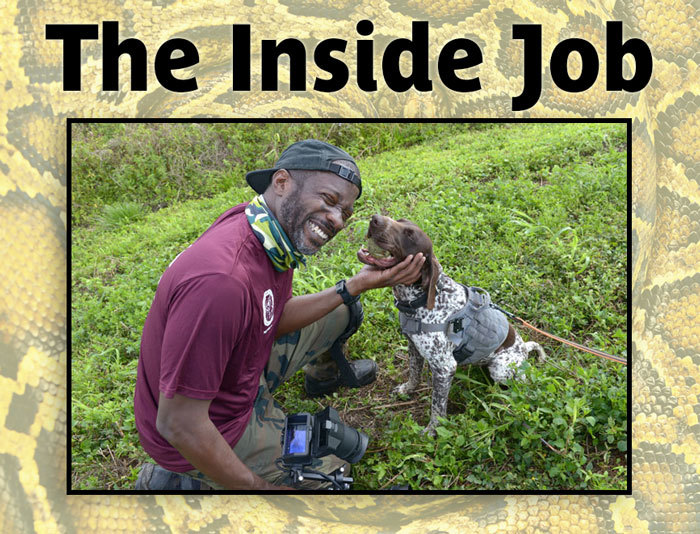
Masthead: CR's Avery Bristol takes a break from filming our python hunting dogs.
Officers Ronald Washington and Guillermo Cartaya had their photo, taken by AP during 2019 Lobster season, featured on Police1.com. The accompanying article under their ‘Rural Law Enforcement’ section is titled “It’s Personal: Understanding the risks poachers pose to LE.”
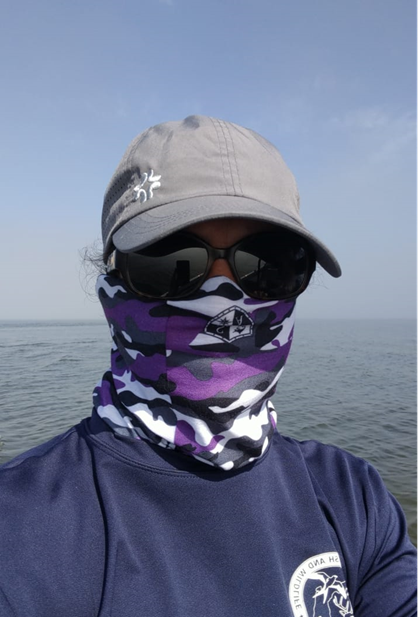
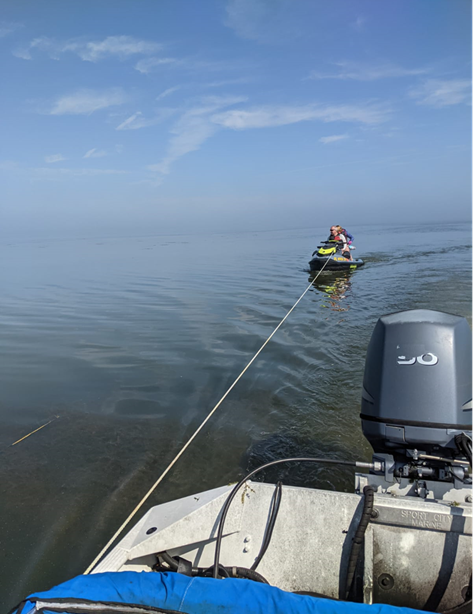
On Feb. 10, our Regional Biologist for Lake County, Nathalie Visscher, was out mapping on the Harris Chain of Lakes. She came across a couple stranded on a patch of hydrilla while on their jet ski. She quickly offered to help them and towed them out of the hydrilla and to the shore. They were so thankful for the help.
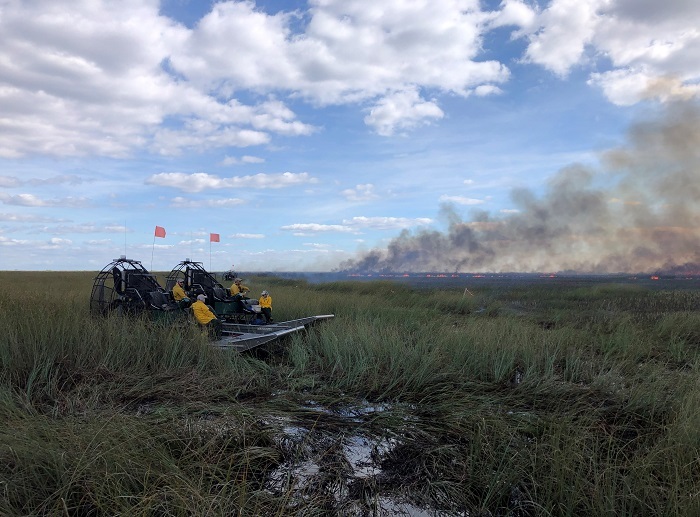
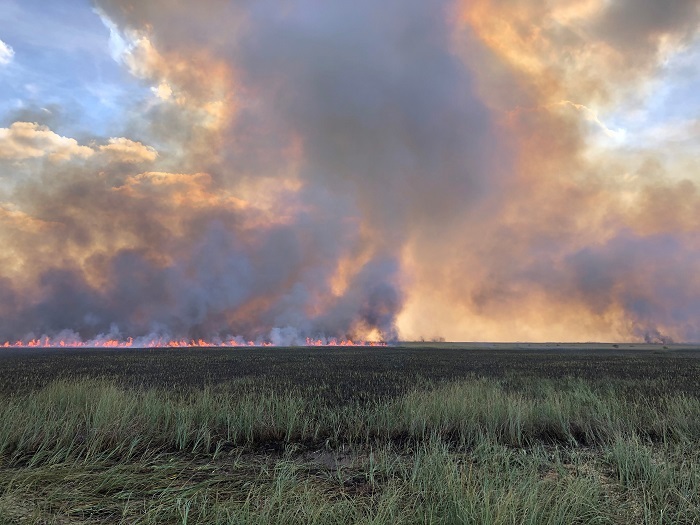
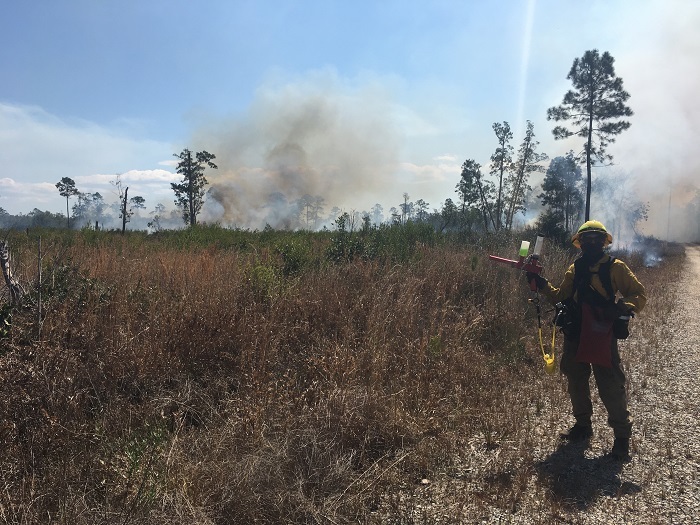
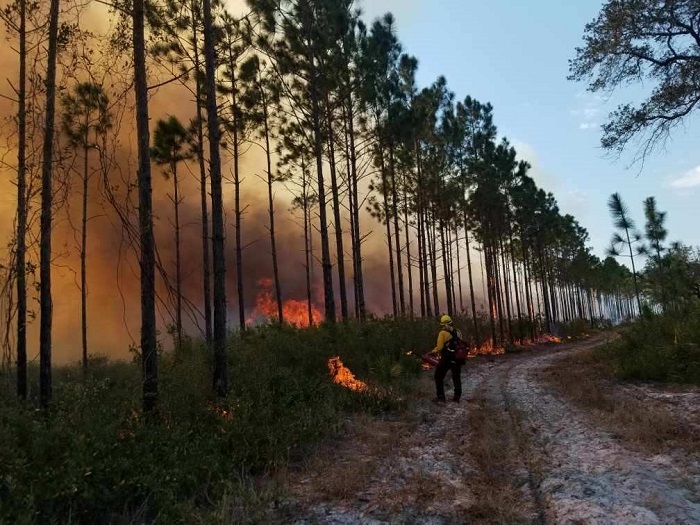
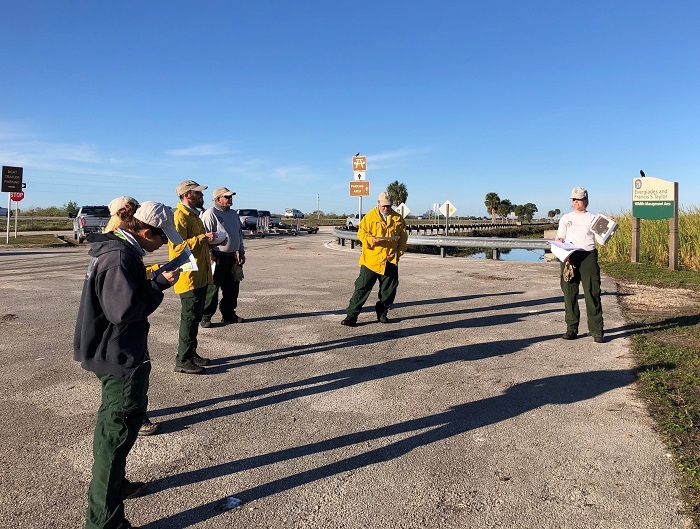 Wildlife and Habitat Management Sunrise Field Office staff, Rachel Taylor, Colleen Closius, Jim Brannon, Rob Creswell and Cory Gillis work with Andrea Pereyra (South Region Volunteer Program Biologist) and Susie Nuttall (Keys WEA) to conduct a prescribed burn in Everglades and Francis S. Taylor WMA.
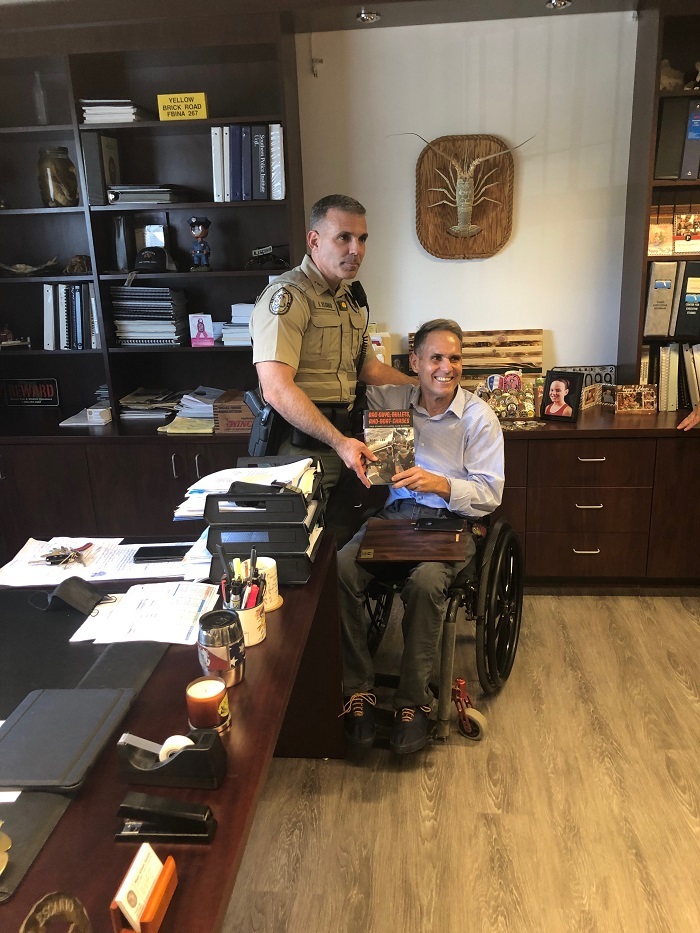 Maj. Alfredo Escanio presents Antonio Rodríguez with an honorary award. Rodríguez is a strong supporter of the FWC and our mission. He lives in the City of Miami (on the water) and writes for an international magazine about boating safety. He also enjoys riding his PWC and spreading the boating safety message.
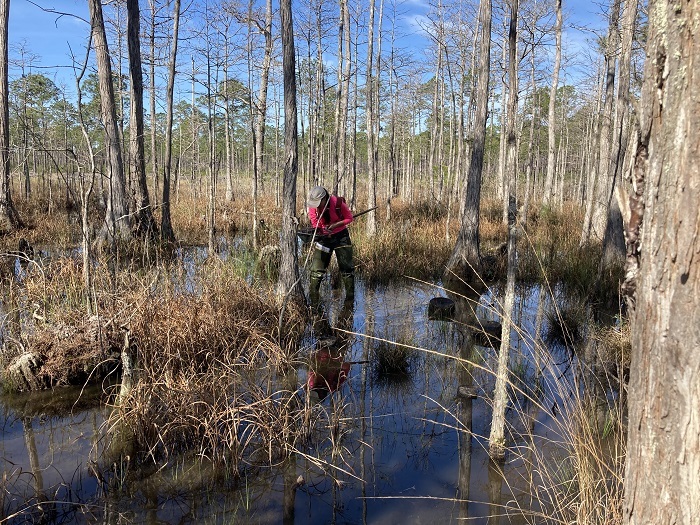 WHM staff dip netting for flatwoods salamanders in Apalachicola NF. Photos by Clint Peters. Above: Diane Alix. Below: Diane Alix and Olivia Wilkes.
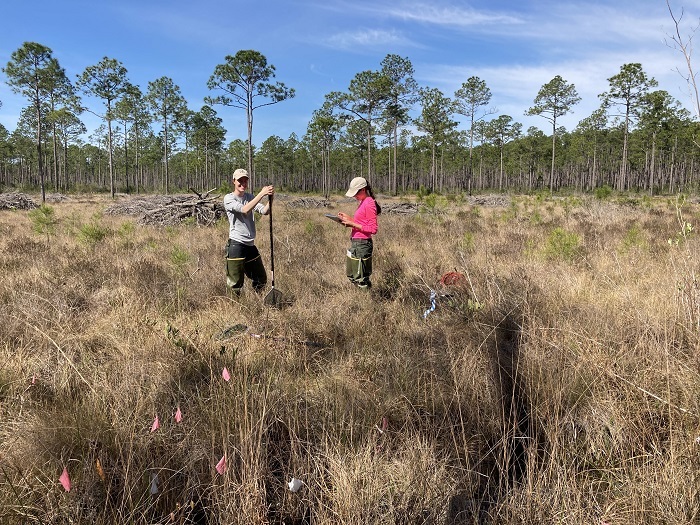 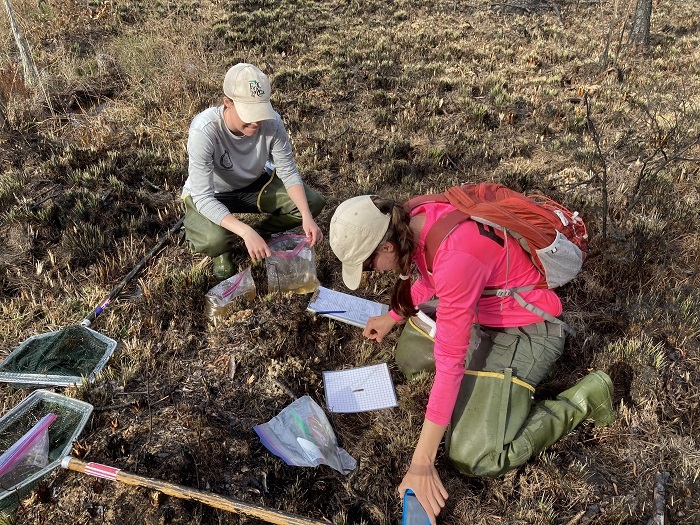 Above: Diane Alix and Olivia Wilkes. Below: Olivia Wilkes with a Flatwoods Salamander.
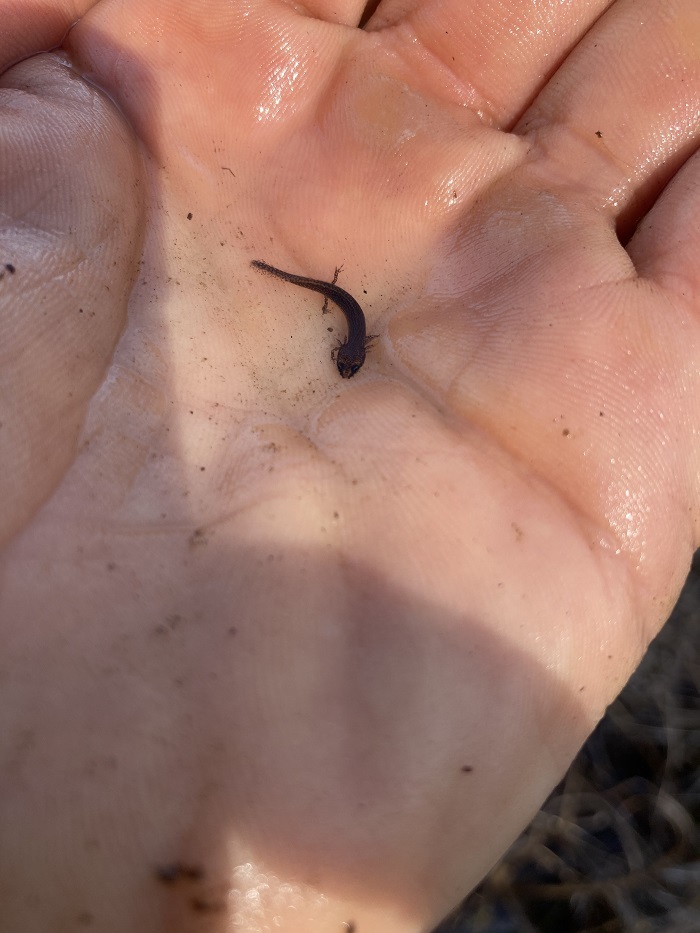
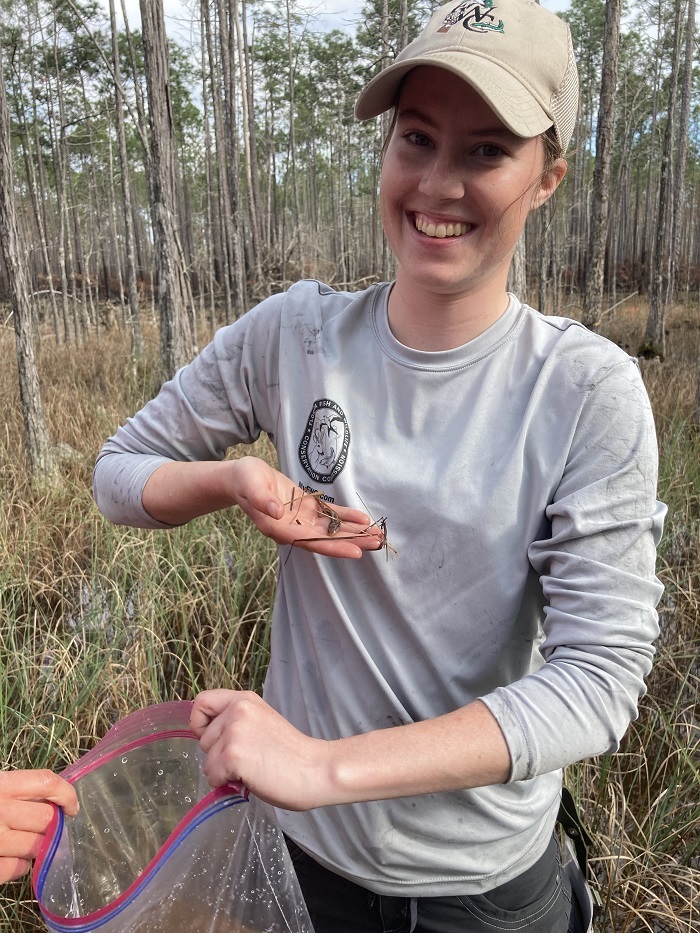 Below: Dwarf salamander.
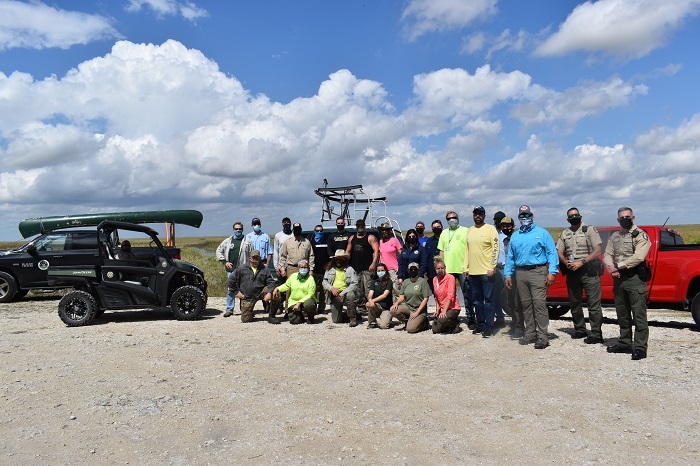 Staff participates in Python Legislative Day.
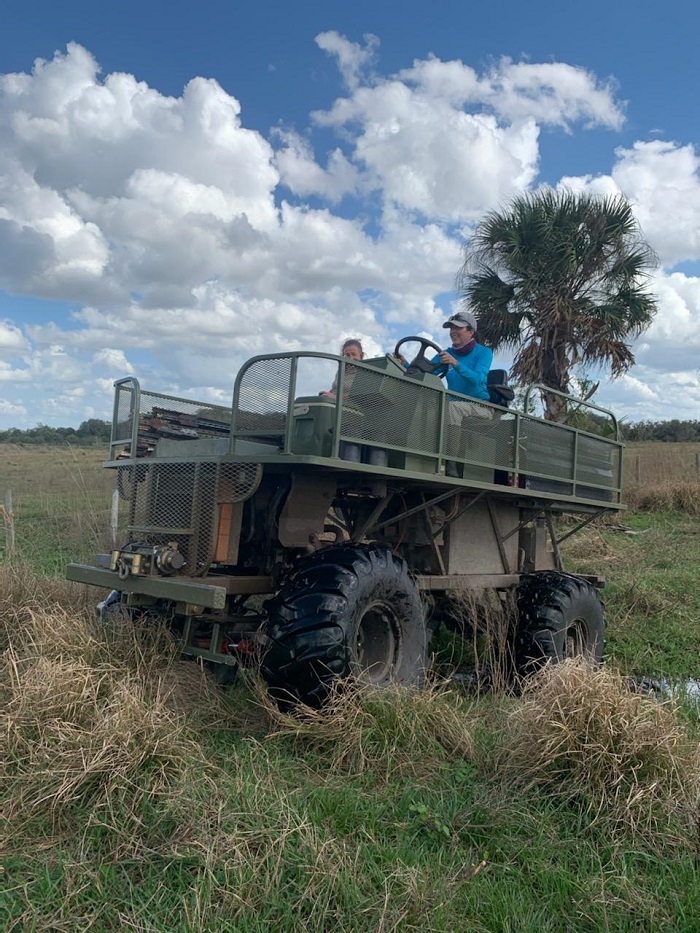 Katelyn Horn and Lt. Pam Steeleman on a swamp buggy with boundary posting materials.
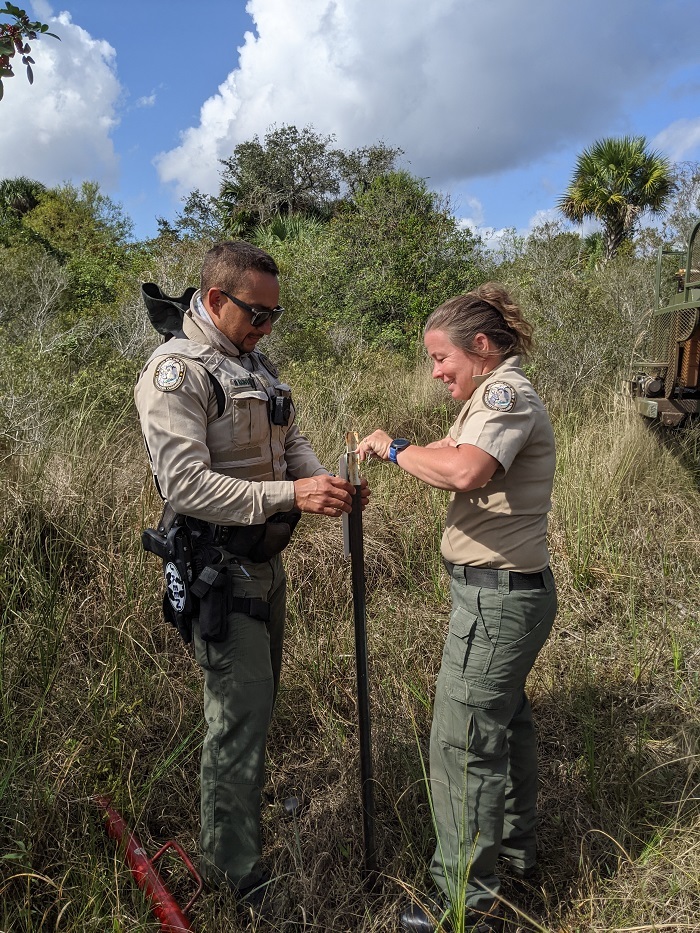
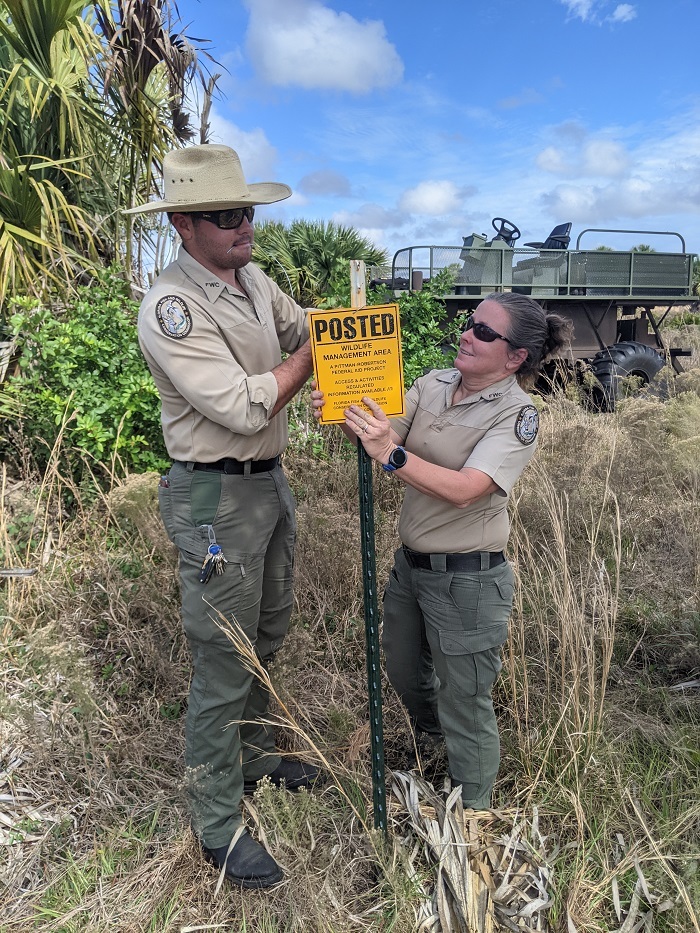 Lt. Pam Steeleman and Officer Jaret Flynn attach a boundary sign to a post on Okaloacoochee Slough (aka OK Slough) WMA.
 Lt. Pam Steeleman and Officer Matt Nasworth post a boundary sign on OK Slough WMA.
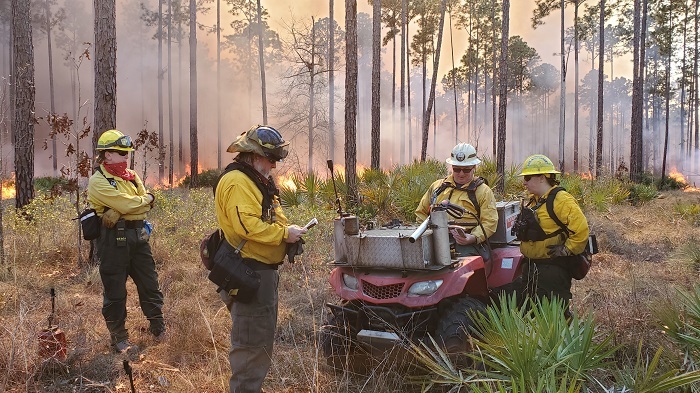 FWC staff assisting Camp Blanding Joint Training Center environmental staff with prescribed burning. L to R: Rebecca Doane (FWC WHM), Scotland Talley (FWC WHM), Paul Catlett (CBJTC) and Cynthia Balboni (CBJTC). Photo by Jessica Baker (CBJTC).
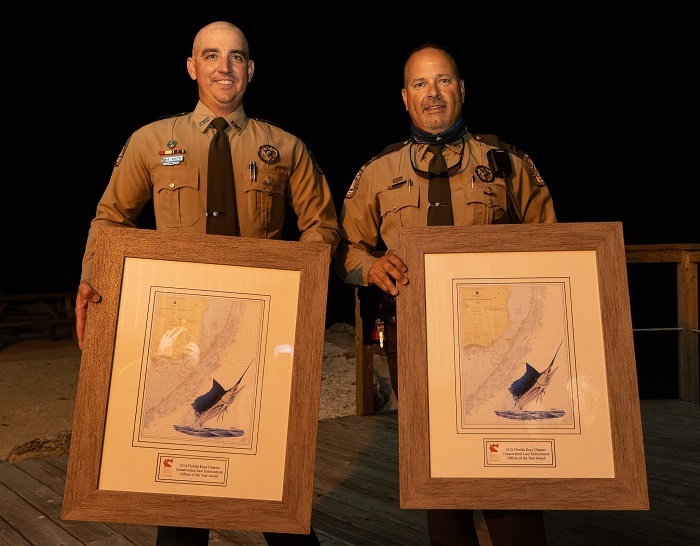 L to R: Officer Scott Smith is awarded CCA Officer of the Year and Capt. David Dipre was given an award for his service in the Keys.
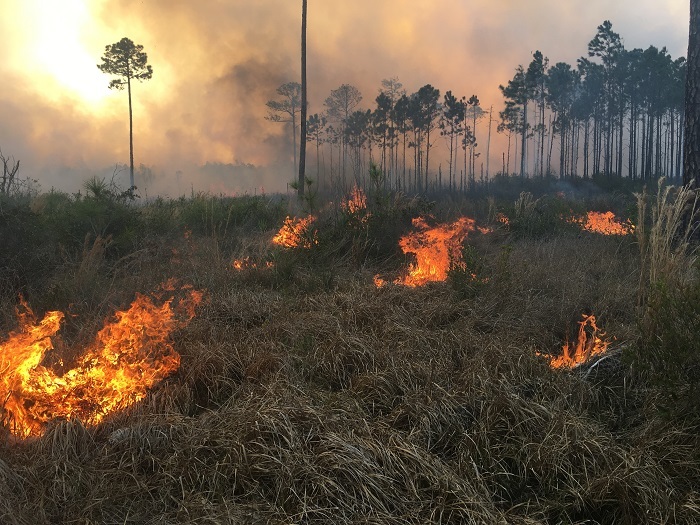 This prescribed fire conducted on Escribano Point WMA successfully improved habitat for the federally endangered reticulated flatwoods salamander (Ambystoma bishopi) and involved collaboration with WHM personnel from four different WMA's, The Longleaf Alliance and Eglin Air Force Base.
 Christine Slowiak (above) and Mackenzie Sconyers (below).
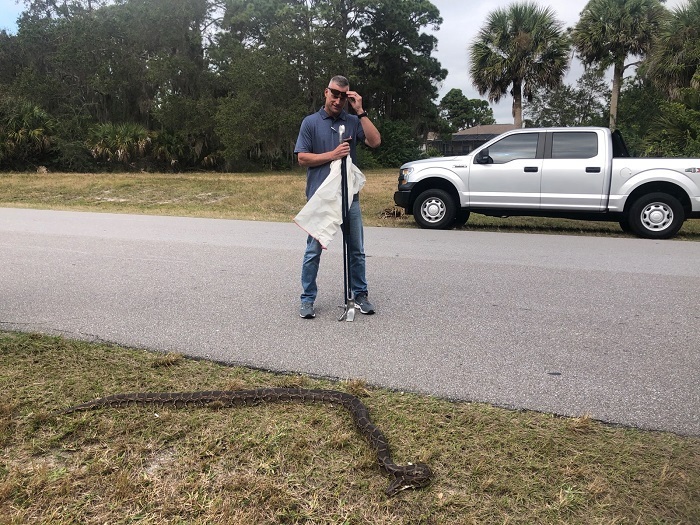 Lt. Louis Hinds thoughtfully prepares to capture a 9-foot Burmese Python in Rotonda.
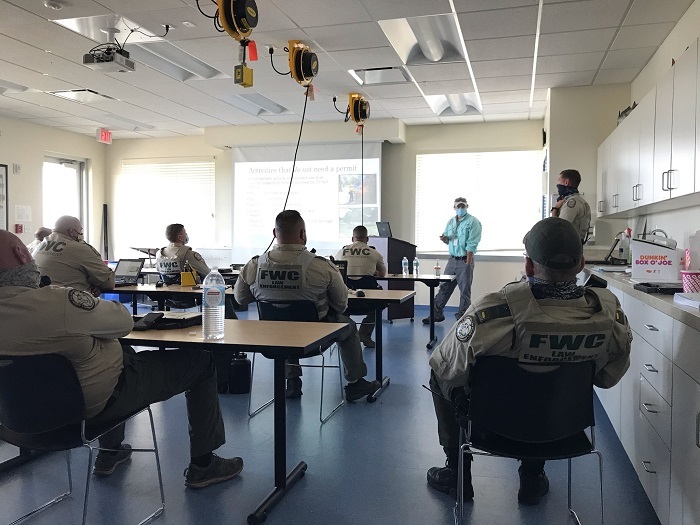 Biologist Kyle Brown speaking at the SW Officer Specialist Imperiled Species class.
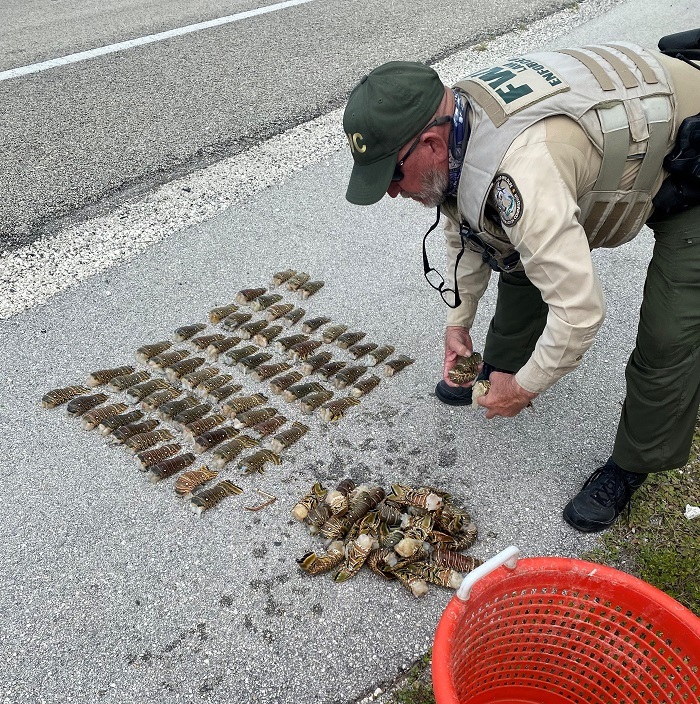
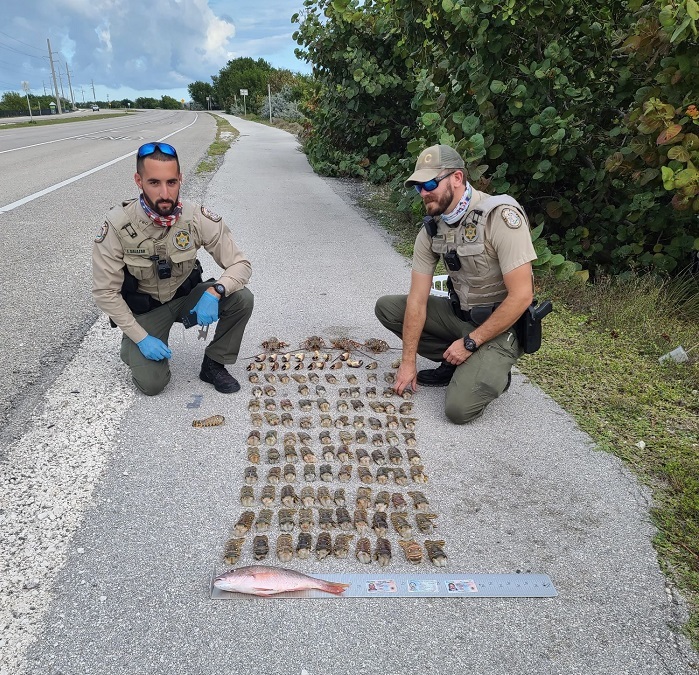 On Feb. 25, Lt. Dodd Bulger stopped near mile marker 37 to assist MCSO Deputy Roddy with a traffic stop. Deputy Roddy stopped a commercial van containing two people for unlawful speed. Deputy Roddy asked Lt. Bulger for assistance because a search of the vehicle revealed saltwater species. Lt. Bulger noticed the lobster tails and stone crab claws seemed smaller than legally allowed. Lt. Roy Payne and Officers Kyle Mason, Alex Piekenbrock and Justin Salazar arrived later to assist. The two subjects were detained for questioning. All the seafood products were measured and inspected, and officers found 100 undersize wrung spiny lobster tails, four undersize whole spiny lobster, 17 undersize stone crab claws and one undersize mutton snapper inside plastic bins in the van. Both subjects were arrested and transported to jail.
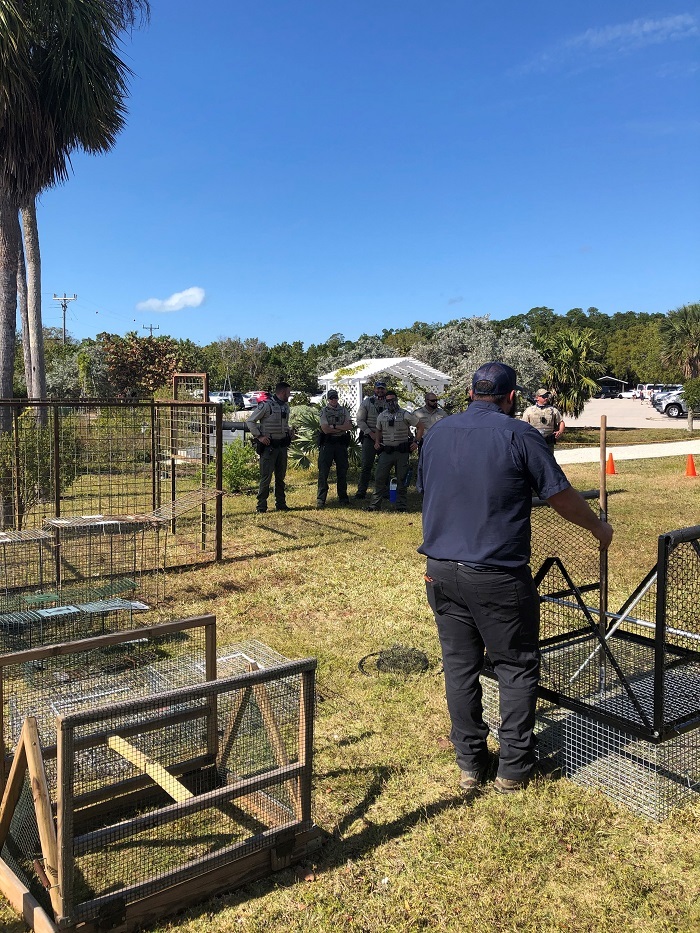
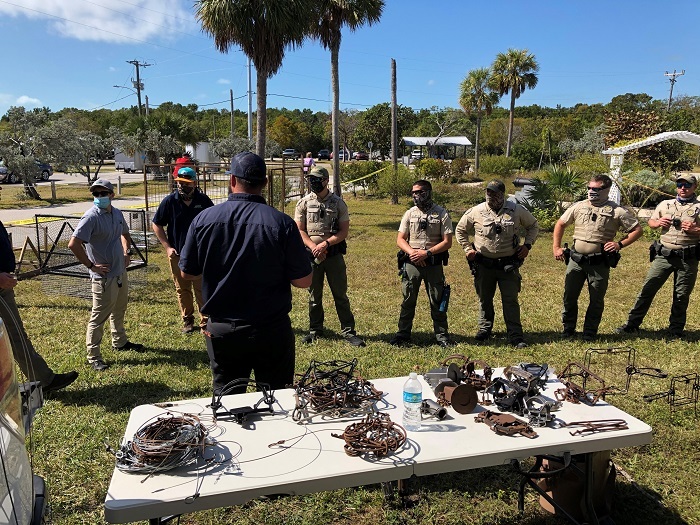 Officer specialist training with USDA and FWRI at John Pennekamp Coral Reef State Park.
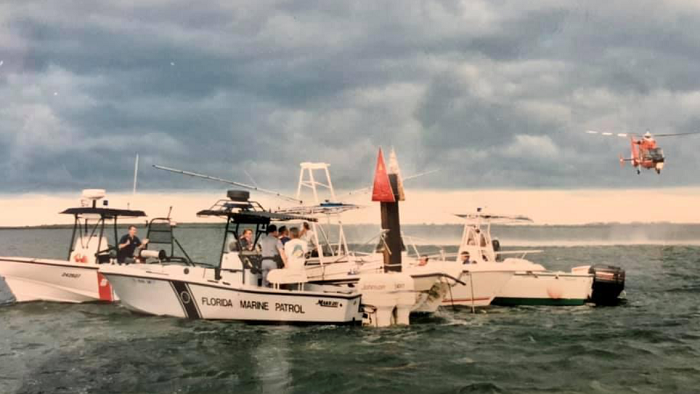 Historical photo from a boating accident at Angel Fish Creek.
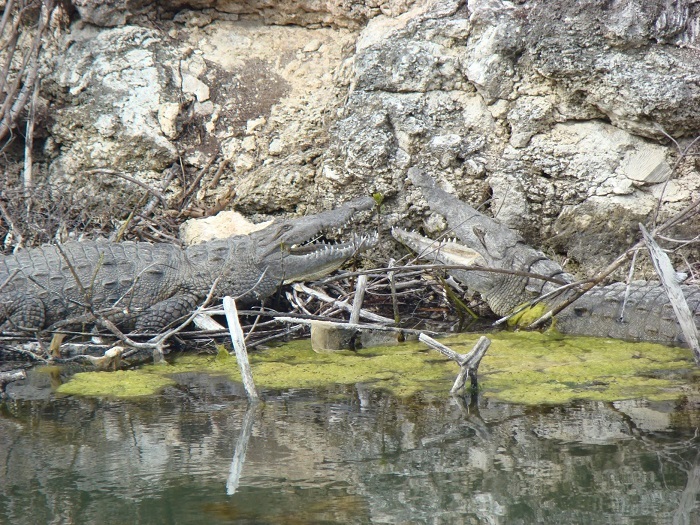 Mating crocodiles in the Keys. Photo by Robert Dube.
|
|
|
The Inside Job is a monthly newsletter featuring
the employees and programs of the FWC.
Send your submissions, comments and questions to Kelly.Broderick@MyFWC.com.
Deadline for the April Issue is Friday, March 26.
|
|
|
|
|