|
 July 2020
Having trouble viewing this email? View it as a website.
 To help prevent the spread of COVID-19 and ensure the health and welfare of our staff and visitors while in FWC facilities, the following safety measures concerning the use of Personal Protective Equipment have been implemented. Please ensure that these precautionary measures are adhered to in order to protect our employees and the public.
- Employees who are in close contact with each other or have a high potential for exposure to COVID-19 are required to wear masks, cloth face coverings or other PPEs. These precautionary measures include:
- Employees who are unable to maintain social distancing while inside an FWC Facility (e.g. hallways, stairwells, bathrooms, breakrooms, conference rooms and other common areas).
- Employees who are within close proximity to members of the public.
- Non-FWC employees who are authorized to enter an FWC facility will be required to wear masks, cloth face coverings or other appropriate PPEs during their visit.
During the upcoming weeks, communications concerning next steps will be provided to ensure staff are fully aware of actions being taken concerning staff safety and plans for returning from temporary telework, as well as our plans for the reopening of offices to the general public.
Official messaging will come from myself, Susan Neel (Communications Director) or Jon Creamer (Acting Chief Operating Officer). Once those messages have been released, it will be the responsibility of divisional leadership to confirm all employees in the field receive that direction. A consolidated list of messages is located on the following SharePoint site: fwcc.sharepoint.com/sites/COVID19.
 The next Commission meeting will be a virtual meeting beginning at 9 a.m. EDT on July 22 and 23. The Florida Channel will be broadcasting live video coverage at TheFloridaChannel.org and participants watching via the Florida Channel can utilize the telephone conference line to call in for public comment. View the full July 22-23 agenda, links to background reports and ways to participate.
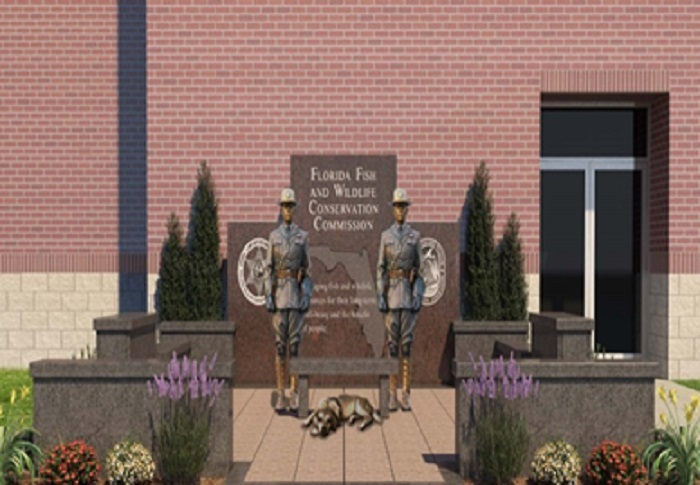 The tragic passing of Officer Julian Keen has shined a light on the fact that we are missing a memorial for our fallen officers at the FWC law enforcement training academy.
The FWC and predecessor agencies have lost 20 officers to line of duty deaths. These brave men and women deserve a proper tribute to honor their sacrifice. Over the past few years, the division has been working with a sculptor and contractor to have a memorial for our fallen officers constructed at the Florida Public Safety Institute. The memorial will be placed outside the FWC law enforcement training center where new officers can see it daily as a reminder of the men and women who have come before them and paid the ultimate sacrifice protecting the people and natural resources of Florida. It will also be open to the family members of our fallen officers, and our current and past employees to visit and pay their respects to their former colleagues.
This is a very costly project and we are working to raise $250,000 to construct this memorial. The Fish & Wildlife Foundation of Florida has graciously offered to host an account to receive tax deductible donations. If you are interested in being a part of bringing this project to fruition, additional information including how to donate, an artist’s rendering of the memorial, and donation levels can be viewed at the Foundation's website. There are many contribution options and each level comes with items such as shirts, challenge coins, and recognition at the memorial.
Remembering those that came before us by honoring our fallen heroes is a very noble way to pay tribute to the ultimate sacrifice. Your support is greatly appreciated!
If you need assistance with making a donation or have any questions, we have contacts in each region and at the training center who are happy to help. Lieutenant Matt Prowant is leading this initiative and can be reached at: Mattison.Prowant@myfwc.com.
The regional liaisons who are assisting with this project are listed below.
NW- Captain Charlie Wood; Charlie.Wood@MyFWC.com
NC- Nichole Landrum; Nichole.Landrum@MyFWC.com
NE- Officer Kurt Harris; Kurt.Harris@MyFWC.com
SRA- Officer Jason Willems; Jason.Willems@MyFWC.com
SRB- Officer Jason Rafter; Jason.Rafter@MyFWC.com
SW- Investigator Ashley Tyer; Ashley.Tyer@MyFWC.com
 The statewide State Reef Fish Survey replaced the Gulf Reef Fish Survey on July 1. All anglers and divers (including those 65 and older) who intend to fish for or harvest certain reef fish from a private vessel in Florida are required to obtain the State Reef Fish Angler designation.
State Reef Fish Anglers will help improve recreational data for several reef fish species such as snapper, grouper and hogfish. Data collected through the SRFS will provide a clearer picture of the health of reef fish stocks throughout the state and help ensure the long-term sustainability of recreational fishing in Florida.
Signing up is easy, no cost and available anywhere FWC saltwater fishing licenses are sold and at GoOutdoorsFlorida.com
For additional questions, visit our frequently asked questions page.
|
|
|
Cloth face coverings are an additional step to help slow the spread of COVID-19 when combined with every day preventive actions and social distancing in public settings.
Cloth face coverings should be washed after each use. It is important to always remove face coverings correctly and wash your hands after handling or touching a used face covering.
How to clean
Washing machine
- You can include your face covering with your regular laundry.
- Use regular laundry detergent and the warmest appropriate water setting for the cloth used to make the face covering.
Washing by hand
- Prepare a bleach solution by mixing:
- 5 tablespoons (1/3rd cup) household bleach per gallon of room temperature water or
- 4 teaspoons household bleach per quart of room temperature water
- Check the label to see if your bleach is intended for disinfection. Some bleach products, such as those designed for safe use on colored clothing, may not be suitable for disinfection. Ensure the bleach product is not past its expiration date. Never mix household bleach with ammonia or any other cleanser.
- Soak the face covering in the bleach solution for 5 minutes.
- Rinse thoroughly with cool or room temperature water.
How to dry
Dryer
- Use the highest heat setting and leave in the dryer until completely dry.
Air dry
- Lay flat and allow to completely dry. If possible, place the cloth face covering in direct sunlight.
CDC Cloth Cleaning
|
|
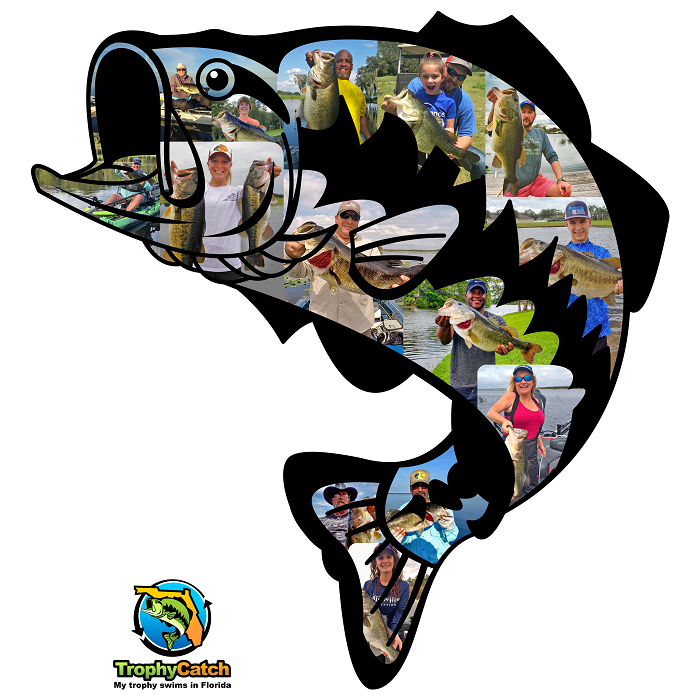
The Florida Fish and Wildlife Conservation Commission’s (FWC) TrophyCatch program, now in Season 8, has awarded prizes for the catch and release of more than 10,000 largemouth bass since the program began in 2012. Thus far, 8,006 Lunker Club, 1,966 Trophy Club and 78 Hall of Fame fish comprise this landmark occasion.
“If Florida is to remain the big bass capitol of the world, Florida anglers need to be part of our research team. The FWC receives valuable data from TrophyCatch anglers and this information will continue playing a crucial role in management decisions,” said FWC Commissioner Gary Lester. “Their participation is vital in keeping bass fishing in Florida great!”
The TrophyCatch program rewards anglers who provide documentation of their catch and release of largemouth bass weighing 8 pounds or heavier in Florida. In order to be eligible for prizes, anglers are required to submit photos or videos of their catch to TrophyCatch.com, showing the entire fish and its weight on a scale, before releasing it back into the water. FWC biologists use TrophyCatch data for bass research to make informed decisions about the management of Florida bass fisheries and to promote the catch and release of trophy bass.
“We want to thank Bass Pro Shops and all of our partners and anglers for their continued commitment to the conservation of Florida’s trophy bass fishery,” said Jon Fury, FWC’s Director of the Division of Freshwater Fisheries Management. “TrophyCatch would not be possible without our anglers’ participation in this program. It is truly a unique collaboration between anglers, partners and the FWC to ensure that future generations will experience the same excitement that these anglers did when they reeled in their trophy bass.”
The FWC encourages anglers to join TrophyCatch to become citizen scientists and assist in the management and the conservation of Florida’s freshwater fisheries. The associated TrophyCare program promotes best handling practices for trophy bass to ensure that each TrophyCatch bass is released alive. For more information about the TrophyCatch program, email Laura Rambo at Laura.Rambo@MyFWC.com.
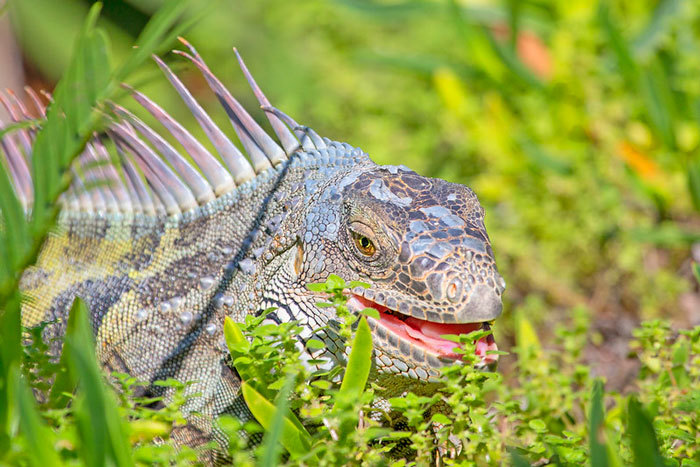 In late June, Executive Director Eric Sutton signed Executive Order 20-19, related to the regulation of certain high risk nonnative invasive reptiles. The EO is designed to clarify changes made to Section 379.372, Florida Statutes.
The changes in statute notably add tegus (all species in the genera Salvator and Tupinambis) and green iguanas (Iguana iguana) to the existing list of regulated species and limit possession, importation and breeding of all nonnative reptile species listed in the statute (including the reptiles currently listed as Conditional) to permitted facilities engaged in educational exhibition, research, eradication or control activities.
The EO will be implemented until final rules are approved by the Commission. Pet owners may legally keep green iguanas and tegus with a free permit from the FWC. To learn more, visit the new webpage on Law Changes Regarding Invasive Nonnative Reptiles.
Photos: Iguana at top, tegu below.

|
|
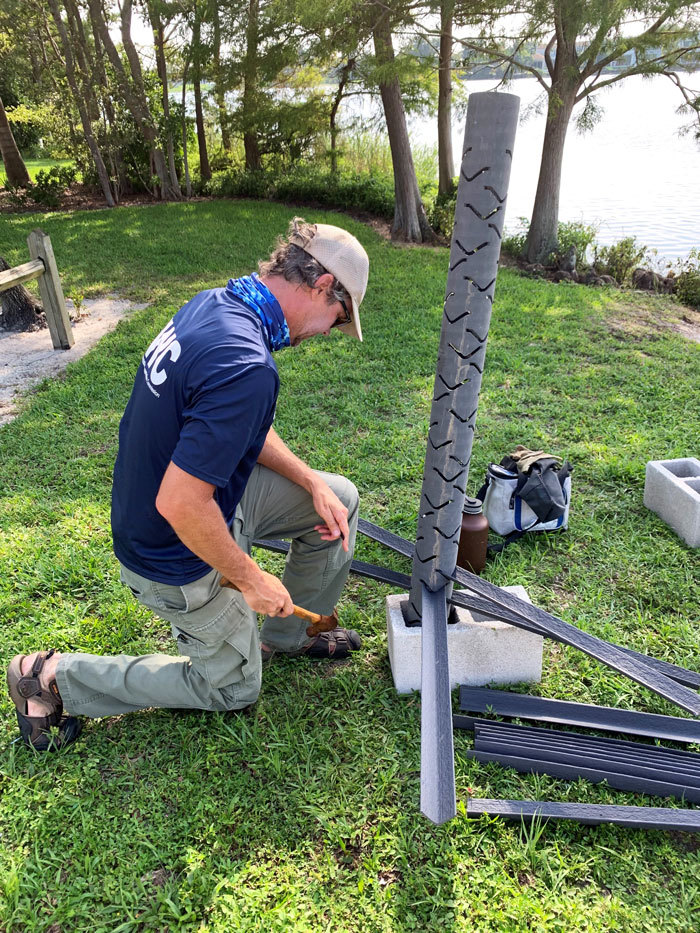 Article and photos by Carol Lyn Parrish
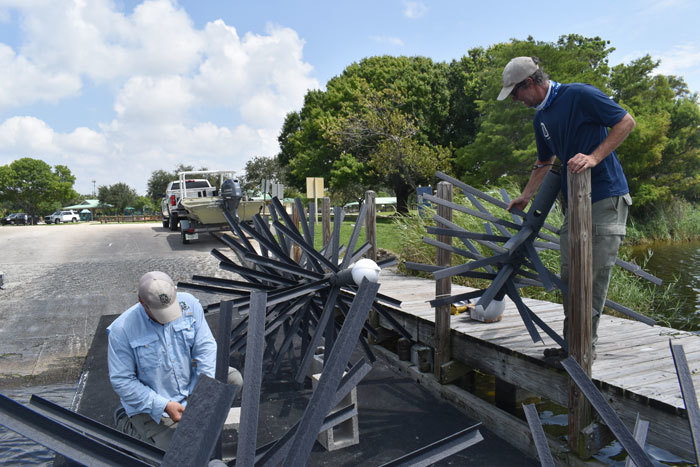
Did you know that we practice the science of attracting fish? When I heard about it, I had to learn more. On June 10, I joined the Division of Freshwater Fisheries Management South Region team on an outing replacing fish attractors. We met in Delray Beach at Lake Ida West Park for this specific project, led by FFM staff member Katrina Wert. Over the course of several days, FFM staff, with assistance from HSC staff, worked diligently replacing fish attractors at 12 sites, six at Lake Ida and six at Lake Osborne in Lake Worth. These two sites were selected, in part, due to the high urban population and accessibility for users. Lake Osborne and Lake Ida are used frequently by the public for water sports, and these attractors create an opportunity for anglers in the area and a great place to locate enhanced fishing opportunities for the urban angler.
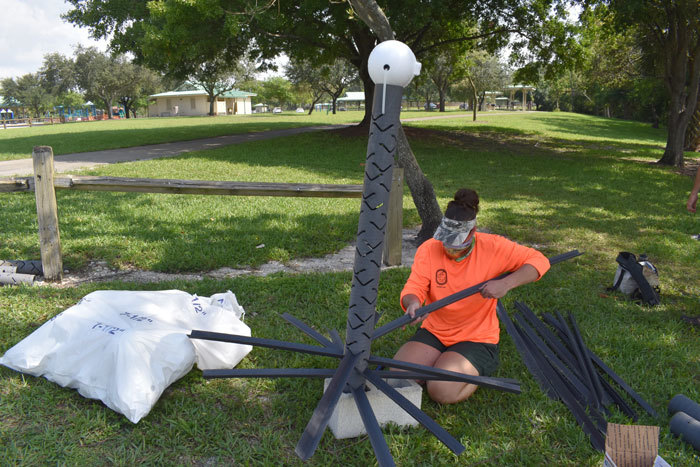 You may ask, what is a fish attractor? The attractor itself is made of PVC and designed to create areas for both predator and prey to utilize. The attractor with minimal “branches” is designed like a tree with spaces between the branches for large prey species to use as cover. In these two lakes, largemouth bass and butterfly peacock bass are the large predators. The attractor with many “branches” is designed similar to a bush, with many branches to create cover for prey fish such as bream and bluegill. Each of the 12 sites had a variety of attractors deployed providing fishing opportunities for a variety of species.
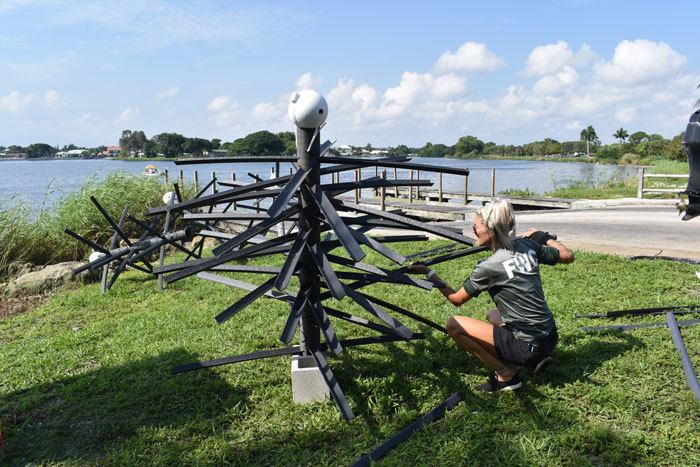 So how does staff make this happen? First, a permit was required from DEP, along with Palm Beach County’s support of this project as they own the selected lakes. Once the permit was approved, a coordinated effort amongst staff began with the assembly of the attractors. Many “trees” and “bushes” were assembled, specifically built for the needs of each site. Once assembled, a buoy was attached, and each attractor was loaded onto a barge waiting at the boat ramp. Once on the barge, each attractor was weighted with a block to secure under the water. The attractors are purposely placed three feet below the surface to mitigate any vessel traffic and allow for fluctuations in water levels in the area. After loading, the barge headed out to the site which covers approximately one acre and is marked by a Fish Attractor buoy. On site, it only takes a few minutes for staff to hand deploy the attractors, working like a well-oiled machine. After all sites were completed, a total of 100 fish attractors were set out, with an expectancy of 20+ years before replacement is needed. Sometimes vegetation is also used as a fish attractors, however, it is not as sustainable and requires replacement every four to five years.
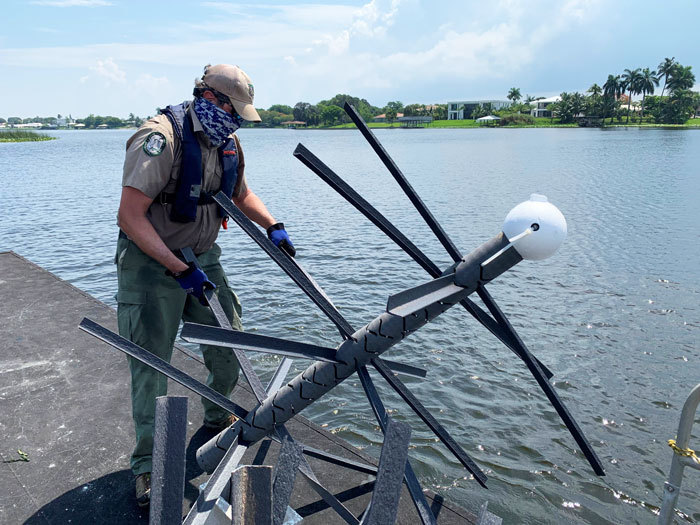 Fish attractors are utilized all around the State. Learn more about attractors and find sites near you.
|
|
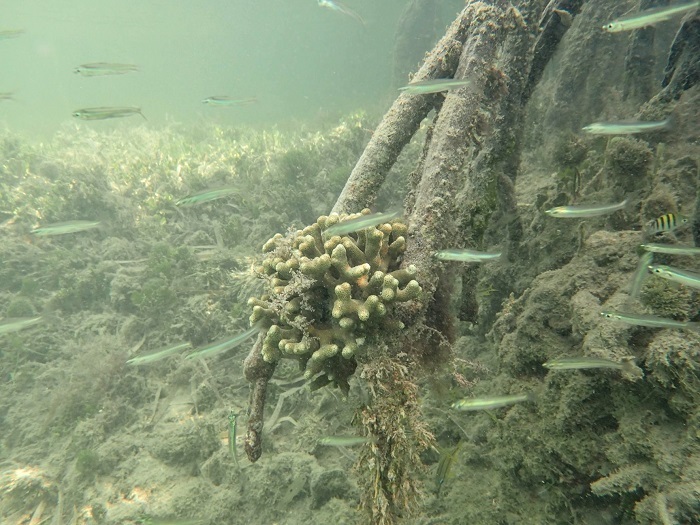 Did you know corals are growing in mangrove habitats in the Florida Keys?
A recent study conducted by Mary Jacobsen, intern with FWRI Coastal Wetlands Research Program, set out to identify locations where corals are growing in Florida Keys mangrove habitats. In collaboration with USGS St. Petersburg Coastal and Marine Science Center, researchers were looking for single or cluster coral colonies growing on mangrove prop roots or underneath the mangrove canopy. They had much success - identifying several different locations where corals were growing directly on mangrove prop roots. This confirmed their hypothesis that mangrove shorelines in the Florida Keys do in fact have the right environmental conditions to serve as habitats for some species of coral.
USGS scientist Dr. Kimberly Yates published a study in 2014 that documented over 30 species of scleractinian corals growing on or under mangrove prop roots in Hurricane Hole, St John, US Virgin Islands. This led to the hypothesis that mangrove canopy cover protects the corals from extra heating and solar radiation, serving as good habitat for some coral species experiencing stress in their natural reef habitats. Learn more.
This research was funded in part by a grant awarded from Mote Marine Laboratory’s Protect Our Reefs Program, which is funded by proceeds from the sale of the Protect Our Reefs specialty license plate. Learn more at www.mote.org/4reef
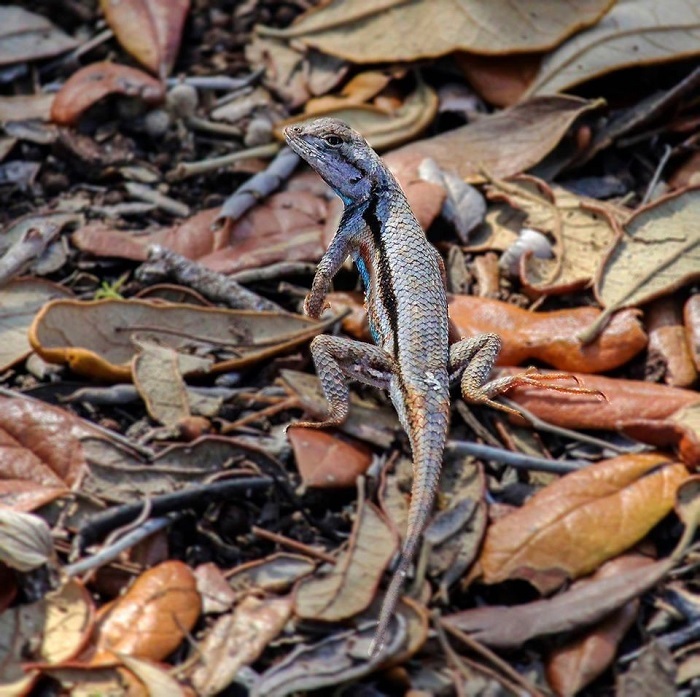 It’s been one year since FWC biologists reintroduced 100 Florida scrub lizards (50 male/50 female) from stable populations in southern Martin County to Hypoluxo Scrub Natural Area in Palm Beach County, to reestablish a population in an area once occupied by the Florida scrub lizard. Our most recent monitoring survey shows that the population is growing and continues to disperse along sand trails throughout Hypoluxo Scrub. This is great news for the scrub lizard! Researchers will continue monitoring for one more year. Watch our video of the scrub lizard translocation project.
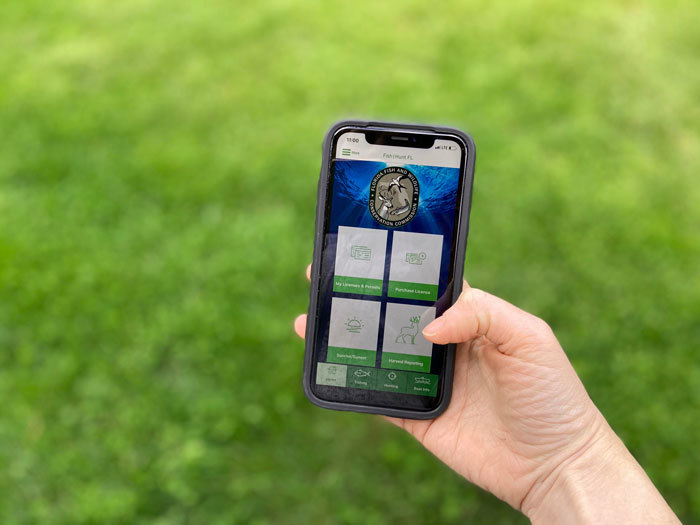 The FWC is introducing new, user-friendly options for logging and reporting harvested deer. Beginning this year, the following options are available:
Please see instructions and FAQs about how to use these new options to log and report harvested deer.
Bookmark the following links for quick access to hunting information.
- Zone A’s archery and crossbow seasons are opening Aug. 1 on lands outside of the wildlife management area system. See other 2020-2021 hunting season dates and bag limits.
- Direct stakeholders to WMA Finder so they can locate WMA hunting opportunities based on species, season, location and more
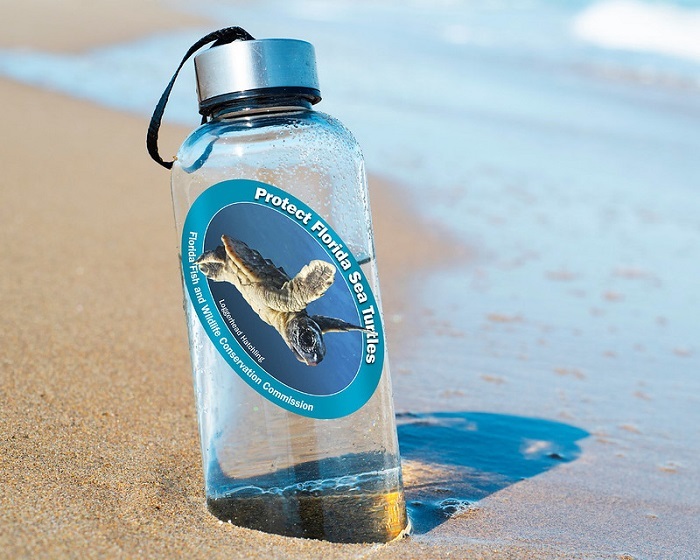 We have unveiled our new 2020 manatee and sea turtle decals. New editions of these collectible stickers are released every July and are available with a $5 donation online or at your local tax collector’s office. All proceeds from the decals help fund manatee and sea turtle conservation efforts.
Learn more about how to help conserve manatees and sea turtles at MyFWC.com/Manatee or MyFWC.com/SeaTurtle. To view and order past editions of decals from 1992 through 2019, simply type “decals” in the search box at MyFWC.com.
You can also support these species by purchasing a “Save the Manatee” or “Helping Sea Turtles Survive” license plate at your local Tax Collector’s office.
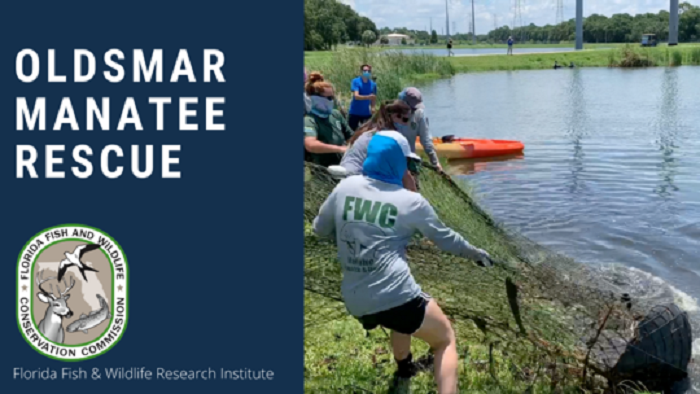 Last week FWRI’s manatee rescue team, along with partners Clearwater Marine Aquarium and University of Florida, were back at an Oldsmar retention pond system to rescue an entrapped manatee. This system has a spillway that inadvertently allows manatees to swim over the weir structure during extreme high tides and when the tide recedes, the manatee’s access to Tampa Bay becomes obstructed. After the 296 cm adult male manatee was captured, he received a complete health assessment and was transported and released back into Old Tampa Bay. FWC management is working with the City of Oldsmar to modify the existing spillway to prevent future entrapments. Activities conducted under USFWS permit MA770191. Watch the rescue.
|
|
|
A new FWC Lake Management Plans webpage is designed to strengthen communication and encourage stakeholders to become more involved with the management plan process.
The FWC’s lake management plans focus on the management of a system’s fish, wildlife and habitat. They are intended to guide the successful management of fish and wildlife on these systems for their long-term well-being and the benefit of people. The FWC is committed to designing these plans using stakeholder input and feedback to help guide management activities on individual lakes. Input from the public is vital to the success of these projects. The FWC is actively gathering input on each plan through multiple methods to ensure stakeholders can be involved in the development of management goals and objectives.
|
|
 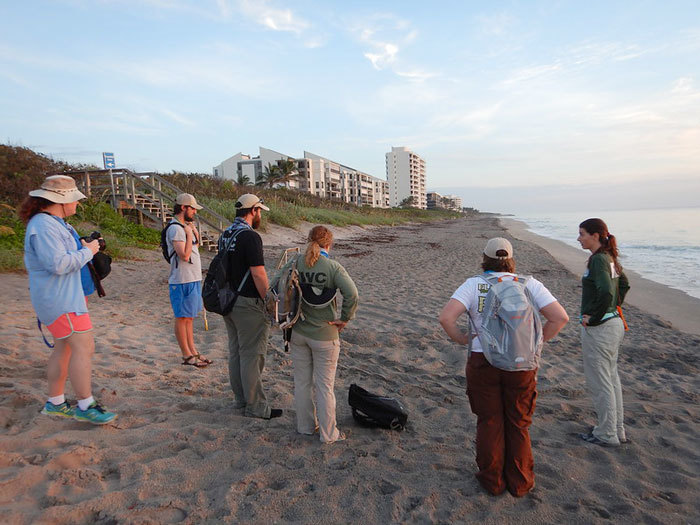 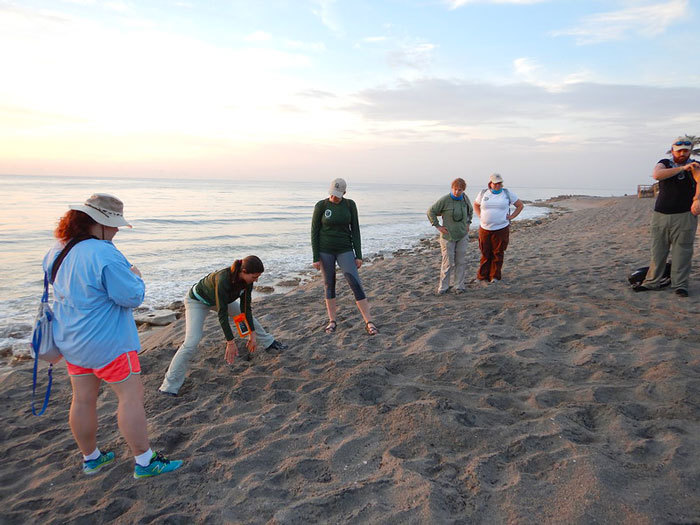 FWRI's sea turtle nesting program coordinator led a three-day training for FWC sea turtle staff. This included a night walk, morning survey and ground truthing.
During their night walk, staff observed nesting behavior of loggerheads and analyzed marks left by nesting females. A morning survey was taken to identify turtle species and activities that occurred overnight, based on evidence left in the sand.
The last night of training, FWC researchers performed a ground truthing exercise to find nesting turtles. This exercise is important to assure the quality of the data FWC receives from the permit holders.
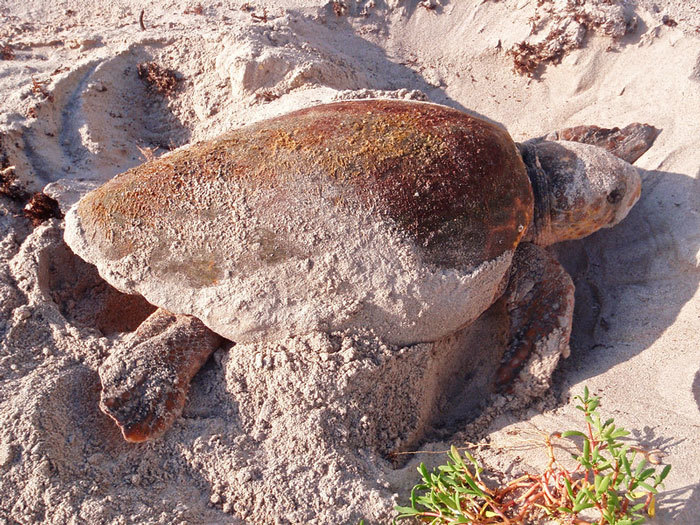 Photos by Cheryl Sanchez.

 Recent News Releases
 K-9 Chaos Retires
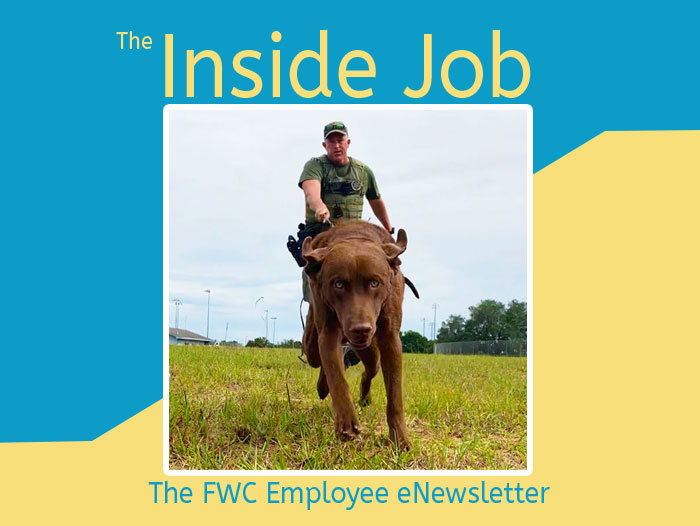
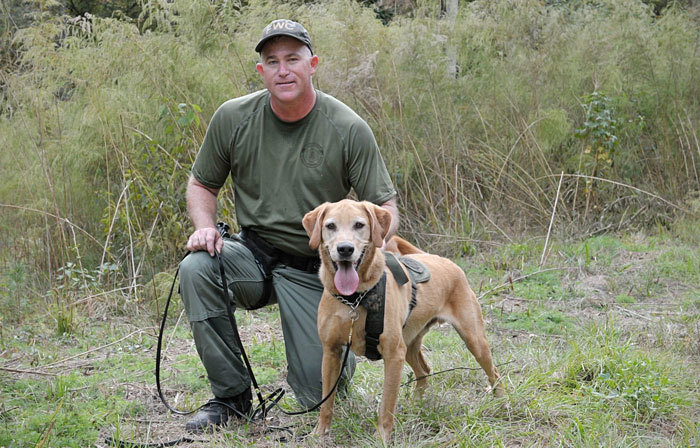 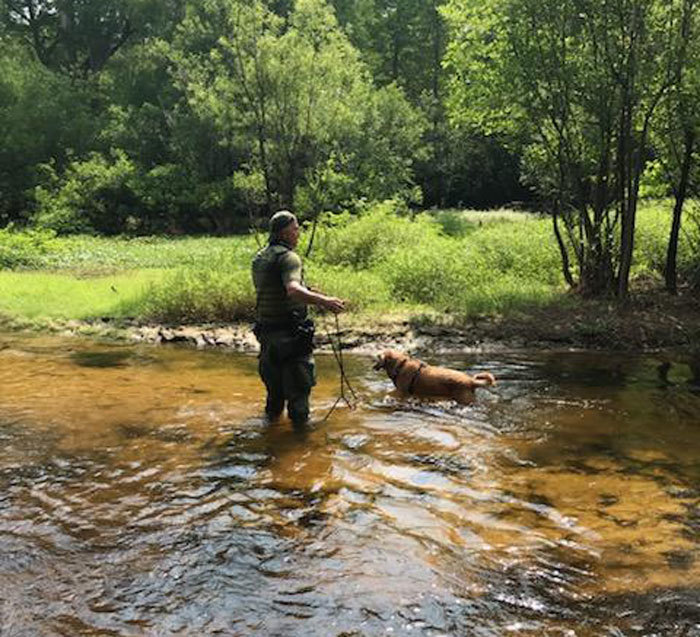 FWC canine “Chaos” is preparing to retire after seven years of service—that’s 47 in dog years! The FWC K-9 unit is comprised of 12 traditional K-9 teams and five port and package facility K-9 teams. Chaos was donated in 2013 by the Southeastern Guide Dog Association and is trained in tracking, wildlife detection and article searches. During his career K-9 Chaos has conducted many successful tracks, article searches and wildlife detection cases. Chaos also has assisted many partner agencies with a variety of cases. His successor is K-9 Duke, an 8-month-old Chesapeake Bay retriever who was donated by a private citizen. Duke (masthead and below) is eager to begin his training, which is approximately 10-12 weeks in length and consists of tracking, wildlife detection and evidence recovery. Chaos and Duke’s handler is Officer Joe Wolff, one of FWC’s three K-9 trainers. Officer Wolff has been with the FWC since 1998 and has been a K-9 handler since 2004. Duke will be Officer Wolff’s fourth K-9 partner. Welcome Duke and congratulations on your retirement Chaos!

 Citizens and FWC customers were so impressed by the following employees, they told us about it through email on the "Praise an Employee" page of MyFWC.com/Contact. When your coworkers receive kudos, help share the good news by contacting Kelly.Broderick@MyFWC.com.
Officer David Bingham
We are writing this letter to give my upmost thanks and recognition to the outstanding service and professionalism of Officer David Bingham. My husband and I recently purchased an old boat that required significant TLC as a project to stay busy during the COVID 19 stay-at-home order period. This is our first, and probably last, experience with such a laborious undertaking. After months of sanding, fiberglass repair, repainting and muttering “I had no idea this would be so much work,” we were very excited to take it out for a few hours one evening. About 15 minutes after putting it into the water and anchoring near a bridge to fish, Officer Dave pulled up to our boat. I remember thinking to myself, “There is no reason to be concerned as we have our fishing licenses, appropriate lights on, no alcohol, etc.” He cordially said good evening and then stated “Wait, are you anchored from the back of your boat?” When I hesitantly replied, “Is that a bad thing?” I believe it became clear that we knew nothing about safe boating. He also noted that our boat didn’t have a vessel registration number and instructed us to meet him at the nearby dock. As we drove our boat to the dock, my husband and I asked each other “Did you know that boats needed vessel registration numbers?” As two law-abiding citizens, we felt terrible and incredibly ignorant. Upon docking, I braced myself for horrible news. Instead, Officer Dave adopted an attitude of a mentor and teacher. He patiently explained to us how vessel registration works, how boats should be sold and possible outcomes for our boat. I had luckily taken a picture of the vessel registration number before sanding it off and Officer Dave was able to determine the original owner and promised to follow up with the owner to assure that it was not stolen. He also took the time to explain required items on boats and why it was a very poor choice to anchor from the back. He also provided information about a free boating course online so we could become more knowledgeable and safer boaters. During the next week, Officer Dave called and emailed the previous owner who didn’t not respond. Finally, he even took the time to visit the original owner to assure appropriate sale of the boat. He even followed up with the subsequent owners of the boat who had not bothered to register it to assure that it had not been stolen along the way. Additionally, he helped me step-by-step to register the boat correctly. He was always available to help, even on his days off, to answer any questions. He stayed in regular contact with us for over two weeks to assure that the process was going well. On the day that we had planned to register with the tax collector’s office, Officer Dave even checked in to make sure we were able to get the title successfully. Meanwhile, I completed the online boating course he had recommended and realized how much I did not know about boating rules, appropriate equipment and, most of all, safety. I realize that our lack of knowledge was an unnecessary risk to ourselves and now I feel much more confident on the water. With his amazing service and knowledge, we were able to appropriately title our boat, learn about boating regulations, and become safer boaters in general. We could not have had a better experience and are grateful for all his hard word, teaching and support of two new boaters. We cannot thank Officer Dave enough for going above and beyond expectations. He potentially saved us from disaster, and we will always look forward to seeing him on the water.
Officer Markiel Curbelo
Officer Curbelo was the first officer to arrive at my home when I called FWC. It was a very disturbing and emotional call I had to make knowing there was a large dead animal in my back yard. He was very calm and professional after finding a dead bear cub. He remained calm after having to deal with my reaction. I basically had an anxiety attack! Many officers showed up throughout the day including Officer Kevin Kleist, Lt. Kevin Balfour along with one other officer (don't know his name) along with Chris Boyce who brought a Necropsy Kit. All parties involved completed a thorough investigation. I don't believe they could have done a better job, everything fell into place perfectly. Their expertise and some luck was on our side to complete their report and catch out killer. On behalf of all of our bear lovers in Golden Gate Estates we thank you very much....and hope to find justice for our cub.
Madeline Fernandez, FFM
Madeline has gone way above and beyond assisting me every year in issuing my depredation permits. She handles herself well and provides help with any questions I might have. She is truly an asset to the FWC and should be appreciated in a Job well done. Thank you, Madeline!!
Officer Hank Forehand
My wife, daughters and I enjoyed a great kayaking trip down Spring Creek/Chipola River. Upon finishing our trip at Hwy. 280 we realized the keys to the vehicle we left at our take out point were in my truck at the head of Spring Creek at Hwy 90. While my daughter researched Uber availability (ha, ha) Officer Hank Forehand pulled up to ramp. Meantime, I was across the road inquiring about a ride from a tubing outfitter. Seems the only person who could approve such a request was unavailable. My wife asked Officer Forehand if a ride would be possible. He gladly got me back to Hwy 90 and saved the day. Thank you, Officer Forehand and the FWC.
Officer Seth Gray
On Father's Day, Officer Gray made contact with my son and myself as we were about to leave the public boat ramp area after our day of fishing the flats. He was professional and introduced himself and inquired about our fishing trip. My son showed Officer Gray our fish and we quickly learned we were unknowingly in violation of the slot limit on speckled trout. We were shocked and I was embarrassed. Officer Gray explained the recently revised rule, measured the affected fish and asked if either of us had previously been warned about the slot limit (neither of us had been previously warned). He then asked for our DLs, FLs, and the vessel registration - all with a professional, polite and non-judgemental demeanor. Officer Gray queried our credentials and issued us warning tickets. He even took the time to show us the revised Florida Administrative Rule on his in-truck computer. We parted ways with a handshake, my apology and thanks for his kindness. Just so you know, I'm a retired lieutenant with the Tallahassee Police Department after serving 30 years on the job. In supervisory and command positions, including Internal Affairs Commander, for most of my career, I can tell you with 100% confidence that the way Officer Grey conducted himself is what we all want in community/officer interactions on misdemeanor violations. He established his authority without being overbearing, was knowledgeable of his duty without being aloof, and imparted needed information to us with a professional posture of one teaching us instead of punishing us. Please pass along my thanks for a job well done to Officer Gray and his chain of command.
Bradley O'Hanlon, HSC
I submitted photos of a snake found in my yard on a Sunday morning. I asked for assistance in identifying the snake because I didn't want it to be what I thought it might be. Unfortunately, Mr. O'Hanlon confirmed it was in fact a cottonmouth. I was not thrilled. I don't live by the water, I have dogs and, while I understand the importance of snakes in a healthy ecosystem (no snakes means more rodents, more rodents means more fleas, more fleas means the plague - I get it, I'd just rather apply topical flea preventative to all the squirrels), I'd prefer not to have vipers IN MY YARD. What I was thrilled about is how quickly he responded to my request. I had an answer in 24 hours. I was expecting to wait days. He provided species information and reassurance. When I had further inquiries as to what to do, he was once again quick with his reply. I greatly appreciate the service FWC provides the residents and visitors of Florida and always believe in acknowledging a job well done.
Lt. Darrin Riley
I watched a video of a man being harassed by Titusville police. When Lt. Riley arrived, he assessed that there were no violations or crimes. He followed the law and, most importantly, the Constitution of the United States. This person was issued a trespass ticket by the city police even though what he was doing was perfectly legal. Lt. Riley helped explain and deescalate the situation. Hopefully, this FWC officer will be responsible for training new recruits.
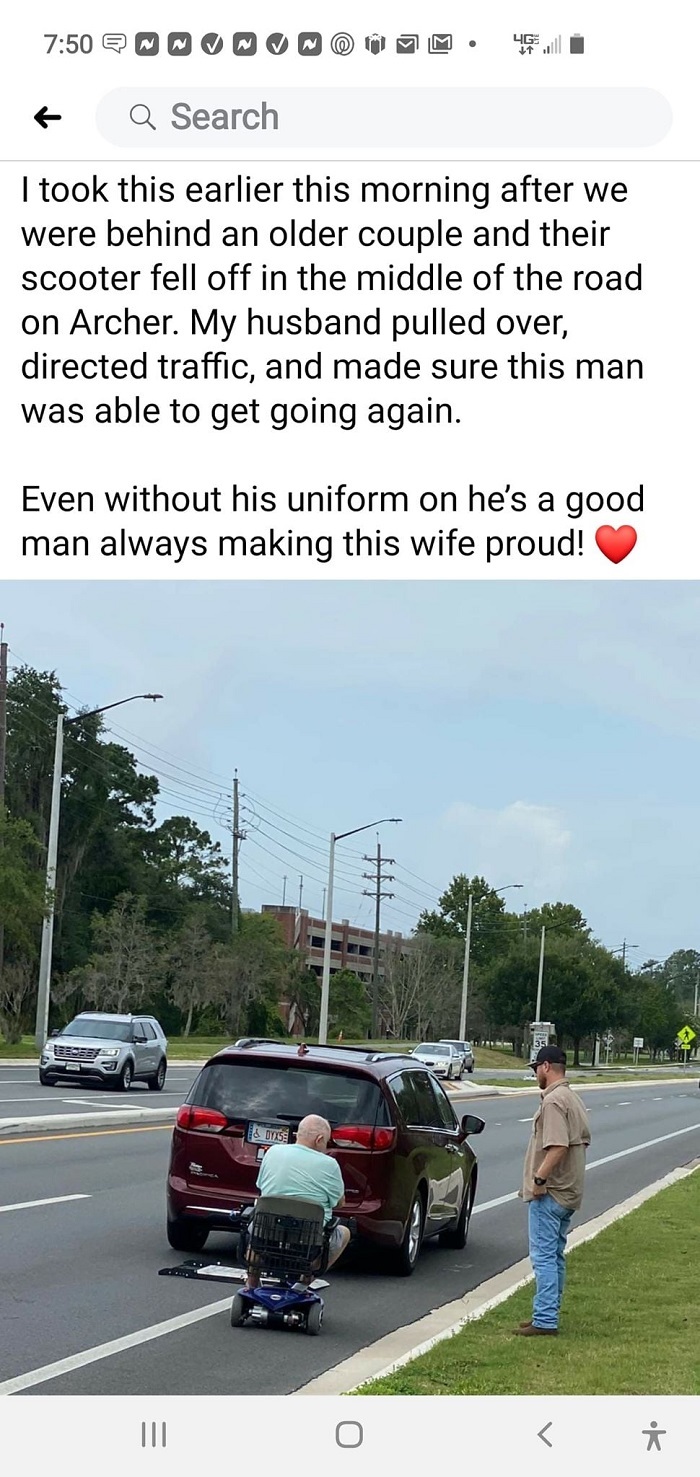 Officer Brennan Starling of the North Central Region (even while off duty) did the FWC motto "Patrol, Protect, Preserve" proud.
 Congratulations to the following employees for reaching 5-year milestones of employment with the FWC.
|
|
|
30 Years
Bob DeMauro, FFM
25 Years
Ron Bielefeld, FWRI
Jasmine Cumberbatch, MFM
Steve Glass, HSC
20 Years
Eric Nagid, FWRI
David Sauls, FBO
15 Years
Brian Beneke, FWRI
Paul Coglon, LE
Josh Taylor, FWRI
Nick Trippel, FWRI
Melissa Tucker, HSC
10 Years
Randy Adams, HSC (We missed his anniversary in June)
Eric Weather, FWRI
5 Years
Claire Sunquist Blunden, HSC
Miguel Despian, LE
James Dispennette, LE
Lee Grove, FFM
Lance Jacobson, HSC 7
Janice Kerber, SI
John Hart, FWRI
Michael Meaney, IG
Robert Penny, LE
Gale Smith-Johnson, FBO
Retired!
No one is scheduled to retire this month.
|
|
(The FWC has a great many non-FTE employees, and they deserve recognition for reaching 5-year milestones too. Unfortunately, the system doesn't keep track of such statistics; but we don't want that to stop us. If you know of a non-FTE employee about to reach a 5-year milestone, please notify the Inside Job by email.) |
|

|
FWC employees have some of the most interesting jobs ever! Here are some of our employees doing what they do best. Send your photos of FWC employees in the office and in the field to Kelly.Broderick@MyFWC.com.
|
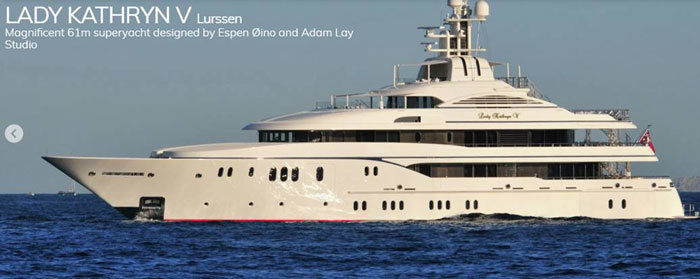 On June 21, Lt. Josh Peters was notified of an Area to be Avoided Violation of the Florida Keys National Marine Sanctuary Act by FKNMS Enforcement Coordinator Steve Werndli. FKNMS Werndli was tracking the vessel “Lady Kathryn V,” a 61-meter yacht, transiting inside the Area to be Avoided by Vessels over 50 Meters. The vessel was heading west toward the Dry Tortugas. Being that no FWC assets were available to make the offshore intercept, it was decided to wait until the vessel returned to port to address the violation.
On June 23, Lt. Peters observed the vessel on the automatic identification system. AIS is required by SOLAS for all passenger ships irrespective of size. The vessel was traveling north, heading to its home port in West Palm Beach. Lt. Peters contacted Officer James Brodbeck of the FWC South A Region to intercept the vessel. Officer Brodbeck, along with Officer C. Mann, conducted a vessel boarding approximately 1/2 mile offshore of the Lake Worth Inlet on the vessel "Lady Kathryn V." The officers collected all the pertinent information to document the violation during the boarding. The captain of the “Lady Kathryn V” was issued a Federal Notice of Violation and Assessment for violating the ATBA of the FKNMS.
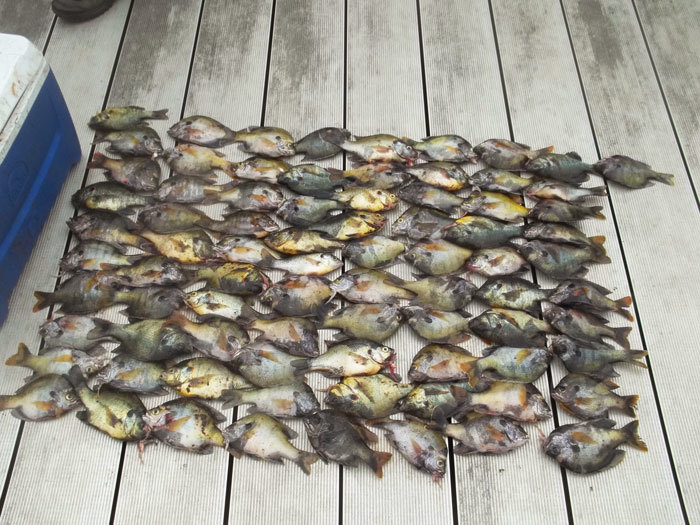
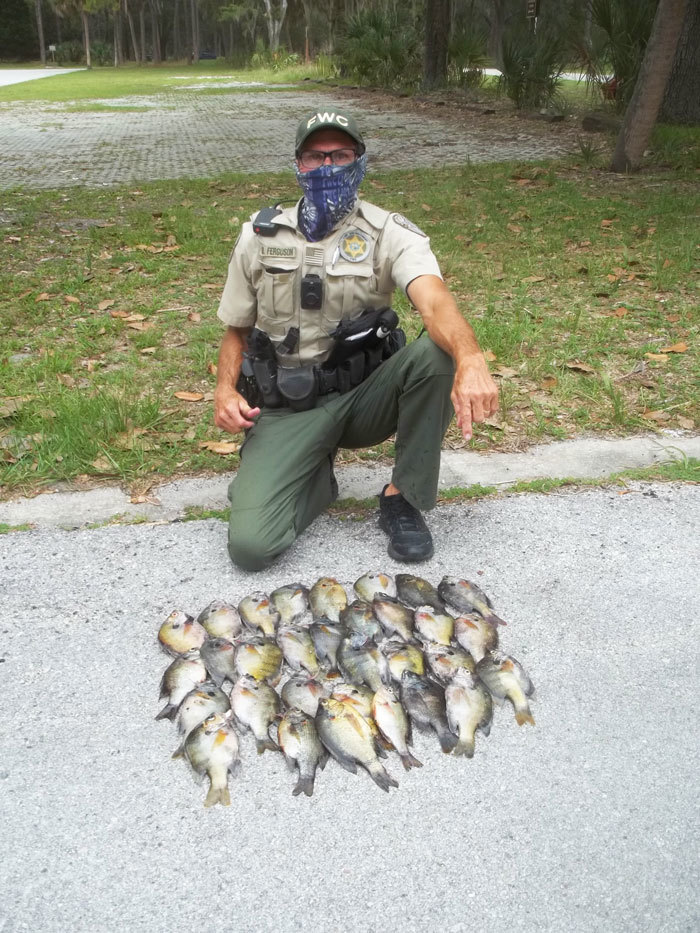 Southwest Region Officer Specialist Brian Ferguson and Offshore Patrol Vessel Officer Thomas Godfrey conducted a vessel stop in Pinellas County. The operator, who was the only individual on the vessel, stated he had caught the 50-55 panfish in a cooler. During the vessel stop the operator tilted the cooler and began to dump the fish into the water and the officers observed 11 panfish floating on the surface of the water. The officers were able to secure the cooler, which contained an additional 82 panfish for a total of 92 panfish (42 panfish over the bag limit). The individual was issued a misdemeanor notice to appear, citation for over the bag limit of panfish, two boating citations and one warning.
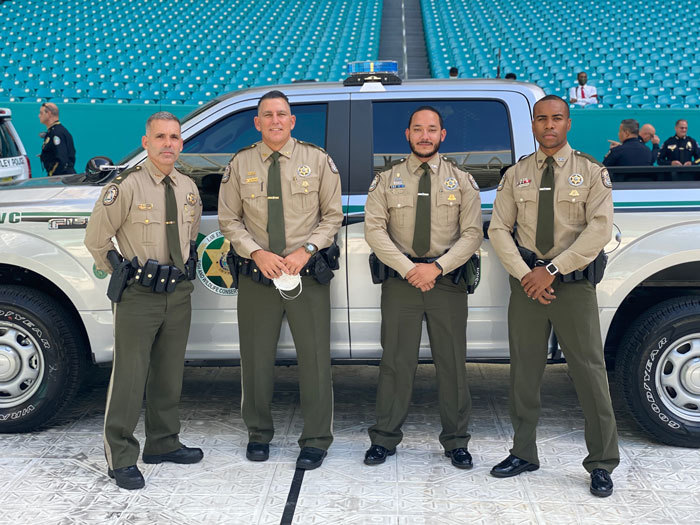 On June 11, Officers Washington and Osorio, Capt. Maza, and Maj. Escanio represented the FWC Division Of Law Enforcement as we partnered with the 5,000 Role Models, Miami-Dade County Association of Chiefs of Police and local law enforcement agencies as well as the Miami-Dolphins for a Police and Youth Conference. The purpose of the event was to come together and show camaraderie between the community and police. At the Hard Rock Stadium, chiefs and upper leadership represented their agencies from Dade and Broward counties with their agency’s marked vehicles on display on the Miami Dolphin’s football field.

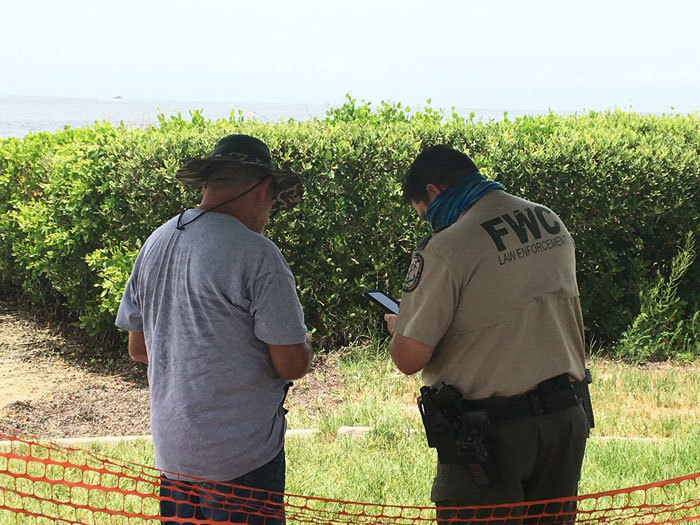 Southwest Region Officer Specialist Manny Tsongranis taking a minute to help a fisherman download the FWC mobile app.
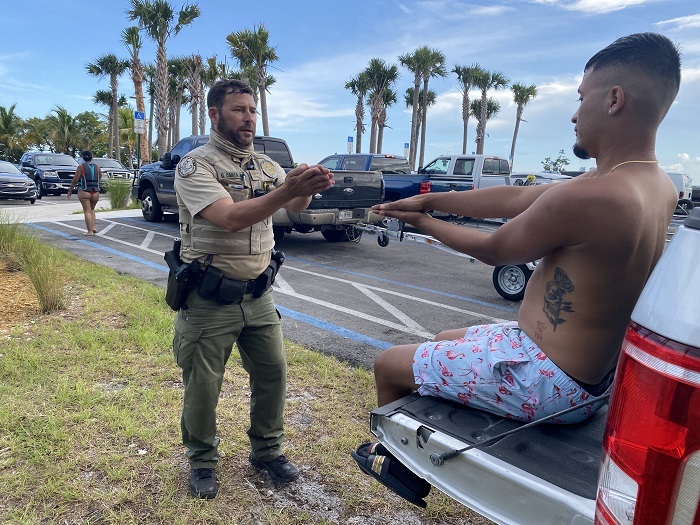 BUI investigation at the 79th Street boat ramp in Miami. Officer Cartaya and Officer Gomez pictured.

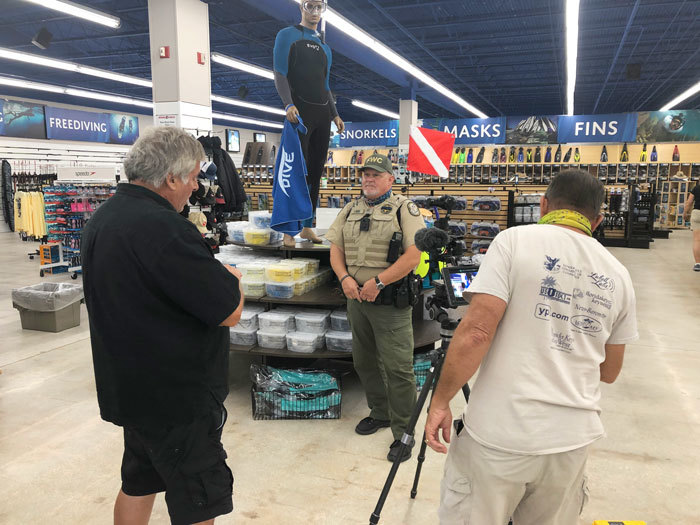 Officer Dube filmed a Public Service Announcement in conjunction with the Monroe County’s Tourist Development Council for the upcoming Lobster Sport Season in the Keys. Officer Dube and a film crew set up cameras at Divers Direct in Key Largo to film. Officer Dube discussed all the current lobster regulations, boating safety tips and gave a demonstration about how to catch a lobster. Officer Dube was also asked numerous questions on camera from Andy Newman, head of the TDC.
Photos by Andy Newman

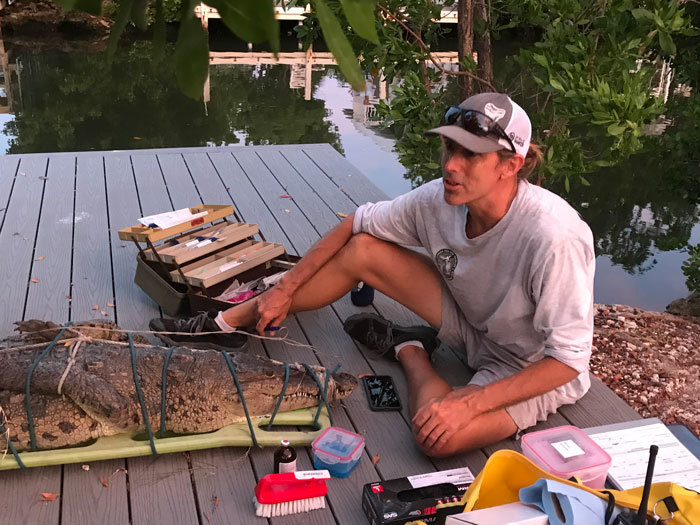
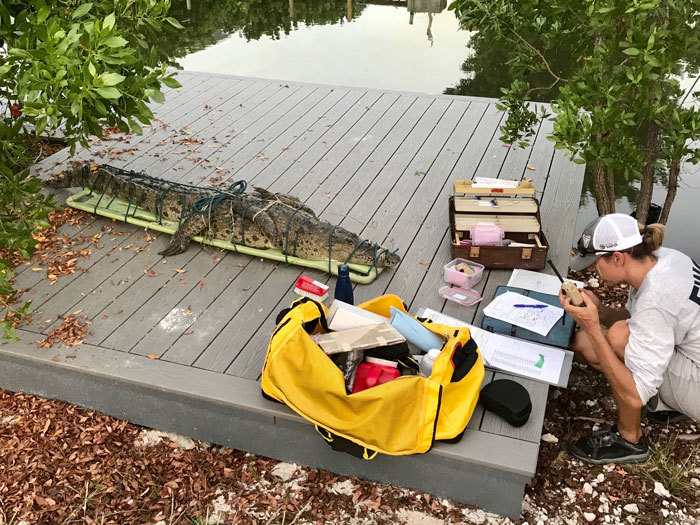 FWC Nuisance Alligator/ Crocodile Response Agent Chris Guinto
FWC officers and an FWC trapper responded to an Islamorada home to remove a crocodile (white #16). This crocodile was translocated to a undetermined location and was fitted with a GPS locater after a brief check-up. The crocodile was approximately 12 feet long.
|
|
|
The Inside Job is a monthly newsletter featuring
the employees and programs of the FWC.
Send your submissions, comments and questions to Kelly.Broderick@MyFWC.com.
|
|
|
|
|