|
By Peter Kleinhenz
I don’t know about you, but when I’m out in nature, I’m
seeking moments of magic. These are instances when time seems to freeze and the
most basic, but powerful, emotions take over once nature decides to
spontaneously pull the curtain back and unveil something extraordinary.
These
days, I’m based in Tallahassee where the opportunities to encounter a magical
experience seem limitless. Perhaps this is true, but I’m going to let you in on
a little secret. Your likelihood of being mystified by the natural world
increases significantly the closer you get to a river that I have fallen deeply
in love with: the Apalachicola.
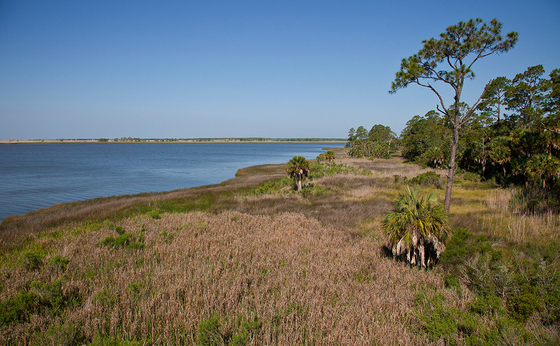 The view from a tower at Apalachicola River Wildlife and Environmental Area's Sand Beach shows the range of habitats on the Apalachicola River from salt marshes to upland pine forests, photo by Liz Sparks
The
Apalachicola River winds approximately 110 miles from the bottom of a dam on
the Florida-Georgia line to the Gulf of Mexico. Along its course, it carves
through immense bluffs peppered with the bones of ancient marine mammals,
meanders past forests that seem to stretch to infinity, snakes through a
labyrinth of dark floodplain forest and, ultimately, pours into the Gulf of
Mexico where it nourishes one of the most productive estuaries on earth.
 |
|
Not
surprisingly, a rich diversity of life finds a home in and along the
Apalachicola. In fact, the Apalachicola Basin has been labeled as one of only
six biodiversity hotspots in the United States. Two tree species, the
critically endangered Florida torreya and the slightly less rare Florida yew,
live only in the steep woodlands along the eastern edge of the river’s 10
or so miles downstream from the dam. Over 40 species of reptiles and amphibians call the surrounding
area home. The endemic, bright-orange fireback crayfish, the secretive torreya
trapdoor spider and the widest diversity of carnivorous plants in the U.S.
round out the fascinating species list in this sliver of Florida. |
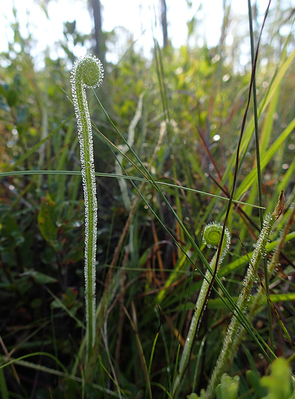
A carnivorous sundew unfurls its leaves to snare flying insects, photo by Liz Sparks
This life serves as a magnet for me whenever I get the
urge to wander (always). I spend a lot of my free time driving the dirt roads
that traverse Apalachicola National Forest, taking friends on hikes in the
region and donating blood in the depths of the floodplain swamps that line the
river. These moments, with the exception of mosquito encounters, are
fantastic, but they aren’t magic. For that, I need to take you a bit farther
downstream.
The
Florida Fish and Wildlife Conservation Commission (FWC) manages 63,257 acres of
the lower Apalachicola River in aptly named Apalachicola
River Wildlife and Environmental Area (ARWEA). It doesn’t get much more
wild than this in Florida. Wet prairie, pine flatwoods and miles of swamp only
accessible by boat define this protected area. It was in the latter region
where one of my most memorable magic moments in Florida took place.
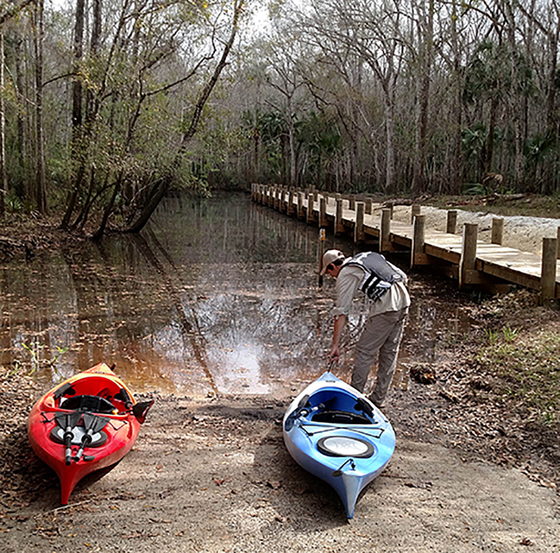 Peter Kleinhenz (pictured) and Liz Sparks (photographer) prepare for their paddling trip on the Apalachicola River
I was paddling down Saul’s Creek, a sizable tributary of
the Apalachicola, in a kayak next to my coworker, Liz Sparks. We were scouting
“Trip 12,” the newest of 12 paddling trails available within ARWEA. While days
like that really don’t feel like work, there was, in fact, work to be done. Liz
and I needed to check out smaller tributaries that fed the creek to see if any
made sense as side trips. With the sun’s rays kept in check by a light breeze,
we turned our boats to the northeast and made our way up Johnson Creek.
An
open canopy of tupelo, bald cypress and cabbage palm rapidly closed. Trees bent
over the sluggish brown water, shading the bright, happy day into one that was
quieter and more introspective. Liz hung back behind me 30 or 40 feet. All was
silent, save for the wind tickling the leaves and the sound of paddles slicing
through the water. The width of the creek became inversely proportional to the
size of the cypress trees that rose up from the muck around us. This was wild.
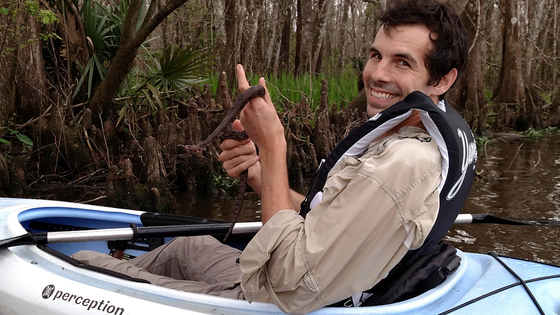 Peter holds a brown water snake while paddling up a tributary of the Apalachicola River, photo by Liz Sparks
We stopped when the stream became so shallow that we had to scoot across fallen tree trunks. A few small rivulets emanated
from the depths of the swamp. Liz followed one. I stayed put.
With
no sounds of traffic, planes or other people, my mind wandered. How many people
had been back here lately? There were no beer cans, no discarded fishing line
and, really, no sign of people whatsoever. As such, it was easy to go back in
time.
I
imagined being in the same spot 200 years before. My eyes scanned the trunks of
the larger cypress trees as I pictured an ivory-billed woodpecker emerging from
the swampy shadows to land on one of them. Ah, what it must have been like to
have had this silence broken by a flock of screeching Carolina parakeets
feeding in the canopy above. Surely, it was not uncommon for Native Americans
to quietly paddle up this swampy backwater in pursuit of fish and game. For
just a few minutes, the species and people that have long fascinated me were
present, in spirit if not in form. It was magic. |
|
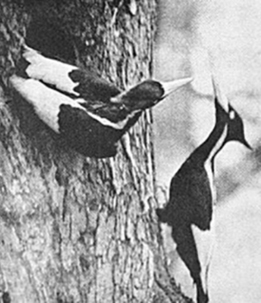 |
Ivory-billed woodpeckers, circa 1935, now considered extinct, photo from Creative Commons
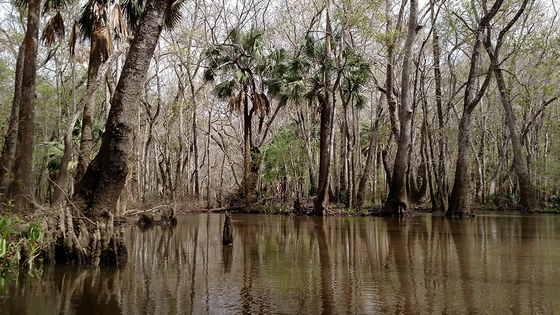 Peter experienced his magic moment on this tributary of the Apalachicola River, photo by Liz Sparks
Liz came back into view. She too
must have had a reflective moment, since we exchanged few words until we
arrived back in the main channel of Johnson Creek. The water carried us away
from this place, a place that has managed to stay with me far longer than I
thought a swamp ever could.
In an age when even earth’s wildest places are
changing, it’s comforting to know that at least one window to the past remains
clear. Sure, much of the Apalachicola Basin has undergone significant change over the years. But, in this
forgotten corner deep within ARWEA, the past and present seem one and the same.
That, to me, is magic.
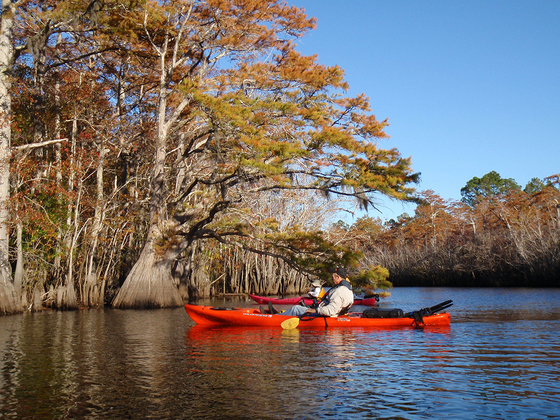 Paddlers explore one of the 12 paddling trails that wind through ARWEA, photo by Liz Sparks
While you can certainly visit Trip 12 like I did, 11
other paddling trips permit access to much of ARWEA, where magic moments
can be plentiful. Several other
paddling trails exist throughout the state. With cooler weather upon us,
there is no better time to explore a wildlife
management area near you. Whether you’re a hunter, photographer,
bicyclist or simply want to experience a moment of magic yourself, you can help
us celebrate 75
years of Florida wildlife management areas by checking out a wildlife
management area this fall. See you out there!
|