|
By Peter Kleinhenz
Salamanders smile. Pick one up
sometime, if you don’t believe me, and look that squirming amphibian right in
the eye. You will see a grin that seems to suggest total contentment with a
life so different from ours.
A
statement so generalized requires a clarifying remark. Here’s mine: Not all
salamanders smile the same. The 2-foot-long eastern hellbender, for instance,
looks like it got flattened by a truck. Its smile could be confused with any of
the countless creases in its flappy skin. One genus of salamanders, however,
possesses a consistent smile that would make any Miss America proud. Meet the
Ambystoma, the genus otherwise known as “mole,” salamanders.
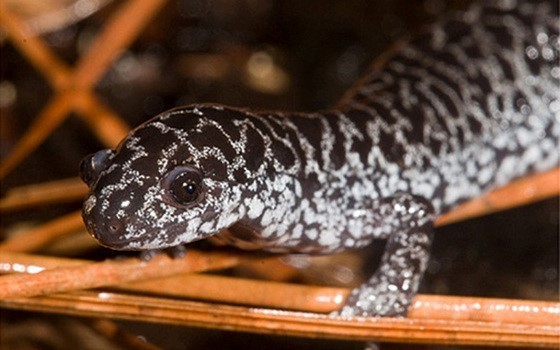 Rare close-up of the federally endangered reticulated flatwoods salamander, Pierson Hill
This group of salamanders contains approximately 33
species whose distribution exclusively includes North America. Ambystomatid
salamanders are characterized by their love of staying underground, emerging
only when warm rains after long cold spells indicate that it’s time to breed.
Wearing what I assume are bigger smiles than usual, they migrate en masse to
breeding pools, do their thing and return to their homes in rotting logs and
animal burrows.
When it comes to these secretive
salamanders, Florida is special. Not only do we have five types within our
borders, but two are found almost nowhere else. These are the flatwoods
salamanders, stunning animals with a pattern that seems excessively spectacular
given the lives they lead. The flatwoods salamanders were one species until a
decade ago. Molecular evidence suggested that the one species was, in fact, two.
Frosted flatwoods salamanders live east of the Apalachicola/Flint River
drainages. Reticulated flatwoods salamanders live to the west.
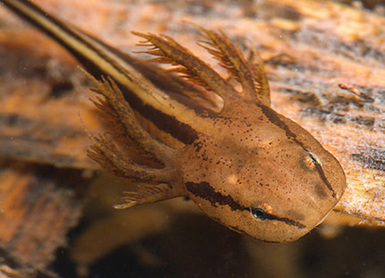 Unfortunately, both species are in serious trouble. Most historic breeding ponds and their surrounding uplands have become slash pine plantations, farms or homes. Decades of fire suppression means that many remaining pools have become forests or, at best, have a substrate so thick with accumulated vegetation that they are at the limits of flatwoods salamander suitability. (Salamander larva photo, above, by Pierson Hill)
Following the federal listing of
both species, agencies managing land within the historic range of these species
ramped up their efforts to determine exactly where these species still
occurred. Biologists for the Florida Fish and Wildlife Conservation Commission
(FWC), for instance, surveyed some promising-looking habitat within a newer
acquisition known as Escribano
Point Wildlife Management Area. Mark Winland, one of the biologists there,
told me about a particularly memorable survey.
|
 “One
of my first memories working with the species happened the first time we
surveyed what has since become known as the 'honey hole,'" Mark described. “We
had four folks working that day and, within about two seconds of starting to
sample, we were catching larvae. In one sweep of the net I caught two larvae,
then the next sweep I caught four and, before it was over, we had caught nearly
50 in 15 minutes. That was when I realized that our population was something
special and that the work we would be doing on Escribano Point was going to
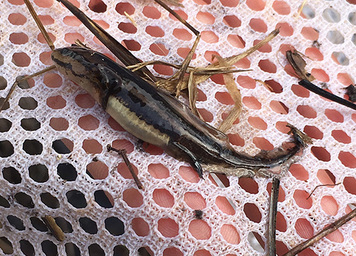
have huge implications for the species.” (Salamander larva photo, above, by Mark Winland)
|
Escribano Point WMA conserves nearly
5,000 acres of habitat and borders Eglin Air Force Base, home to the most
robust population of reticulated flatwoods salamanders. Protecting habitat was
step one. Boosting the population demands more intensive work.
“On Escribano Point we try
to encourage fire to penetrate into our wetlands and have a restorative effect
as much as possible,” Mark explained. “Unfortunately, most prescribed burns
occur in the dormant season and are typically lower-intensity fires. These are
very different from the growing season wildfires that would have naturally
occurred. As a result, management agencies have to incorporate other methods to
manage and restore wetlands. Probably the most common method has been using
hand crews to cut out unwanted vegetation. Then crews can come back in, apply
fire and hopefully maintain the pond.”
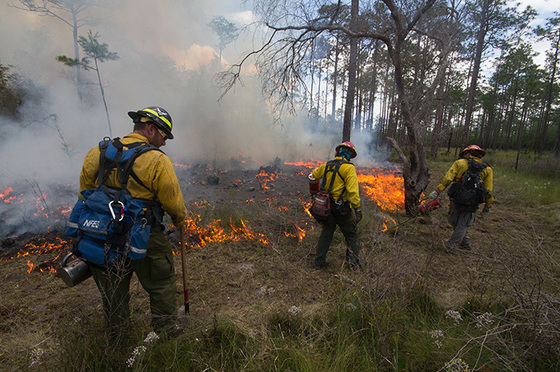 U.S. Forest Service staff conducting a prescribed burn in a flatwoods salamander breeding pond, Pierson Hill
This works, but takes time. That’s not
something very many populations of reticulated flatwoods salamanders have in
excess. To combat this, Escribano Point biologists have established partnerships
to carry out even more dramatic work.
 |
|
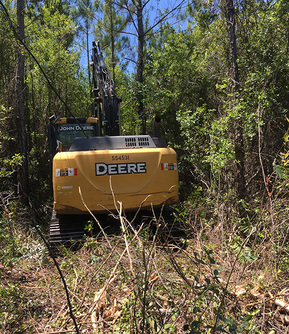
“Another method that we are working on
collaboratively with our partners at Eglin AFB and Virginia Tech University is
using heavy machinery to remove unwanted vegetation and accumulated duff out of
pond basins,” Mark continues. “The idea is that by starting with a blank slate,
we can rely on the naturally occurring seed bank to help create a pond with not
only favorable midstory and overstory, but also the ground cover that is
essential to the reticulated flatwoods salamander.” (Machinery for removing vegetation, left, by Mark Winland)
|
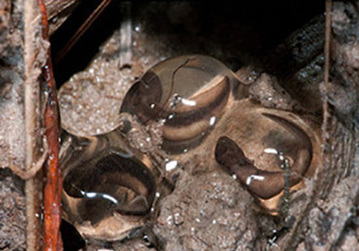 These efforts add to a litany of other creative methods being implemented by FWC and its partners. For example, herpetologists from FWC, in conjunction with the U.S. Forest Service, are collecting wild frosted flatwoods salamander eggs, raising the larvae to the terrestrial stage and then releasing the salamanders back into the wild. The Florida Forest Service, U.S. Fish and Wildlife Service and Florida State Parks are among the many other partners working to safeguard these southeastern specialties from extinction. (Photo of salamander eggs, above, by Pierson Hill)
|
To Mark Winland, doing so makes a lot of sense.
“By protecting flatwoods salamanders and their habitat, we are also protecting habitat for hundreds of other species, both common and imperiled. From a human standpoint, our quality of life increases when we have healthy native flora and fauna populations, and their associated habitats, to enjoy. From birdwatching to hunting, native wildlife and their habitats provide vital recreation opportunities to society.”
There are many reasons to feel pessimistic about the future of flatwoods salamanders. But, increasingly, there is hope.
The salamanders, after all, have never stopped smiling.
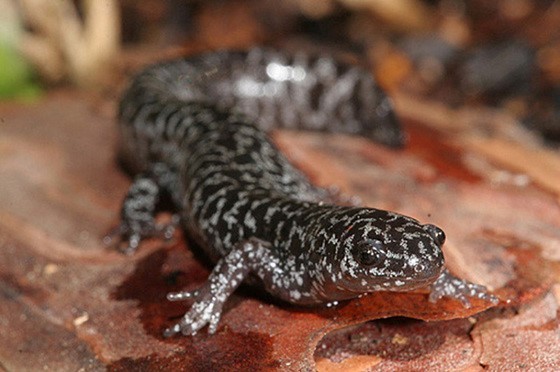 Federally endangered reticulated flatwoods salamander, Pierson Hill
To
see evidence of management at work, or possibly even the wildlife such
management benefits, visit
a WMA near you. If you do stumble upon interesting plants and/or animals
(and you will), submit your finds to the Florida
Nature Trackers program via the free iNaturalist app.
Then, take your photos and enter them into our 75th
Anniversary photo contest. For the more adventurous folks reading this, you
can search
for FWC’s 49 hidden geocaches located at WMAs all around the state. See you
out there!
|