January 2nd, 2026
Happy New Year, and welcome back to the District Fishing Report! We hope everyone enjoyed the holidays and is looking forward to a great season of fishing in 2026. If you are looking for a New Year’s resolution, perhaps consider making yours to get out and catch more fish this year. Washington D.C. is a premier destination for fishing, and there are plenty of opportunities to catch fish in D.C. throughout the year for anglers of all experience levels. You don’t have to wait until the weather warms up to cast a line, either. Our rivers can still offer excellent angling during the winter months, so don't be shy about bundling up and heading out to the water’s edge. The species that will give you the best chance of catching fish this time of year will be blue catfish, common carp, crappie, and largemouth bass. Blue catfish will offer the most widespread opportunities over the next few months and now is a great time to target the big fish in the deeper waters of the Potomac River. In this report, we will be breaking down everything you need to know to go out and catch your first fish of the year. Let’s dive into all the details you will need to know to get your 2026 fishing season started.
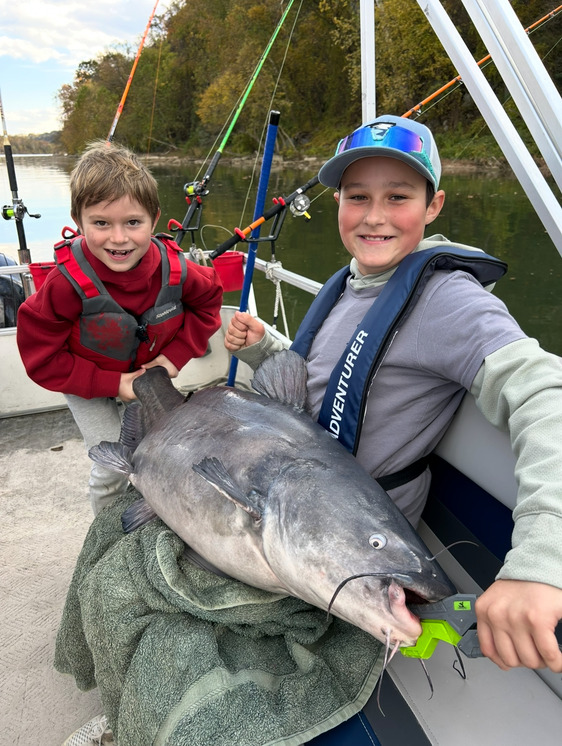 |
Ethan Kapelski landed this behemoth 45-pound, 41-inch blue catfish near Fletchers Cove this past November while fishing with Capital Blues Fishing Charters.
Fishing for catfish is typically slower in the district during the winter months, but the catfish tend to congregate in specific areas, providing a better chance to catch a big fish. The blue catfish have moved into their wintering holes on the Potomac River near Three Sisters Island, Roosevelt Island, and the channel running along Joint Base Anacostia-Bolling. Cold water temperatures will make blue catfish spend most of their time in depths of 20 to 70 feet of water. Our current water temperatures at the start of the New Year are in the 30s, so catfish will not be very active, spending most of their time moving around the river bottom in deeper depths. Captain Owen Koch of Capital Blues Fishing Charters reports that fishing has been slow to end the year, but he has been catching some smaller-sized blue catfish around the Woodrow Wilson Bridge. He also reported seeing loads of carp around the Blue Plains Advanced Water Treatment Plant a few weeks ago. While fishing for catfish, fresh-cut eel and smaller chunks of gizzard shad are both catching fish. Captain Owen mentioned that most of the catfish he is catching are covered in mud, meaning they have been lying on the bottom of the river, so he has switched out his float rigs and is mostly using bottom rigs now. Captain Seth from Fish The Potomac reports that, despite river temperatures in the low to mid 30s, they are still catching catfish in depths of 20 to 30 feet. They also report that they have found some largemouth bass around submerged structures in depths of 10 to 15 feet of water near the mouth of the Anacostia River. The catfish bite has been best when the tide is moving, with stronger currents getting fish up off the bottom to feed. Captain Seth confirms that fresh-cut eel is working best for catfish right now. If you can’t get eel to use as bait, other suitable options are gizzard shad, bunker, chicken, and any other meaty product that will stay on a hook. We want to remind anglers that blue catfish are an invasive species in our waters. They are known to outcompete native fish species, and their population is continuing to grow exponentially. Anglers are not required to remove or dispatch blue catfish that they catch, but we encourage anglers to remove them from the river when caught. The current fish consumption advisory for blue catfish caught in district waters is three eight-ounce servings a month. If you have never eaten blue catfish, they are known to be delicious and offer a firm, white, flaky fillet.
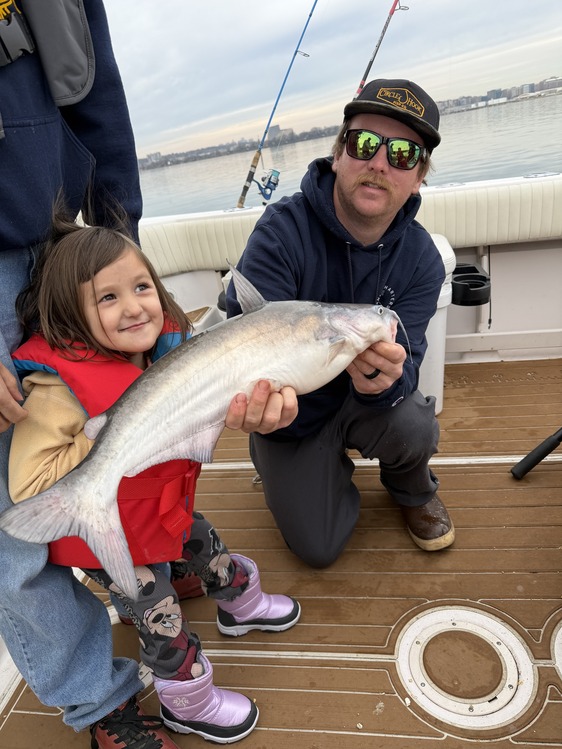 |
Captain Seth from Fish The Potomac helped this young angler catch their first fish during a recent trip on the Potomac River.
Fishing for species other than catfish is usually slower during the winter months, but there are still other opportunities to explore. The cold temperatures typically cause fish such as largemouth bass, crappie, and resident striped bass to retreat to deeper water and be less active. The exception to this rule is the waters surrounding warm water discharges on the Potomac River. These outflows release water that is much warmer than the main stem of the river, so fish tend to congregate nearby to take advantage of the warmer temperatures. This creates a unique angling opportunity where anglers can find a large quantity of fish in a relatively small area. The Blue Plains Advanced Wastewater Treatment Plant is a prime example of this. Unfortunately, the waters surrounding the warm water discharge at this site are only accessible by boat, but anglers with access to boats can launch at either Gravelly Point or Anacostia Park and head downriver to fish these waters. The discharge itself is located just to the north of the concrete dock running along the southern shoreline of the facility. Largemouth bass stage around this area in the winter, and an effective way to catch them is to throw deep-diving crankbaits up to the riprap shoreline and slowly retrieve them near the discharge. Other species that are commonly caught in the winter months at this site include crappie, blue catfish, carp, and striped bass. Crankbaits, spinnerbaits, and football jigs are lures that work well in the winter months. Retrieve them slowly, as fish are usually lethargic and prefer a more subtle bait presentation. Other notable areas to catch fish in the district during the winter are the various marinas located along the Washington Channel. The deep waters surrounding the dock structures are great places to find crappie in the winter. These fish will school up and suspend in the water column around cover. The best way to catch them is to use live minnows fished under a bobber or on a small jighead. Depending on the depth of water you are fishing, the best jighead sizes to use are between 1/16 and ¼ ounce. If you can’t get live minnows, small soft plastic panfish jigs will also work.
The full set of regulated fishing activities for The District can be found on the Regulated Fishing Activities webpage. If you would like to buy a fishing license, please visit the Get a Fishing License webpage. Fishing licenses are sold on a calendar year basis. Anglers under the age of 16, or age 65 and older are not required to buy a fishing license to fish in The District. Washington D.C. has a Recreational Angling Records Program that allows anglers to check in eligible fish caught in D.C. waters for record fish awards and trophy fish awards. There are 29 different eligible species, and many categories currently have vacancies, so we encourage D.C. anglers to check in their fish. The full set of rules for the records program can be found on the Recreational Angling Records Program webpage. If you would like to submit information for the report, please email dillon.waters@dc.gov. If you would like to submit a photo to be included in the report, please send an email with photo attachments to fishandwildlife.photos@dc.gov. Tight lines everyone! 🎣
Volunteer Angler Creel Survey
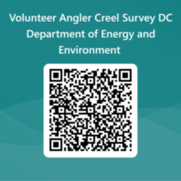
The Department of Energy and Environment’s Fisheries Research Branch is conducting it’s annual creel survey and encourages local anglers to participate. The goal of the survey is to better understand recreational angling efforts, perceptions, and harvests within Washington D.C. The information obtained from the survey will be used to inform fisheries management decisions and regulations. To make it easier for anglers to participate, a QR code has been developed. To access the survey, just scan the QR code using the built-in camera on your mobile device and tap the banner that appears. Already reading this on your phone? Click here. The survey is voluntary, but we encourage anglers to fill out the form after every fishing trip. Good luck fishing and let us know how you do! |
|
 |
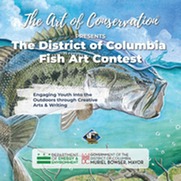
Art Of Conservation Fish Art Contest
The 2025-26 Art of Conservation® Fish Art Contest is now OPEN!
Wildlife Forever invites K-12 students worldwide to dive into nature, learn about fish and aquatic habitats, and express their creativity through art and writing. Since 1997, this contest has inspired over 85,000 youth in 46 countries to become the next generation of outdoor stewards.
The 2024-25 contest is open for submissions until February 28th, 2026. Participants can find more information, educational resources, and submission guidelines at www.FishArt.org.
|
|
 |
|