September 1st, 2025
Welcome back to the District Fishing Report! The dog days of summer appear to be behind us as cooler temperatures have arrived much earlier than expected. It always feels as though summer goes by too quickly, and this year was no different as many kids are now returning to school. The upside for anglers is that most of the public fishing locations in the district should be less crowded going forward the rest of the year. Two of our more popular locations, Hains Point and the Tidal Basin, will see less foot traffic as the tourist season is winding down, and they are great places to fish throughout the fall. The early onset of cooler temperatures will also make it more comfortable to be out during the day wetting a line. Instead of condensed bite windows, cooling water temperatures should make fish more willing to feed throughout the day. The time of day you fish is less of a factor when temperatures cool off, but the tide still plays an important role. Most fish will look to feed during a moving tide as it carries baitfish and other food through the rivers. Make sure to check a local DC tide chart before your outing to plan for the best time to hit the river. The weather is cooling off, but the bite is heating up, so let’s get into the report.
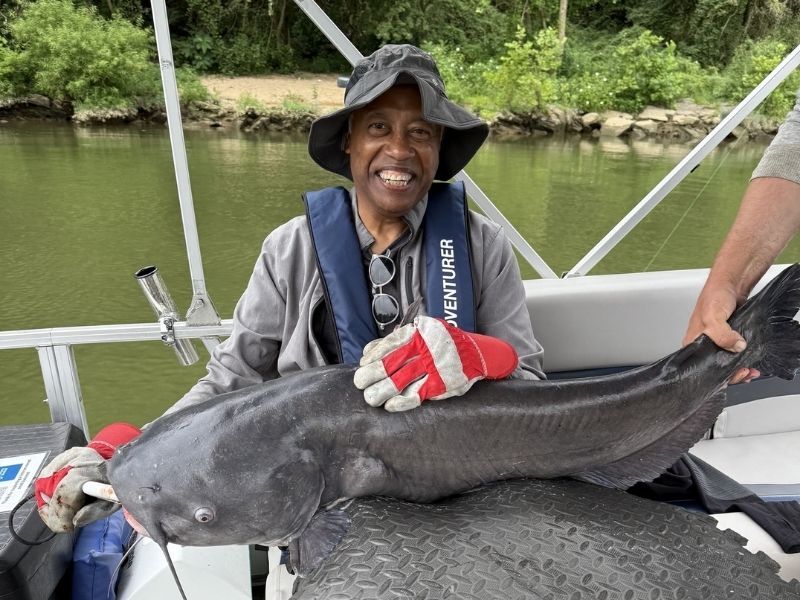 |
Anglers fishing with Captain Owen Koch of Capital Blues Fishing Charters have enjoyed a good catfish bite recently.
Blue catfish are the main target for many of our D.C. area anglers, and for good reason. Blue catfish are one of the most abundant fish in our rivers and grow upwards of 100 pounds. The big ones are a lot of fun to catch! These fish are invasive, meaning that they are not native to the Potomac and Anacostia rivers. The abundance of invasive blue catfish in our waters is greatly concerning because they negatively impact our native fish species. Blue catfish are notorious for feeding on just about everything, including our native fish. They also outcompete native fish for other resources, and since they are prolific breeders, they take up a huge percentage of the total biomass in our waters. These are all reasons we encourage anglers to target blue catfish, but there are many other reasons why they are an appealing target. Anglers in D.C. have the opportunity to catch blue catfish from under a pound to upwards of 80 pounds. If you have ever hooked into a blue catfish over 40 pounds, you know that it is one heck of a fight. Blue catfish are also delicious to eat. The current consumption advisory for blue catfish caught in D.C. waters is three eight-ounce servings per month. They are served in many local restaurants in the DMV area, and are known for their mild, firm, and flaky fillets. Blue catfish can be caught using a variety of baits, but the most popular include gizzard shad, eel, and chicken. They can also be caught using artificial lures such as spinnerbaits, chatterbaits, and soft plastics on jigheads. Anglers reported that the blue catfish bite was slow in July, but it has picked up in August and should continue to get better as we head into the fall. Those able to get out on the river in boats or kayaks are having better success with hotspots around Roosevelt Island, Three Sisters Island, and the Woodrow Wilson Bridge. An angler fishing near the Kennedy Center in his kayak reported catching a jumbo blue catfish last week. The fish weighed an estimated 50 pounds and measured 50 inches in length. He also caught five smaller catfish. A few days earlier, he caught six blue catfish in the same area. Capital Blues Fishing Charters had also been running trips on the Potomac River and had some very productive trips at the end of August. On a recent trip, one of his anglers landed a 43-pounder; The crew also caught several 20- and 30-pound fish. Flathead catfish can also be found in many of the same areas as blue catfish. Flathead catfish are also an invasive species, but not nearly as widespread as blue catfish. They prefer the rocky river bottom found in the upper portion of the Potomac River near Fletchers Cove, but during the summer and fall, they will spread downriver. They can be caught around the various bridges on the Potomac River from Chain Bridge all the way down to the Woodrow Wilson Bridge.
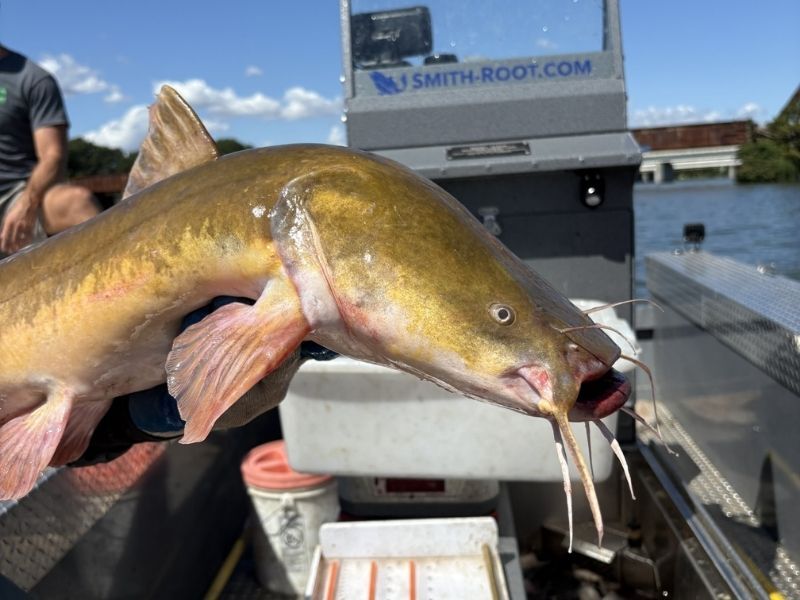 |
Flathead catfish can be caught around the various bridges and rocky areas in the district.
Largemouth bass are still in their summer pattern, but they will soon start to transition as fall arrives. Cooling water temperatures and shorter days will cause submerged aquatic vegetation to begin to die off. The tidal portion of the Potomac and Anacostia River in D.C. has been sparse for SAV grasses in the past few years compared to 2016, when there was a record high of over 1100 acres found in the district. In 2024, there were only 16 acres of SAV grasses found in the district, a far cry from what it once was. There are three types of vegetation that bass anglers should be aware of to look for on the water. They include floating aquatic vegetation (FAV), emergent aquatic vegetation (EAV), and submerged aquatic vegetation (SAV). Examples of FAV include duckweed and water lotus. Examples of EAV include arums, phragmites, wild rice, arrowhead, and cattails. Examples of SAV include hydrilla, coontail, and milfoil. These are all grasses that largemouth bass will hide in and use for cover. Most of the aquatic vegetation in D.C. is located on the Anacostia River, so bass on the tidal Potomac in D.C. now use other cover and structure throughout the year. Cover is temporary, such as aquatic vegetation, fallen wood from trees, or floating docks. Structure is permanent and can be viewed as a geographical change. This can include underwater points, deep holes, and ledges. Bridge pilings can act as both cover and structure where they will offer current breaks, ambush points, shade, and food sources. The Anacostia River has a lot of fallen trees and logs lining the banks, which are great cover for bass. There are also large fields of EAV at Kingman Lake. In the Washington Channel and on the Potomac River, marina docks, sea walls, and bridge pilings are hotspots for bass fishing. Located in the heart of the city, the Tidal Basin is a great location to fish for largemouth throughout the spring, summer, and fall. The bass tend to hang out along the concrete sea walls. Crankbaits and football jigs are particularly effective in the basin and will catch other species as well, including smallmouth bass, crappie, striped bass, and catfish. Crappie are another fish that are abundant in D.C., and they can be found in many of the same areas that largemouth bass inhabit. Anglers will want to downsize their gear a bit as crappie typically range between six and 14 inches, though their upper size range can approach 20 inches. Crappie are a schooling species and spend a lot of their time close to cover such as docks, bridge pilings, and rock piles. The numerous marinas located throughout D.C. waters are great locations to fish for them. Popular angling tactics include using live minnows, live worms, small panfish jigs, and even small crankbaits are very effective. If you are fishing and catch a crappie, make sure to fish that area thoroughly, because there are likely more nearby.
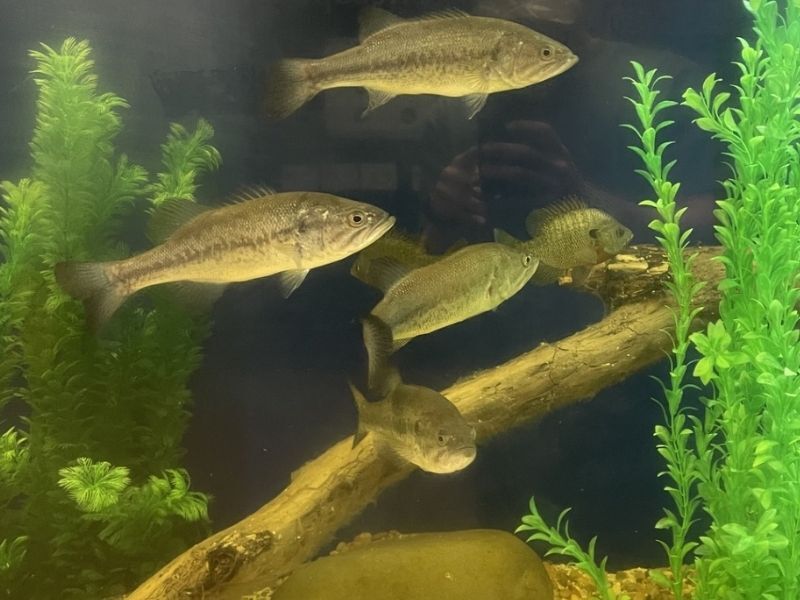 |
Largemouth bass will spend a lot of their time around cover such as logs and SAV on the Potomac and Anacostia Rivers.
The full set of regulated fishing activities for The District can be found on the Regulated Fishing Activities webpage. If you would like to buy a fishing license, please visit the Get a Fishing License webpage. Fishing licenses are sold on a calendar year basis. Anglers under the age of 16, or age 65 and older are not required to buy a fishing license to fish in The District. Washington D.C. has a Recreational Angling Records Program that allows anglers to check in eligible fish caught in D.C. waters for record fish awards and trophy fish awards. There are 29 different eligible species, and many categories currently have vacancies, so we encourage D.C. anglers to check in their fish. The full set of rules for the records program can be found on the Recreational Angling Records Program webpage. If you would like to submit information for the report, please email dillon.waters@dc.gov. If you would like to submit a photo to be included in the report, please send an email with photo attachments to fishandwildlife.photos@dc.gov. Tight lines everyone! 🎣
Upcoming Events
Saturday September 6th, 2025, from 9 am to 12 pm.
Aquatic Resources Education Center staff will be hosting a fishing event at Diamond Teague Park on September 6th. The event is free and open to the public, but registration is required. If you are interested, you can sign up online on Eventbrite using this link: Diamond Teague Fishing Event. DOEE biologists will be on site providing fishing instruction and all the gear you need to fish on the Anacostia River. New anglers are welcomed to attend! Common species caught at Diamond Teague Park include blue catfish, bluegill, and largemouth bass. We hope to see you there!
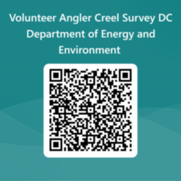
Volunteer Angler Creel Survey
The Department of Energy and Environment’s Fisheries Research Branch is conducting it’s annual creel survey and encourages local anglers to participate. The goal of the survey is to better understand recreational angling efforts, perceptions, and harvests within Washington D.C. The information obtained from the survey will be used to inform fisheries management decisions and regulations. To make it easier for anglers to participate, a QR code has been developed. To access the survey, just scan the QR code using the built-in camera on your mobile device and tap the banner that appears. Already reading this on your phone? Click here. The survey is voluntary, but we encourage anglers to fill out the form after every fishing trip. Good luck fishing and let us know how you do! |
|
 |
|