July 3rd, 2025
Welcome back to the District Fishing Report! Summer is here, and the heat is finally setting in after we enjoyed cooler weather during the spring and early summer. Many of us have been wanting warmer weather, but a jump into the 90’s may be more than we bargained for. Our region has been in a significant drought since last year, but that all changed during the month of May. Several rounds of heavy rain moved through the Mid-Atlantic, almost on almost a weekly basis, that put us several inches above the average monthly rainfall. The stormy pattern has continued through June, and we are now out of the drought and close to average conditions across the Mid-Atlantic. The rain accompanied by below average air temperatures had kept water temperatures on the cooler side in our local rivers. This led to some great fishing throughout the district, with several bites extending further into the summer than we usually see. Anglers have been enjoying excellent action for striped bass and flathead catfish in our upriver waters, while the areas closest to downtown have offered great opportunities for snakehead, bass, and several other species. Our weather has now shifted to intense heat, and we can expect the hot summer temperatures to stick around for the foreseeable future. This will definitely impact the fishing in D.C., and anglers will need to adjust their tactics accordingly. Let's get into where the fishing has been hot, and what we can expect with warmer weather through the rest of the summer.
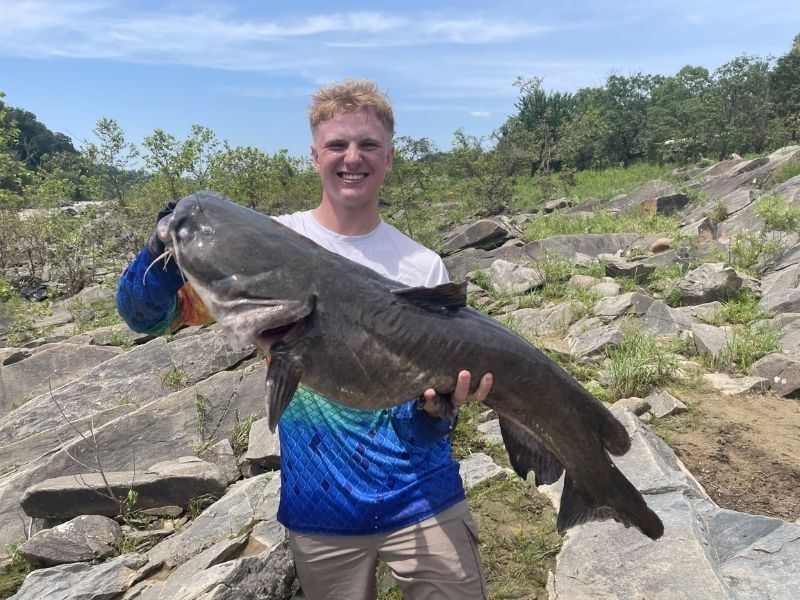 |
Kasper Parfomak set the D.C. flathead catfish record with this 28-pound giant.
Flathead catfish are an invasive species in our waters that have been growing in size and population each year since they arrived in the district. These fish are most abundant in the stretch of river from Georgetown up to Chain Bridge but will spread out into other areas of the Potomac River during the summer months. The bulk of the fish are still further upriver, and anglers have been enjoying an excellent bite for them over the past few weeks. The section of the Potomac from Fletcher’s Cove up to the D.C. line has been a hotspot. The water and current move much faster in this area, but there are pockets and eddies of slower moving water that flatheads and other fish will stage in. The moving water in this area attracts fish this time of year for a few reasons. The faster, more turbulent water tends to create more dissolved oxygen than areas downriver that can become low in dissolved oxygen during the summer. This stretch of river is also cooler than areas downriver, which offers relief from the extreme heat we tend to see this time of year. Finally, there are still a lot of baitfish in the area that predatory fish such as flatheads enjoy feeding on. Flathead catfish sit along the rocky bottom of the river, often lying in between rocks, and wait for smaller fish to swim by them to then feed on. Many recreational anglers enjoy fishing for them because they can be targeted using light tackle gear with artificial lures. Angler Kasper Parfomak recently set the D.C. flathead catfish angling record with a 38”, 28-pound flathead that he caught in the vicinity of Chain Bridge. Kasper has been targeting flatheads in this area of the river over the past few weeks with a lot of success. He uses bass rods or larger surf-style rods to cast swimbaits and jigs out into the current and lets the lure drop to the bottom before bouncing it along as he reels it in. This mimics a baitfish, which is hard to resist for a hungry flathead. Kasper has landed several fish in the 10 to 20-pound range along with some fish in the upper 20’s on recent trips. The new flathead catfish record is another addition to his growing list of D.C. record fish. Anglers who are interested in submitting a catch to the Recreational Angling Records Program for a trophy fish award or a district angling record should read the official rules which include eligible species, sizes, and current records.
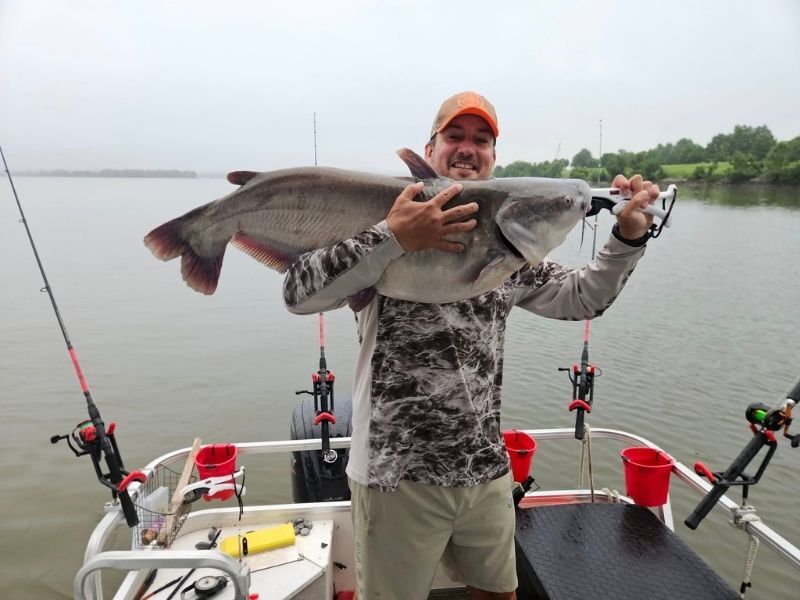 |
Dan Ortiz caught this 37-pound blue catfish while fishing with Capital Blues Fishing Charters.
Blue catfish are another invasive species in our waterways that are much more abundant than flathead catfish in the Potomac River. They can be found in the district both in the Potomac and Anacostia rivers. Blue cats can get very big and fish over 80 pounds have been caught by anglers in our waters. They can be caught using artificial lures, but many anglers prefer to fish for them using fresh cut bait. Some of the top bait choices include gizzard shad, eel, and chicken, but any meaty substance can work. They are relatively easy to target and can be caught from shore at our various public fishing locations across the city. These sites include Anacostia Park, East Potomac Park, Diamond Teague Park, and Fletchers Cove. A fish-finder rig is what many anglers use when fishing for blue catfish. These rigs are versatile and work whether you are drifting, anchored, or fishing from shore. To make your own fish finder rig, you will need a fishing rod spooled with line, fishing line leader, a hook, a weight, a swivel, and a sinker slide. Main lines can range between 10 and 50 pounds, while leader should be between 20 and 50 pounds. Fluorocarbon leader is often the best option to use. Weights can range from one ounce to four ounces depending on the current and depth of water where you are fishing. The best hook sizes to use for catfish usually range between five aught and eight aught. To make the rig, one end of the leader is tied to a hook while the opposite end is tied to a swivel. The main line is then threaded through a sinker slide and tied to the open end of the swivel. Once your lines are tied, attach your weight to the sinker slide, and you are ready to start fishing. When water temperatures get hot during the summertime, blue catfish will often seek out deeper water where temperatures are cooler. We have several bridges across the district that the blue catfish will school up at in depths of 20 feet or greater. Anglers fishing from boats often have success by anchoring up near bridge pilings and tossing out cut bait. The Woodrow Wilson Bridge has large numbers of catfish near its pilings during the summer months. The ledges along the main river channel are other areas that can hold schools of blue catfish this time of year. Depths of 20 to 40 feet of water is a good zone to try, but if you don't get any bites after a while, try moving shallower or deeper until you find some fish willing to bite. Captain Owen Koch of Capital Blues Fishing Charters checked in with us recently and said that the recent heat has made for some challenging fishing conditions, but it is still possible to find trophy catfish. Owen reports that the best time of day has been in the early mornings as the evening bite has been very slow. 85-degree surface temperatures have pushed the bait as well as the catfish into deeper water. Most of the fish his clients have caught are 10 pounds and under, but by throwing out a few bigger baits they have found some nice "teeners", 20's, and a 37-pounder, caught by Dan Ortiz on 6/28/25 in the channel across from Reagan National Airport. Terry Bilbo and his sons Ryan and Tyler each caught 20+ pounders on 6/28/25, including a 25-pounder. Many of the bites have been very tentative, unlike the big takedowns often seen in the spring and fall, so some patience is required before cranking down on them. These fish typically feed during a running tide, so make sure to check the tidal forecasts for Washington D.C. so you know what the river currents will be during your trip. A reliable resource to use for tidal predictions is the NOAA Tides and Currents website.
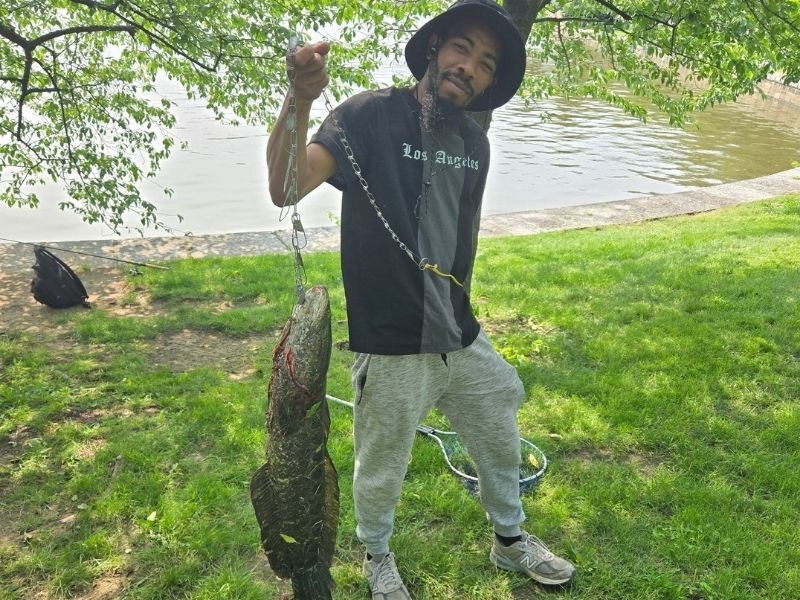 |
Beau Shields caught this 33” snakehead while fishing near the Tidal Basin last month.
The hot weather we have been experiencing makes predatory fish less active during the day and more active at night. Warm water temperatures often make them sluggish and less willing to feed, but once the sun goes down and the water cools off, they will usually move into shallower water looking for smaller fish to feed on. Local anglers have reported that this has been the current pattern during the recent heatwave. Largemouth bass, striped bass, crappie, and several other species are being caught in the Washington Channel and in the Tidal Basin at night. Areas with light illuminating the water have been mentioned as hotspots with fish hitting a variety of lures, including topwater lures, crankbaits, and jigs. An angler fishing in the channel at night reported that the largemouth bass were eager to hit crankbaits. Most of the fish were hanging out near docks and pilings. Another angler also fishing the channel said that there are plenty of schoolie stripers around the area with some slot-sized fish in the mix as well. Casting topwater lures and jigs next to docks and seawalls has been producing consistent bites. Snakehead anglers have reported mixed results across D.C. waters, with some areas producing big fish and others leading to lackluster results. The Tidal Basin seems to be the area producing the most consistent bite for snakeheads and there were several big fish caught there in June. Angler Beau Shields landed two giant snakeheads recently that measured 31.5” and a 33”. Both fish were caught using a soft plastic worm lure. Anglers fishing in the Anacostia River for snakehead have reported that fish are more willing to hit swimbaits than topwater frogs. The spatterdock fields near Kingman Island and Kenilworth Park are good places to find these fish. Catching them may be tough after heavy rains, and we heard from a kayak angler who fished the Anacostia last week after storms that reported the water was very muddy. They fished for a few hours without any bites. Cleaner water is better for snakehead fishing, and you can often spot snakehead swimming in the shallows in the right conditions. A good pair of polarized sunglasses helps reduce glare and improve clarity when looking into the water. This is also the time of year when snakehead fry balls will be popping up. A fry ball is a school of baby snakehead that parent snakehead will stay with and protect. Fry balls look like a small ball of bubbling water at the surface. This offers the opportunity for anglers to catch snakehead by spotting fry balls and casting lures at them. Parent snakehead are very protective and will bite lures cast in the vicinity of the fry ball. Keep an eye out for them the next time you are on the water.
The full set of regulated fishing activities for The District can be found on the Regulated Fishing Activities webpage. If you would like to buy a fishing license, please visit the Get a Fishing License webpage. Fishing licenses are sold on a calendar year basis. Anglers under the age of 16, or age 65 and older are not required to buy a fishing license to fish in The District. Washington D.C. has a Recreational Angling Records Program that allows anglers to check in eligible fish caught in D.C. waters for record fish awards and trophy fish awards. There are 29 different eligible species, and many categories currently have vacancies, so we encourage D.C. anglers to check in their fish. The full set of rules for the records program can be found on the Recreational Angling Records Program webpage. If you would like to submit information for the report, please email dillon.waters@dc.gov. If you would like to submit a photo to be included in the report, please send an email with photo attachments to fishandwildlife.photos@dc.gov. Tight lines everyone! 🎣
Volunteer Angler Creel Survey
The Department of Energy and Environment’s Fisheries Research Branch is conducting it’s annual creel survey and encourages local anglers to participate. The goal of the survey is to better understand recreational angling efforts, perceptions, and harvests within Washington D.C. The information obtained from the survey will be used to inform fisheries management decisions and regulations. To make it easier for anglers to participate, a QR code has been developed. To access the survey, just scan the QR code using the built-in camera on your mobile device and tap the banner that appears. Already reading this on your phone? Click here. The survey is voluntary, but we encourage anglers to fill out the form after every fishing trip. Good luck fishing and let us know how you do! |
|
 |
|