May 16th, 2025
Welcome back to the District Fishing Report! It has been an exciting spring full of great fishing opportunities all across district waters. The upper Potomac has once again provided a prolific spring for catfish, shad, striped bass, and many other fish species. Most of our anadromous fish species are concluding their spawning runs, which will be all but over by the end of May. Although these fish will be leaving our waters, there are plenty of resident fish species, both native, non-native, and invasive, to target throughout the rest of the year. Invasive fish are non-native species that are introduced to a new ecosystem where they cause economic and environmental harm. Non-native fish species are species that have been intentionally or unintentionally introduced to an ecosystem outside their natural range where they do not cause significant harm. Native fish are species that have naturally existed in an ecosystem without human intervention. Popular invasive targets include blue catfish and snakehead, popular non-native fish include largemouth bass and common carp, and popular native fish include crappie and white perch. Each species, plus many more, can be caught in D.C. throughout the spring and summer. The Potomac River is currently running very high thanks to a deluge of rain that swept across our region this week. The upper portion of the river from Georgetown north will be difficult to fish for a few days as the flow is fast with a lot of debris coming downriver. A great tool for checking river conditions is the USGS flow gauges. These monitor the current river conditions and the Little Falls Flow Guage is a good one to monitor. Fishing patterns are beginning to change as we approach the start of summer, and anglers will need to switch up their tactics as we progress into the warmer months. There are still a few spring bites to catch the tail end of, but let’s discuss what anglers can expect from now through the end of the month.
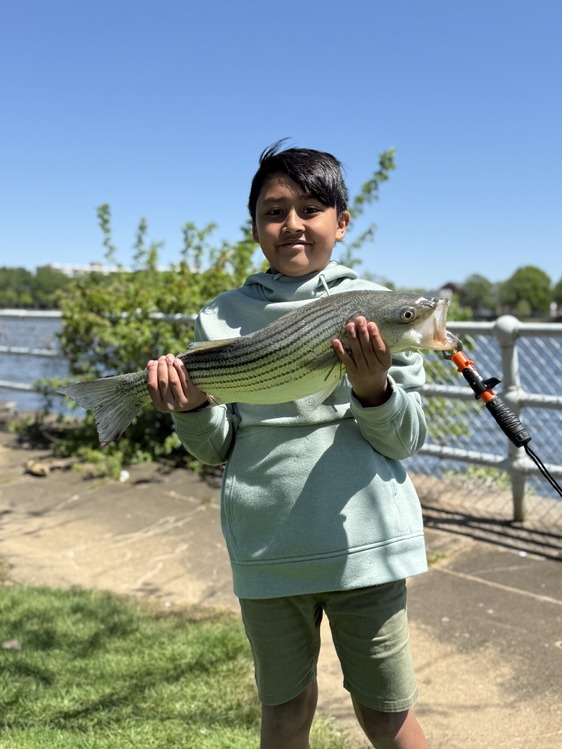 |
Striped bass season is now open, and it looks like there are some keepers around.
As we inch closer to the start of summer, anglers are doing their best to take advantage of what's left of the spring runs on the Potomac River. The shad run is starting to wind down with schools of hickory and American shad beginning to make their way back to the ocean. Although some fish have concluded their spawning, there are always late arrivals that make their way to the upper Potomac River in May, mostly consisting of American shad, but some hickories too. Lack of rain and low flows this spring had all signs pointing to the run winding down ahead of schedule. Luckily, we got some much-needed rain and cooler temperatures last weekend which dropped water temperatures from the mid 70s down into the mid 60s. A near 10 degrees drop in water temperature, along with increased flows, is exactly what we needed to rejuvenate the bite. The current flood conditions are not ideal for fishing right now, but as the river recedes over the next few days, we may get prime conditions for a hot late spring bite. American shad have been holding in deeper water along seams out towards the Virginia side of the river and there were some very big roes caught by both fly anglers and those using spinning rods this month. Hickory shad enthusiasts should also be happy to know that the bite upriver from Fletchers closer to Chain Bridge improved last week with several anglers catching fish that had not spawned yet. Casting from the rocky outcrops led to good results for hicks with metal spoons, shad darts, and other jigs producing bites in pockets of slower moving water and seams in the river. If you want to catch some shad before the run ends, it would be in your best interest to get out within the next week or two because the run will likely be wrapped up by the end of the month. If you haven’t already signed up, the Friends of Fletcher’s Cove Shad Report is an excellent resource put out by Mark Binstead documenting the highlights and recent reports during shad season. Mark gives an excellent in-depth view of what the patterns have been. Anglers fishing in the vicinity of Fletcher’s Cove also reported schools of white perch in the area that have been willing to hit shad darts and marabou jigs, which work very well when fished in tandem. Once the perch conclude their spawning, many will return to the Chesapeake Bay, but there are also plenty that will stay in district waters. They often spread out in the Potomac and Anacostia Rivers during the warmer months. Anglers often report catching them at Hains Point, Anacostia Park, and Kingman Island starting in mid to late May.
Large trophy sized striped bass have finished their spawning activities on the Potomac and are heading downriver where they will then migrate out of the Chesapeake Bay and up to New England for the summer months. Although the big fish are gone, there has been a push of schoolie sized fish into the upper Potomac thanks to recent rains that have increased the flow of the river. Even if they do not fall within the slot, these fish offer great catch and release angling opportunities on light tackle as they fight hard for their size, often making drag screaming runs. Anglers fishing from Fletcher’s Cove up to Chain Bridge have reported that schools of stripers in the 18” to 25” size class are roaming around the area. Fly anglers throwing clouser minnows are finding success just south of Fletcher’s Cove. Making long casts and stripping the lures back rapidly has enticed the stripers to bite. The early morning and late evening hours have been the most productive and seem to be when the stripers are feeding best. Anglers using spinning gear are catching them using one and two-ounce lead jigheads paired with soft plastic straight tails and paddletails. Casting out and jigging the lures along the bottom or steadily retrieving them in the current is working well. Every year there is typically a run of schoolie sized stripers in the Fletcher’s area. The number of fish and how long they stay for is often dictated by river conditions. Lower water temperatures and higher flows lead to an extended run of these fish in the area and just so happen to be the conditions we are currently experiencing. The weekend forecast is calling for more rain and cooler temperatures, so just as we mentioned for shad fishing, if the forecast holds true, we can expect good fishing conditions for striped bass this weekend and through next week. Hopefully the striped bass will stick around as the season is now open, starting today, May 16th. This year's season will run from May 16th through December 31st and anglers will be allowed to keep one striped bass per person per day. The slot limit is still 19” to 24”, so any fish outside that slot must be released. The area around Fletcher’s Cove is not the only place in D.C. to catch striped bass. After the spring, resident stripers will spread throughout our waters and can be found in the Tidal Basin, in the Anacostia River, at Hains Point, and around the various marinas in D.C. They will eat many of the same lures thrown for largemouth bass and snakeheads such as spinnerbaits, crankbaits, jigs, and topwater poppers.
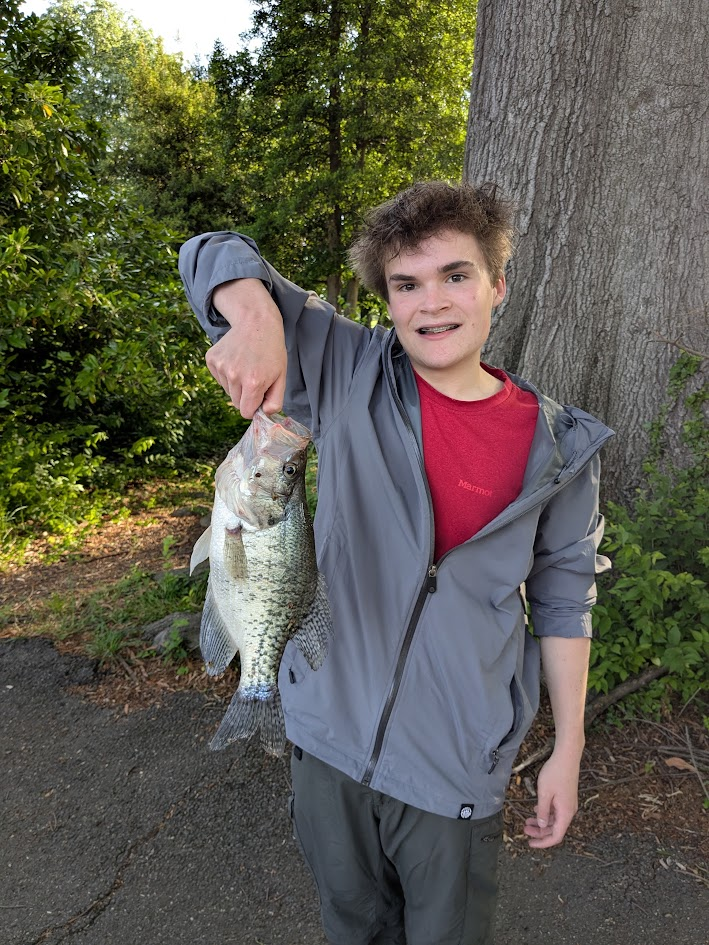 |
Angler Colin Jackson set the new D.C. white crappie record with a 15-inch, 1.9-pound fish caught near the Columbia Island Marina.
Bass fishing has improved in the district, with anglers reporting that fish have moved into areas such as the Tidal Basin and the Washington Channel. Crankbaits are a top lure for fishing these areas and casting them along the seawalls is a good strategy for finding fish willing to bite. Bass can be found throughout the tidal basin, but it is always a good idea to take a few casts near the bridges as these are great ambush locations for predatory fish such as largemouth. Crappie have finished their spawn and are now spread throughout our rivers. These fish are a schooling species and often congregate around structures such as bridges, docks, or fallen trees along the shoreline. Casting small artificial jigs or using minnows under a bobber are two popular ways to catch them. We just had a local angler set a new D.C. record for white crappie. The fish was caught by Colin Jackson in the boat channel near Columbia Island Marina using a crappie jig. Northern snakehead will also be a popular target for anglers now that we are moving into the warmer months. Snakeheads can be found throughout D.C., but the Tidal Basin, the various marinas in the district, and the Anacostia River are hotspots. The Anacostia River from Anacostia Park up to Bladensburg is a great section of river to fish as there are a lot of fallen trees along the banks that snakeheads tend to hangout near. There are also large lily pad fields near Kingman Island that are known to hold snakeheads at high tide. When fishing thick vegetation, or areas with a lot of debris in the water, topwater lures will be more effective than sub-surface lures. Topwater frogs are very popular lures for both bass and snakeheads and can help keep your bait in the strike zone for a longer period of time. Casting the frogs and slowly popping them through vegetation or along shoreline structures is a great tactic. If you get a bite from a snakehead on a topwater lure, do not set the hook right away, instead wait a few seconds, then set the hook. Snakeheads are notorious for short striking lures and not eating them all the way. Waiting a few extra seconds after a bite will help your hook up ratio. As spring is winding down and summer is coming up, it is a great time of year to be on the water in our nation's capital. Get out there and enjoy all the great fishing opportunities right in the heart of our city.
The full set of regulated fishing activities for The District can be found on the Regulated Fishing Activities webpage. To purchase a fishing license, please visit the Get a Fishing License webpage. Fishing licenses are sold on a calendar year basis. Anglers under the age of 16, or age 65 and older are not required to buy a fishing license to fish in The District. Washington D.C. has a Recreational Angling Records Program that allows anglers to check in eligible fish caught in D.C. waters for record fish awards and trophy fish awards. There are 29 different eligible species, and many categories currently have vacancies, so we encourage D.C. anglers to check in their fish. The full set of rules for the records program can be found on the Recreational Angling Records Program webpage. If you would like to submit information for the report, please email dillon.waters@dc.gov. If you would like to submit a photo to be included in the report, please send an email with photo attachments to fishandwildlife.photos@dc.gov. Tight lines everyone! 🎣
Upcoming Events
Anacostia River Reel Invasion Fishing Tournament
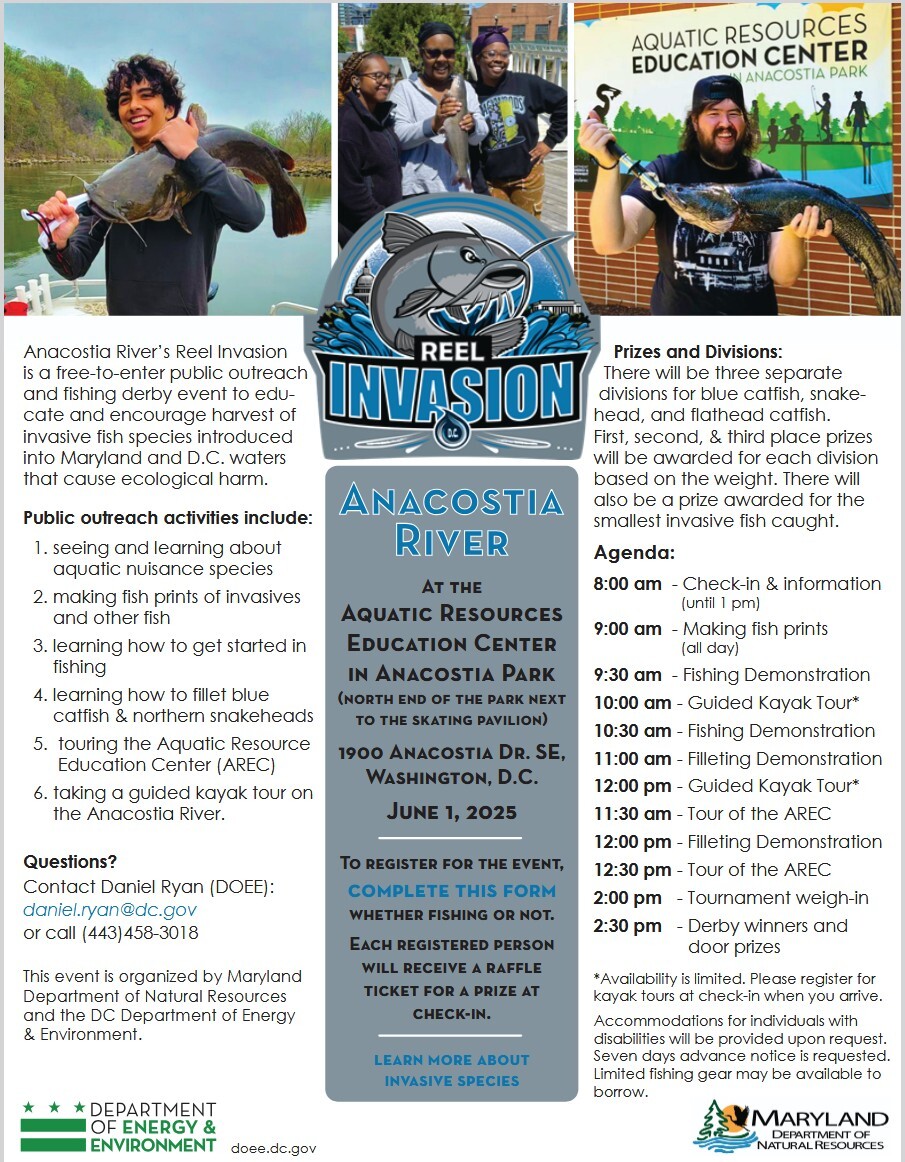 DOEE and Maryland DNR will be hosting an invasive species fishing tournament on Sunday, June 1st, from 8am to 3pm. The event will be held in Anacostia Park at the Aquatic Resources Education Center (AREC), but anglers will be able to fish anywhere in D.C. or Maryland. Qualifying catches must be brought to the AREC for weigh-in by 2pm on the day of the tournament. There will be three divisions for blue catfish, flathead catfish, and northern snakehead. First, second, and third place prizes will be awarded to the three largest fish in each division. There will also be a prize for the smallest invasive fish caught. Biologists from both Maryland and D.C. will be offering several activities, including fishing demonstrations, filleting demonstrations, kayak tours, and much more. Anglers can sign up for the tournament prior to tournament day using this Google Docs form, or in person the day of. We hope to see you there!
Volunteer Angler Creel Survey
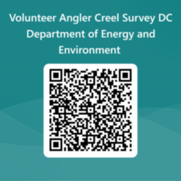
The Department of Energy and Environment’s Fisheries Research Branch is conducting it’s annual creel survey and encourages local anglers to participate. The goal of the survey is to better understand recreational angling efforts, perceptions, and harvests within Washington D.C. The information obtained from the survey will be used to inform fisheries management decisions and regulations. To make it easier for anglers to participate, a QR code has been developed. To access the survey, just scan the QR code using the built-in camera on your mobile device and tap the banner that appears. Already reading this on your phone? Click here. The survey is voluntary, but we encourage anglers to fill out the form after every fishing trip. Good luck fishing and let us know how you do! |
|
 |
|