April 23rd, 2025
Welcome back to the District Fishing Report! Spring has sprung, and it is a great time of year to fish in the district. April has brought us warmer weather, longer days, an abundance of fishing opportunities, and wind. A lot of wind. While a stiff breeze isn’t ideal for fishing, there are plenty of locations to fish from shore that can still be productive on windy days, especially this time of year. Right now is a great time to fish in D.C. as there are several different bites anglers can take advantage of. The most popular angling opportunity at the moment is shad fishing on the upper Potomac River near Fletchers Cove, but catfish, largemouth bass, and snakehead are other popular species to target in the spring. Our anadromous fish have arrived in force with several different species being caught in D.C. waters. As more anglers are hitting the water to take advantage of the numerous fishing opportunities, we want to remind you about the Recreational Angling Records Program. This program gives anglers the opportunity to submit their catches for award certificates. Trophy fish awards are length-based photo-entry awards that can be obtained by submitting a picture of a qualifying fish on a measuring device. District angling record certificates are weight-based, and catches must be verified by a DOEE biologist. Anglers can reach out to fishing license coordinator Dillon Waters at dillon.waters@dc.gov to submit pictures for trophy fish awards or to schedule a time for their catch to be weighed at the Aquatic Resources Education Center located in Anacostia Park at 1900 Anacostia Drive. The full list of eligible species and minimum length and weights for entry can be found on the Recreational Angling Records Program webpage. Now let’s dive into what's biting and where to fish!
Shad season is in peak form and there are large schools of hickory shad being found from Fletcher’s Cove to Chain Bridge. Anglers are reporting a good bite on the river anywhere from a half mile upriver to a half mile downriver from the cove. Drought conditions have been persistent across the region over the past few months, but recent rains have brought some relief and increased flows in the upper Potomac have been a welcomed change of pace. This has improved shad fishing conditions, especially for shoreline anglers as the hicks are moving into shallower depths along the rocky shorelines to get out of the main river current. Deeper pools of slower-moving water and seams in the river are ideal casting locations to look for when shad fishing. Anglers getting out on the river in rental boats from Fletcher’s Boathouse, or on their own watercraft have encountered increasing numbers of American shad this week. The edges of the boulder field just out in the river from Fletcher’s Cove is a good area to target them. American shad prefer deeper water, which is why anglers who fish from a boat typically catch more as they can fish deeper holes in the river. Lures and rigs that have been working well to catch shad include shad darts, marabou jigs, twisty tails, and metal spoons. Many anglers will tandem rig two shad darts about 12 to 18 inches apart when targeting shad. Another common rig that many experienced anglers use is to tie a three-way swivel onto your main line. Once the swivel is tied on, use around 18 to 24 inches of leader to attach a shad dart or jig to one swivel loop and then around 12 inches of leader to attach a heavier shad dart or metal spoon to the other swivel loop. The heavier lure will help get your rig down in the water column and the lighter lure with a longer leader will swim more freely in the current above the bottom lure. Slow and steady retrieves work well to entice bites. Popular colors for lures include white, pink, chartreuse, silver, and gold. Don’t hesitate to change colors or lure sizes when fishing, as shad can prefer different colors and lures depending on the day. It is best to have a variety of options in your tackle box. The shad bite should remain good for the next few weeks, but the best action is happening right now, so don’t miss out. We had a report from a fly angler who landed close to 30 hickory shad while fishing in front of Fletcher’s last weekend. Another group of shoreline anglers said they caught over 100 shad among three anglers in a few hours of fishing upriver from Fletcher’s. A kayak angler fishing last week said he caught one of the biggest American shad he has ever seen. Though he didn’t put in on tape or weigh it, he estimated the fish to be around five pounds. American shad are bigger on average than hickory shad, but that is definitely a big one. If you haven’t already signed up, the Friends of Fletcher’s Cove Shad Report is an excellent resource put out by Mark Binstead documenting the highlights and recent reports during shad season. Mark gives an excellent in-depth view of what the patterns have been.
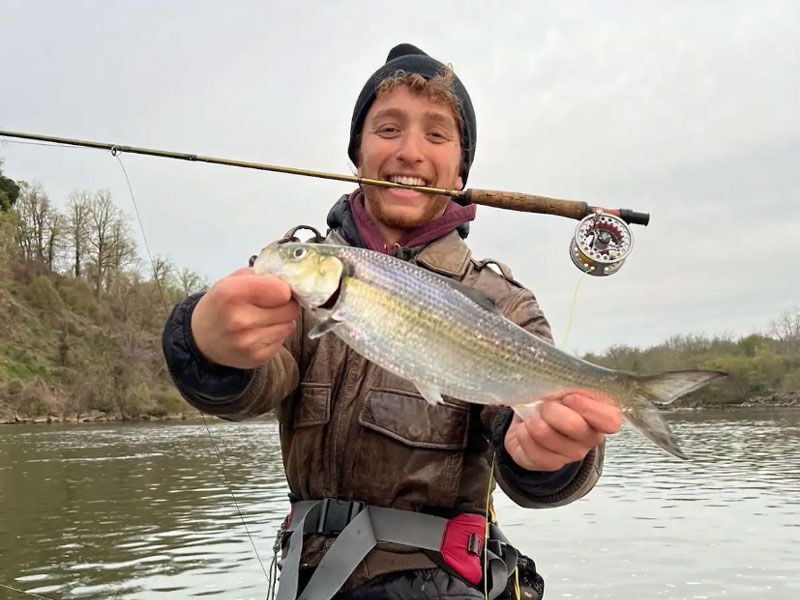 |
Ethan enjoyed a hot bite for hickory shad while fly fishing near Fletcher’s Cove.
Another hot bite around the district has been for catfish. Both blue catfish and flathead catfish are abundant in the upper Potomac River from the Georgetown waterfront up to Chain Bridge. This section of river is a hotspot for both species as they are following the schools of shad, herring, and perch that have migrated into the area. Captain Owen Koch from Capital Blues Fishing Charters checked in and says that at the beginning of this month he noticed a strong correlation between the drop in river current volume and the number of big blue catfish caught. In March, blue catfish over 30 pounds were common, but now, fish over 20 pounds are harder to come by when the river current drops below 5500 cubic feet per second. Owen experimented with different baits but saw little to no difference. The exception to this rule is that the flathead bite has remained good. His clients have had success jigging for them in the area of Fletcher’s Cove. One recent catch was more memorable than the others though. One of Owens’ clients, Atticus Khaira, was casting for shad using an ultralight spinning rod with six-pound monofilament line and hooked into a 22-pound flathead. A thirty-minute battle ensued that tested both the angler and guide alike, with multiple long runs and lots of maneuvering to keep the fish out of rocks and other obstacles. Ultimately, the “world record shad” was no match for Atticus, whose patience and skill paid off despite overwhelming odds. River flows have bumped slightly in the past few weeks thanks to a few weather systems moving through the area. A good resource to check the current river conditions on the upper Potomac near Chain Bridge is to use the USGS flow gauge at Little Falls. It shows real-time water data including river height, discharge, temperature, and many other environmental factors. Flathead catfish are becoming more abundant in this section of the river and seem to be growing bigger every year. Vertical jigging has become a popular method to catch them. This method of fishing works best when fishing from a boat or kayak in the river because you can keep your line vertical in the water column. If you try to use this method from shore, you will likely get snagged on the bottom. A good fishing rod setup for this style of fishing is a seven-foot medium heavy rod with a 5000 series spinning reel rigged with 50-pound braided line. Fluorocarbon leader is also recommended when jigging in the river because of the abrasion resistance it offers when fishing along rocky bottom with lots of snags. Of course, this is just one option. Anglers can fish with lighter or heavier setups, but this is a good starting point. Lures that work well are lead jigheads paired with five-to-nine-inch soft plastic straight tails or curly tail lures. Jighead weights that work well are usually two to four ounces depending on how fast the river current is moving. To effectively jig, drop your lure down to the bottom and “jig” or lift it up off the bottom, then let it drop back down. Repeat this over and over again, making sure to keep your line vertical. The further away your lure gets, the easier it is to get snagged. Anglers can catch a variety of fish using this method, including flathead catfish, blue catfish, striped bass, walleye, and many more. Angler Adam Greenberg has fished the Fletcher’s area a few times this month and has caught some very big flathead catfish. Including one that measured an impressive 38 inches. Adam says that adding fish attractant to his lures made a noticeable difference to get bites when jigging. Downriver from the Fletcher’s area, catfish are being caught well throughout the river. A few land-based locations where anglers are reporting success include Hains Point, Diamond Teague Park, and Anacostia Park. We are seeing blue catfish move into shallower water as water temperatures are rising, and the bite should continue to improve with the milder spring weather. We want to remind anglers that both blue catfish and flathead catfish are invasive to D.C. waters, and we recommend anglers remove them from the water if caught. The D.C. fish consumption advisory offers recommended guidelines for which fish and how much to eat out of our waters.
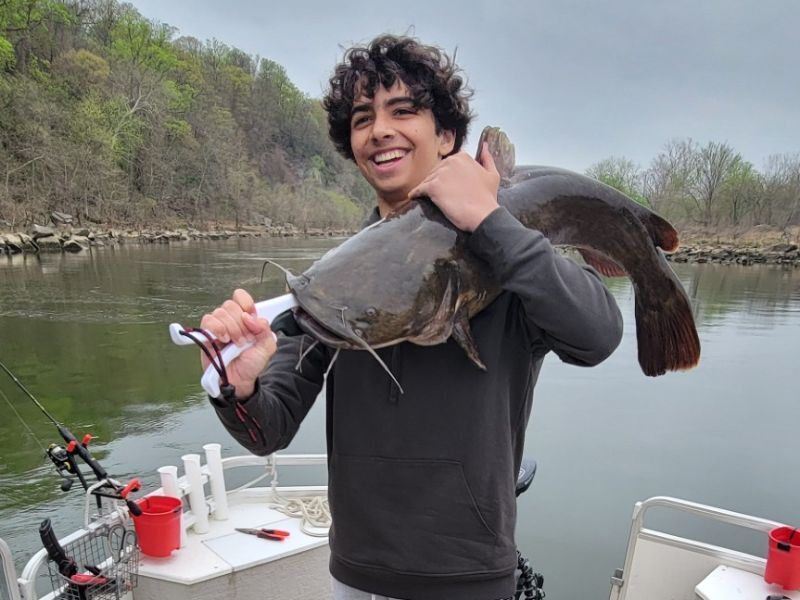 |
Atticus had quite the battle with a big flathead catfish when he hooked it while shad fishing.
Largemouth bass anglers have been enjoying the pre-spawn bite on the Potomac River in recent weeks. A cold start to the month of April delayed the bite, but now the fish have moved into the shallows and are actively feeding on the abundance of baitfish in the area. The Tidal Basin has been a hotspot recently and anglers have been catching fish between one and five pounds on a variety of lures. Bass and other predatory fish will be holding close to the sea wall where they can ambush baitfish. They can also be found near the bridges surrounding the basin and the inlets and outlets controlling water into the basin. Crankbaits are reportedly working best, and they are a great lure to cover a lot of water by casting them along the seawalls. They will bounce off the rocky bottom and entice bites from nearby predatory fish. Other lures also working well include football jigs, suspending crankbaits, and spinnerbaits. Throughout the year, largemouth bass can be found in and around the various marinas in the district, such as the ones in the Washington Channel, on the Anacostia River, and in Pentagon Lagoon. Northern snakehead also frequent these waters and can be caught on the same lures as bass. By this time of year, we are starting to see submerged aquatic vegetation and spatterdock fields emerge. Snakeheads are ambush predators and will often be found in these areas with vegetation and along shorelines with a lot of debris. The Anacostia River is a prime location to fish for snakehead in D.C., especially the waters around Kingman Island. Northern snakeheads are also an invasive species, and we encourage anglers to remove them from the water if caught. Another species that is in pre-spawn mode an actively biting in our waters is crappie. They are being caught in the Tidal Basin, around the various local marinas, in Oxon Cove, and around the Navy Yard. Crappie are a schooling fish and if you can locate one, there are likely others nearby. Small jigheads of an ounce or less paired with small soft plastic panfish jigs work very well for crappie and other panfish. During the pre-spawn period, warmer weather will usually trigger the crappie to use main river channels where they will then move into shallow areas and creek mouths or coves. If we get a shot of colder weather, this will usually make them move to structure in slightly deeper water until the warm weather returns. Last week, we had a report from an angler who was fishing from a boat using spider rigs, which consist of rod holders that allow you to fish several rods at once, who said that the crappie and bass were biting well in Oxon Cove. They put several keeper crappie in the cooler using live minnows as bait. Another local angler reports that the crappie are biting very well at night in the Tidal Basin and near bridge pilings. The bite will remain good for the next few weeks through their spawn. After these fish are done spawning, they will spread throughout the Potomac and Anacostia rivers for the summer.
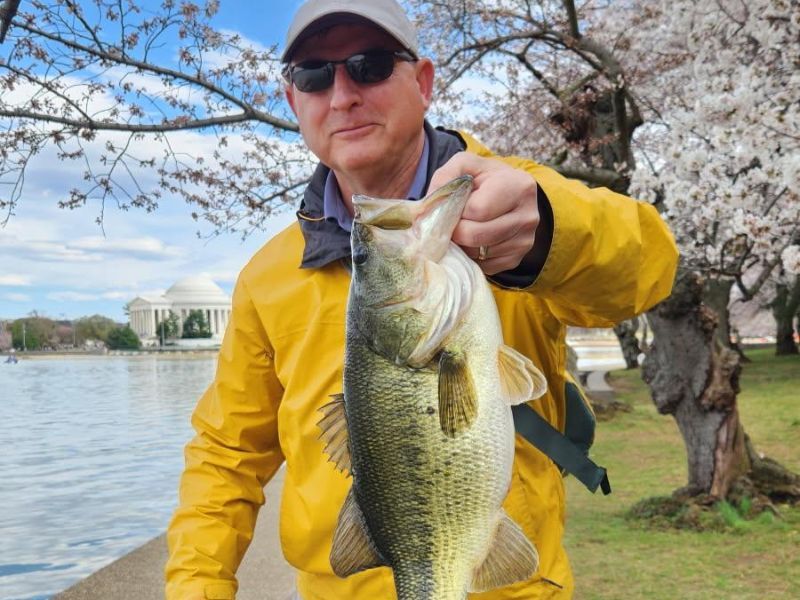 |
Paul Parfomak caught some nice largemouth bass at the Tidal Basin while the cherry blossoms were in bloom.
While there have been several great fishing opportunities to enjoy this spring, we want to remind anglers to fish responsibly while out on the water by following the D.C. fishing regulations. The regulated fishing activities include information on general fishing regulations, gear restrictions, and species-specific creel limits for fishing in the district. The Metropolitan Police Departments Environmental Crime Unit has been working in conjunction with Harbor Patrol to enforce our fisheries regulations this spring. They will continue to conduct enforcement patrols throughout the Potomac and Anacostia rivers to ensure that anglers are following our fisheries regulations. During their patrols so far this spring, officers have issued citations for fishing without a license, using illegal gear, including cast nets and sein nets, and possessing prohibited species. When officers encounter anglers using illegal gear to catch fish in the river, they will confiscate the gear. Our fisheries regulations are set in place to ensure we have a sustainable fishery for the future, and we encourage all anglers to read and follow these laws. If you would like to buy a fishing license, please visit the Get a Fishing License webpage. Fishing licenses are sold on a calendar year basis. Anglers under the age of 16, or age 65 and older are not required to buy a fishing license to fish in The District. Washington D.C. has a Recreational Angling Records Program that allows anglers to check in eligible fish caught in D.C. waters for record fish awards and trophy fish awards. There are 29 different eligible species, and many categories currently have vacancies, so we encourage D.C. anglers to check in their fish. The full set of rules for the records program can be found on the Recreational Angling Records Program webpage. If you would like to submit information for the report, please email dillon.waters@dc.gov. If you would like to submit a photo to be included in the report, please send an email with photo attachments to fishandwildlife.photos@dc.gov. Tight lines everyone! 🎣
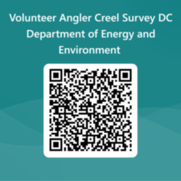
Volunteer Angler Creel Survey
The Department of Energy and Environment’s Fisheries Research Branch is conducting it’s annual creel survey and encourages local anglers to participate. The goal of the survey is to better understand recreational angling efforts, perceptions, and harvests within Washington D.C. The information obtained from the survey will be used to inform fisheries management decisions and regulations. To make it easier for anglers to participate, a QR code has been developed. To access the survey, just scan the QR code using the built-in camera on your mobile device and tap the banner that appears. Already reading this on your phone? Click here. The survey is voluntary, but we encourage anglers to fill out the form after every fishing trip. Good luck fishing and let us know how you do! |
|
 |
|