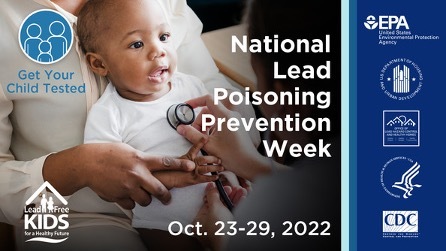
 Each year, National Lead Poisoning Prevention Week (NLPPW) is a call to bring together individuals, organizations, industry, and state, tribal, and local governments to increase lead poisoning prevention awareness in an effort to reduce childhood exposure to lead. NLPPW brings awareness to ways parents can reduce children’s exposure to lead in their environment and prevent its serious health effects. Mark your calendars for next year’s NLPPW, October 22-28, 2023.
DOEE kicked off NLPPW with a Mayoral Proclamation, proclaiming October 23 – 29, 2022 as Washington DC’s Lead Poisoning Prevention Week. In addition, the Lead-Safe and Healthy Housing Division (LSSHD) participated in a few exciting events.
Community Health Workers Learn about Lead and Maternal and Child Health
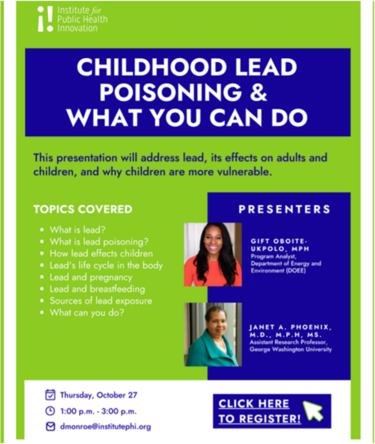
LSHHD collaborated with the Institute for Public Health Innovation, George Washington University, and Mamatoto Village to provide continuing education credits to community health workers. The presentation was conducted by Gift Oboite-Ukpolo and Dr. Janet Phoenix. They presented “Childhood Lead Poisoning, The Lifecycle of Lead in the Body, and Lead on Maternal Health.” Email gift.oboite@dc.gov for a recording of the presentation.
 “Don’t Get Tricked by Lead, Treat Yourself to a Healthy Home”
LSHHD hosted a resource table at DC’s Department of Parks and Recreation’s event POP-UP PUMPKIN PATCH & RESOURCE FAIR at King-Greenleaf Recreation Center Field. They handed out reusable bags filled with goodies and helpful information for families on lead poisoning prevention. They also brought their fun game wheel so attendees could win extra prizes!
 Housing Expo Demonstrations
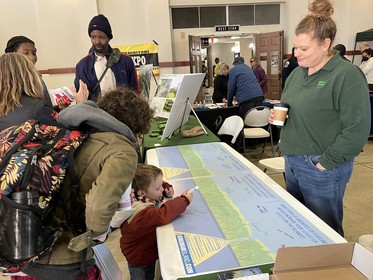
The Capitol Hill Restoration Society held its annual House Expo where experts in the field of home rennovation, real estate, property management, insurance, finance, and other district agencies came together to provide information to residents about safe home rennovations and other home-related topics. The Lead-Safe and Healthy Housing Division provided demonstrations and tips on reducing the spread of lead hazards in the home. LSHHD also discussed how to renovate right.
 Additionally, the CDC, EPA, and the National Center for Healthy Housing hosted webinars and other events to celebrate National Lead Poisoning Prevention Week. Below are some of them.
Understanding Lead
The EPA hosted a webinar where they discussed potential sources of lead exposure, its health effects, simple actions to reduce lead exposure, and the importance of testing children’s blood lead levels. Click here for slides from the presentation.
CDC and HRSA Partner for Childhood Lead Poisoning Prevention: Guidance for Clinicians
In partnership with the Health Resources and Services Administration (HRSA), CDC subject matter experts provided up-to-date information about preventing exposure to lead, testing, and medical management of children with lead poisoning. Click here for more information.
#NLPPWchat
The National Healthy Housing Center (NCHH) hosted a National Lead Poisoning Prevention Week-themed Twitter chat (#NLPPWchat) to exchange ideas, spread awareness, and take action on lead poisoning prevention and response policies.
Renovation, Repair and Painting (RRP) Rule Awareness: Learn about EPA’s RRP Rule
This presentation for contractors and local building code and enforcement officials about EPA's Renovation, Repair and Painting rule.
All Children can be Exposed to Lead: CDC’s Efforts to Promote Awareness and Testing
CDC subject matter experts discussed the many ways children can be exposed to lead and share tangible ways families can protect children from the harmful effects of lead exposure. Click here for information about the presenters.
DOEE’S LEAD-SAFE AND HEALTHY HOUSING DIVISION IS GEARING UP TO RECOGNIZE SAFE TOYS AND GIFTS AWARENESS MONTH IN DECEMBER!
December is one of the biggest gift-giving months of the year, so Prevent Blindness America has declared December as Safe Toys and Gifts Awareness Month. The group encourages everyone to consider if the toys they wish to give suits the age and individual skills and abilities of the child who will receive it, especially for infants and children under age three.
The Lead-Safe and Healthy Housing Division will be observing Safe Toys and Gifts Awareness Month by spreading the word about common items that are known to contain lead, and recalled toys. Additionally, LSHHD will be hosting two events to display toys known to contain lead. Follow DOEE’s twitter page for tips and safety information about toys and gifts and to stay on top of the upcoming events. Want to get involved? Reach out to Gift Oboite-Ukpolo at 202-308-4263 or at gift.oboite@dc.gov.
This holiday season (and beyond), the makers of Safe Toys and Gifts month (Prevent Blindness America) asks everyone to consider the following guidelines for choosing safe toys for all ages:
- Inspect all toys before purchasing. Avoid those that include parts that fly off. The toy should have no sharp edges or points and should be sturdy enough to withstand impact without breaking, being crushed, or being pulled apart easily.
- When purchasing toys for young children try to: choose toys that may appeal to different senses such as sound, movement, and texture; consider interactive toys to allow the child to play with others; and think about the size of the toy and the position a child would need to be in to play with it.
- Be diligent about inspecting toys your child has received. Check them for age, skill level, and developmental appropriateness before allowing them to be played with.
- Look for labels that assure you the toys have passed a safety inspection – “ATSM” means the toy has met the American Society for Testing and Materials ASTM is an international standards organization that develops and publishes voluntary consensus technical standards for a wide range of materials, products, systems, and services.
- Gifts of sports equipment should always be accompanied by protective gear (give a helmet with the skateboard).
- Keep kids safe from lead in toys by: Educating yourself about lead exposure from toys, symptoms of lead poisoning, and what kinds of toys have been recalled; being aware that old toys may be more likely to contain lead in the paint; having your children wash their hands frequently and calling your doctor if you suspect your child has been exposed to lead.
- Do NOT give toys with small parts (including magnets and “button” batteries which can cause serious injury or death if ingested) to young children as they tend to put things in their mouths, increasing the risk of choking. If the piece can fit inside a toilet paper roll, it is not appropriate for kids under age three.
- Do NOT give toys with ropes and cords or heating elements.
- Do NOT give crayons and markers unless they are labeled “nontoxic.”
LEAD-FREE BY 2030 (Date Correction from September 2022 Issue) • DC Water estimates that the District of Columbia has more than 28,000 water service lines with lead or galvanized-iron pipe. It’s DC’s goal to replace all of them with copper by 2030. The District will now pay for 50-100% of lead pipe replacement if your home has an owner-side lead service line, and 100% of the cost if the replacement is done during general water line improvement projects. Read the FAQ about this program here, and you can apply for a private-side replacement through DOEE by going here or emailing leadline.replacement@dc.gov.
|
CUSTOMERS CAN GET A FREE LEAD TEST • DC Water offers annual free lead testing for residential and commercial customers. Lead test kits are mailed to customer households and residents are responsible for collecting water samples. The kit includes two sample bottles, detailed sampling instructions, and information and a questionnaire about plumbing materials. These water samples provide a snapshot of the water quality in your pipes at the moment of collection, which can indicate potential sources of lead such as household plumbing, fixtures, and service pipes. In other words, the results from these lead test kits are used to determine the existence (or presence) of a lead source in the service line or plumbing. Request a free lead test kit.
|
DC HEALTHY HOUSING COLLABORATIVE LAUNCHES NEW WEBSITE! • DC Healthy Housing Collaborative (DCHHC) is a coalition of many organizations working together to improve the health of District of Columbia residents by making sure their homes are safe and free of harmful exposures such as pest, mold, and lead.
This year DCHHC has launched a new website to serve as a one-stop-shop for education on how to maintain a healthy home and resources that can help promote home health.
MILLERKNOLL RECALLS DESK AND STORAGE UNITS DUE TO LEAD POISONING HAZARD
Eames Desk Units and Eames Storage Units have been recalled by retailer Herman Miller. These products are being recalled because surface paint on the tan side panels of the desks and storage units contains levels of lead that exceed the federal lead paint ban, posing a lead poisoning hazard.
The surface paint on the tan side panels of the desks and storage units contains levels of lead that exceed the federal lead paint ban, posing a lead poisoning hazard. Lead is toxic if ingested by young children and can cause adverse health effects.
The desks and storage units were sold at Herman Miller and Design Within Reach stores nationwide and online at store.hermanmiller.com, dwr.com and other websites from October 2020 through March 2022 for between $800 and $4,000. More information about this recall including specific models being recalled is available on the CPSC’s website.
In addition, CDC’s Childhood Lead Poisoning Prevention Program encourage health care providers to:
- Raise awareness among parents about these products.
- Encourage parents to stop using these items and contact MillerKnoll for either a full refund and free pickup of the desks and storage units or to receive a free repair kit that includes a replacement panel requiring a screwdriver and a needle nose plier for consumers to install. Additionally, MillerKnoll is contacting all purchasers directly.
- Considertesting children for lead exposure from these and other sources.
JUVO PLUS RECALLS CHILDREN’S BUTTERFLY NET SETS AND ARMY ACTION FIGURE PLAYSETS DUE TO PTHALATES AND LEAD POISONING HAZARDS
 The company Juvo Plus recalled their Children’s Butterfly Net Sets and Army Action Figure Playsets because they contain levels of certain phthalates and lead that exceed the federal phthalate and lead content standards, posing a health hazard.
The butterfly net sets were sold online at Amazon.com, eBay.com, Facebook.com, Kroger.com, Overstock.com, Target.com, Walmart.com and Wish.com from September 2017 through June 2022 for about $10. The Action Figure playsets were sold online at Amazon.com, Bluepanda.co, eBay.com, Facebook.com, Groupon.com, Kroger.com, Overstock.com, Target.com and Walmart.com from February 2018 through June 2022 for about $35. We encourage you to share this information with your colleagues and partners. More information about this recall including specific items being recalled is available on the CPSC’s website.
In addition,CDC’s Childhood Lead Poisoning Prevention Program encourage health care providers to
- Raise awareness among parents about these products.
- Encourage parents to stop using these items and contact Juvo Plus for a full refund of the purchase price. Juvo Plus can be contacted at 833-408-0493 from 8 a.m. to 7 p.m. ET Monday through Friday, by email at figuresandnets@realtimeresults.net, or online at www.recallrtr.com/figuresandnets and click on the Recall link under About Us at the bottom of the page for more information.
- Consider testing children for lead exposure from these and other sources.
KEEP INFORMED ON PRODUCT RECALLS
Subscribe to the US Consumer Product Safety Commission’s email list here, or follow them on Twitter!
|