|

Letter from the director
As someone who has had the opportunity to visit and work alongside industry professionals across Texas, Wyoming, and beyond, I can confidently say Weld County stands apart not just in terms of geology but in its community, innovation and history.
While Texas boasts massive shale plays like the Permian, and Wyoming has long produced from conventional reservoirs, Weld County is the heart of the Denver-Julesburg (DJ) Basin – a geologic gem that has shaped the energy landscape of Colorado for over a century. What makes Weld County truly unique is the blend of world-class resource potential and a community that has grown with, not apart from, energy development. Unlike other regions where oil and gas exists far from towns and infrastructure, here in Weld County, energy is woven into the fabric of our daily lives by supporting jobs, schools, and public services.
Our department is proud to work with local operators who understand this balance. We’ve seen tremendous strides in technology, from horizontal drilling to emissions reduction, that are helping produce energy responsibly, while protecting the land and water we all share.
Weld County’s legacy isn’t just about what’s underground, it’s about the generations who’ve worked above it. We honor that history, while looking ahead to a future where the county continues to lead not just in production but in stewardship, transparency and innovation.
Thank you for being part of that journey.
Brett Cavanagh, Director of the Weld County Oil and Gas Energy Department
|
|
|
By Baker Geist, Weld County Communications Specialist
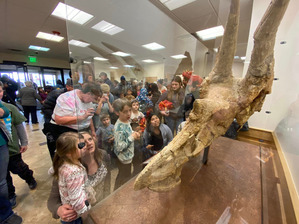
Anyone who is curious as to how Weld County ended up with so much oil and gas can start to find the answer by looking at the Triceratops display in the lobby of the Weld County Administration Building in Greeley. The artwork, depicting the dinosaur in what would become Weld County some 66 million years later, is lush and green and formerly the bottom of the Western Interior Seaway, also called the Niobraran Sea. And where there was ancient marine life millions of years ago, there is likely oil today.
The story of oil and gas in Weld County, however, only starts with ancient sea life. Paleontology — specifically paleobotany — would play a role, as would the drive of early settlers to establish homesteads in the West and, later, the arrival of the railroad.
“Go West Young Man”
In the 1800s, while some early explorers referred to Weld County (then the St. Vrain Territory) as a “Great American Desert,” others, like those who settled on the 70 Ranch near Kersey, were inspired by what they saw when they arrived after the Homestead Act of 1862.
In her book, “The 70 Ranch: Colorado and the West,” author Dana EchoHawk describes settlers arriving to years of significant rainfall and sunlight, which provided confidence that crops would flourish.
And while some came to the West to start a new life founded on farming and ranching, others came chasing fortune from silver and gold. The railroad made its way to Colorado in 1867 and just a few years later (around 1871) coal was mined in the southern part of Weld County — first in Erie then soon after in what would eventually become Frederick, Firestone and Dacono — collectively known as the Carbon Valley.
The search for “black diamond”
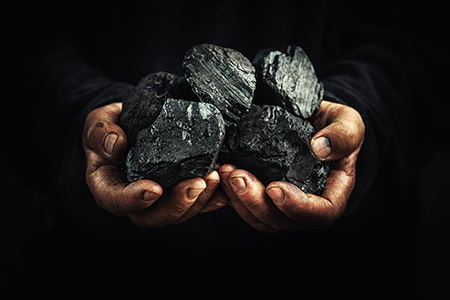
In the early 1900s, the push was on by the U.S. Geological Survey (USGS) to map coal fields in the West. Coal, sometimes referred to as “black diamond” because of its value in powering the country, was crucial for both industry and transportation (trains); it was fervently needed for a growing nation. Enter into this story, the geologists and paleobotanists.
|
F.H. Knowlton, a paleobotanist, wrote a paper in 1922 about “The Laramie Flora of the Denver Basin.” His study of plants found in the Laramie Strata (a common geological formation in northern Colorado housing fossils including Weld County’s own “Pops the Triceratops”) was part of the USGS research to map out coal resources in the country. By studying and understanding the ancient plant and sea life found in the Earth’s layers, the hope was to discover more coal beds throughout Colorado’s Front Range.
But coal wasn’t the only thing that was found deep beneath the Earth’s surface in northern Colorado. The discovery of oil in Wellington (Larimer County) in 1923 kick-started a boom in the area to search for more oil.
With support from state geologist RD George and the Greeley Chamber of Commerce, geologist Charles S. Lavington was tasked in 1923 with researching oil possibilities in Weld County. He started by evaluating the Greasewood Field — near what is today the intersection of Weld County Road (WCR) 97 and WCR 68. In his report, Lavington noted that while it was likely oil was present, the drilling depth needed to reach the oil — 6,800 to 7,000 feet — would make any effort to extract it difficult, if not impossible.
Undeterred, George sent more geologists to the area to map and examine the area. As work continued, interest grew, likely generated from a press bulletin advertising the location of the Greasewood Field.
The Platte Valley Petroleum Company, which Lavington noted was “financed largely around Chicago,” worked in the field from 1926 to the morning of Oct. 10, 1930, when oil started flowing — first at 184 barrels daily, then 300 barrels a day.
A basin, a field, and a bright future for Weld County
Almost every story about Weld County’s oil and gas supply can be credited to one location — the Denver-Julesburg (DJ) Basin. Encompassing more than 70,000 square miles, the basin extends into Colorado, as well as parts of Wyoming, Nebraska and Kansas.
|
In Weld County, an important part of the basin is the Wattenberg Field. While the year of its exact discovery is debated — some say 1967, others 1970 — its impact on production is significant. Since 1971, the field has been responsible for the production of 36 million barrels of oil and 164 billion cubic feet of natural gas, according to the American Association of Petroleum Geologists.
Horizontal drilling — used by the industry intermittently since the 1920s — debuted in the DJ Basin in 2009, thanks to an experimental well near Grover known as the Jake Well. This drilling technique ushered in record production, and in 2011, Weld County was credited with producing 75% of the state’s 49.1 million barrels of oil and a year later was on pace to produce nearly 80% of the state’s total.
This state-leading figure is one Weld County has maintained, not just in oil production but also in the production of natural gas. With improved technology and extensive interest by the industry, oil and gas production in Weld County has remained strong and is vital not only to the county’s budget but also to the state’s finances and national security.
|
|
|
Books
Weld County history website
Articles
|
|
|
Q: I’m enjoying this newsletter, but I’m curious what has the oil and gas energy department been up to lately?
A: Great question! This month, the department, along with the Weld County Board of Commissioners, met virtually with the U.S. Department of Energy to discuss concerns about the state’s overregulation of oil and gas.
The department also met with the board in a work session to discuss possible code changes to Chapter 21 Article 5 of the county code. The proposed revisions reflect significant collaboration with industry and other stakeholders, and they aim to improve efficiency while supporting responsible development and community protection. To move revisions forward, they must be considered and approved by the board as part of a three-reading process at future board meetings.
Proposed revisions discussed include:
-
Streamlining the Weld County Oil and Gas Location Assessment process to reduce redundancy and provide more clarity for all parties involved.
-
Eliminating the Location Assessment for Pipeline code to prevent unintended surface encroachments and subsurface conflicts, especially in areas where new development intersects with existing oil and gas infrastructure.
-
Ensuring better consistency with evolving Energy and Carbon Management Commission and State of Colorado standards, keeping Weld County at the forefront of regulatory best practices.
-
Supporting emergency planning and infrastructure protection by requesting Geographic Information Systems data from our industry partners — both basic and detailed (secured) pipeline data to allow for better coordination, safety and land use decisions.
Do you have questions about the energy in Weld County? Reach out to the Weld County Oil and Gas Energy Department.
|
|
|
|
|