It happens every week: a pivotal meeting to decide how an offender will be reintegrated into society.
Weld County Justice Services Director, Doug Erler, sets the scene — telling of the nine-member Weld County Community Corrections Board (CCB) sitting around a table flipping through referral packets from the Colorado Department of Corrections while discussing an individual’s criminal history.
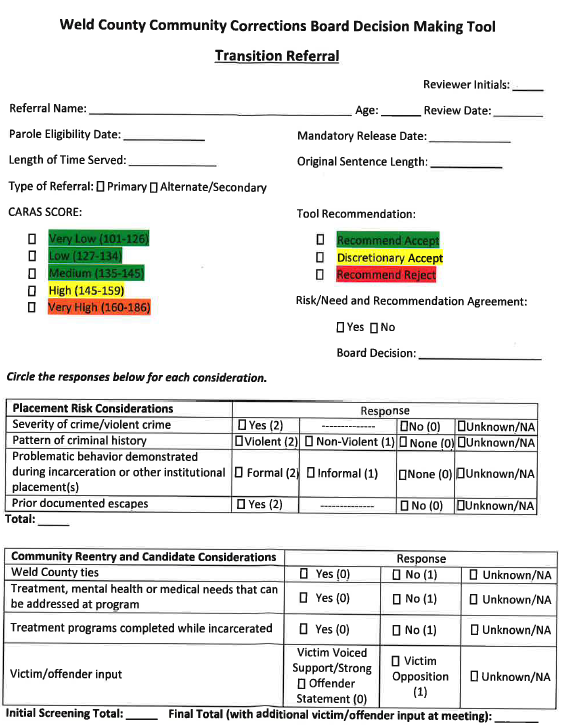
One page in this packet, titled the Structured Decision Making (SDM) tool, makes everyone take notice. For good reason, the information on it plays a huge part in helping the CCB decide which offenders, who have committed drug-related, property or theft crimes, can safely be placed into Weld County’s community corrections program via two paths: An individual may be referred to the CCB as a “transition case” where they are continuing to serve a prison sentence and are now being considered to step-down into the community prior to traditional parole supervision; or an individual may be referred by a District Court as a “diversion case,” an alternative to a prison sentence.
“The Structured Decision Making tool has a big impact in helping to decide who may be successful in the community corrections program,” Erler said. “While in the program, they receive educational and financial skills, along with life skills and counseling resources. They also have the opportunity for gainful employment to help with their overall reintegration into society.”
According to Kyle Ward, the University of Northern Colorado’s (UNC) Associate Professor of Criminal Justice and creator of the SDM tool, 75% of people successfully transition in and out of Weld County’s community corrections program thanks to this tool. Before, only 50% did. Ward is proud of that 75% rate, but he’s even more proud of the weight the tool holds as a starting point for the CCB and intervention program.
The SDM tool, which debuted in 2018, following the passage of House Bill 18-251, seeks to provide the clearest data possible to help the CCB make its decision — eliminating the possibility of inherent bias or individual feelings alone from being a deciding factor. The recommendations of a CCB member can now be weighed against statistical data, providing a more thorough look at an individual’s history, allowing the CCB to make a decision that increases the odds of someone successfully completing the program.
“The ability to look at a variety of factors when making a recommendation for placement in the community corrections program has been a big benefit both to our board and to the individuals being considered for placement,” Erler said. “The background and expertise of our members, who represent our community and the criminal justice system, combined with a complete view of data thanks to the SDM tool, makes the likelihood of an individual’s successful community corrections intervention stronger.”
A main reason for the SDM tool’s 75% success rate can be difficult to pinpoint as it’s not that different from ones used by other counties, according to Ward. Perhaps the success was in the tool’s implementation, an effort led by Ward, who spent a lot of time developing a baseline for Weld County to use. Beyond examining other tools, he attended 20 Weld County CCB screening meetings to get a feel for why the board approved or denied an individual for placement. He analyzed recurring topics and interviewed CCB members about what sways a vote — such as testimony from victims at meetings and ties of referred individuals to the Weld County community. After observing and talking with the CCB, Ward created a SDM tool for Weld County to better capture an individual’s criminal history in one place.
|