|
By Baker Geist, Communications Specialist |
|
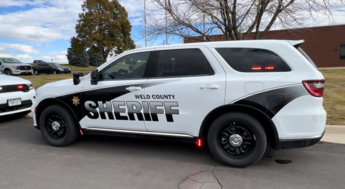
In seven and a half years as the director of Weld County Fleet Services, David Springer knew there had to be a quicker, more efficient way to transform regular vehicles into ones built for use by the Weld County Sheriff’s Office.
Following the COVID-19 pandemic in 2020, he knew it was time to turn ideas into action.
“The supply chain problems were magnified to a point where we were sometimes waiting on a vendor to upfit a vehicle for 15, 16, sometimes 18 months,” Springer said. “When I was unable to fulfill the needs of our Sheriff’s Office, I began talking to the commissioners about a new process.”
Supply chain issues — something affecting consumers and the auto industry nationwide during the pandemic — weren’t the only problem facing Weld County. The inconsistency of vendors to upfit vehicles correctly or to the standard needed for the Sheriff’s Office was a bigger concern. Upfitting means modifying a vehicle for a specific purpose, such as converting a consumer SUV or sedan to one equipped with a cage, lights, sirens, wiring harness, space for a K-9, electronics and other features the Sheriff’s Office needs.
At the time Springer was talking to the board of commissioners about his idea to alleviate the problem, Weld County Undersheriff Donnie Patch was also encouraging Springer with a request that matched his vision: bring the upfitting process in-house and have the work performed by Fleet Services.
We just had a ‘We need to do it ourselves’ kind of conversation,” Patch said. “(The vendors) were just taking too much time.”
To the Sheriff’s Office, vendor delays result in using a vehicle well beyond its target mileage of 100,000 to 125,000 miles. This places greater demand on vehicles used in a variety of high-stress situations, like high-speed chases, that make them more susceptible to wear and tear. Patch and Springer agree this means more time and taxpayer money spent on replacing parts while waiting for the upfitting process to be completed.
Moving the upfitting process into Fleet Services did have growing pains. Space was a concern, but that was eliminated by utilizing an old car wash bay. Four employees — each with their own skills in upfitting — were added to Fleet Services’ staff. There were steps taken to become familiar with the needs of the Sheriff’s Office and some learn-as-you-go moments. Still, these challenges were minor, considering what the in-house move brought to Fleet Services and the Sheriff’s Office.
“It just gives more control over the end product,” Springer said.
With greater control comes many benefits, including less time waiting for parts. Vendors typically don’t order parts until a car arrives, but because Fleet Services is familiar with Sheriff’s Office vehicles, parts can be ordered in advance, allowing work to begin immediately once a vehicle is received.
|
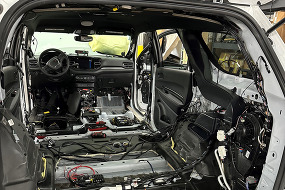
The close proximity of Fleet Services to the Sheriff’s Office means that if a modification is needed, the issue can be addressed quickly, versus sometimes a 40-mile, or longer, trip to a vendor.
The above benefits speak to the managerial side of the upfitting process, but a lot can be said of the talent and expertise that can be seen in the transformation of a patrol car and in the excitement of technicians making it happen.
“Just being able to turn a vehicle around quickly (is rewarding),” Fleet Services technician Robert Abbas said, smiling.
The excitement for technician Harper Ward, who worked at a dealership prior to joining Fleet Services, comes from seeing what he worked on serve the community.
“We know the numbers (of the vehicles), so you can see one and say, ‘That’s mine. I did that!’ It’s very fulfilling,” he said.
But most exciting to both Springer and Patch is the end result of the relatively new effort, which began in the middle of 2023. The 18-month vendor wait times are gone. It takes Fleet Services, on average, just a week and a half to upfit a patrol car. So far, Fleet Services has upfitted 35 Sheriff’s Office vehicles, stats that bring a smile to Springer’s face.
|
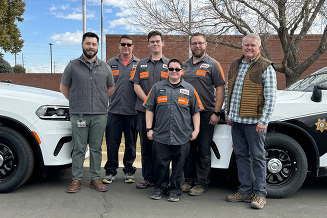
"Seeing this process come to fruition has been great … the work we do assists residents indirectly. Our work, in a way, helps the Sheriff’s Office respond to emergencies,” he said. “Giving departments the tools that help them be successful is of great importance to me as a director and us as a department.”
Patch explained a bigger benefit can be found in what the speedier process means to deputies traveling in safe, reliable vehicles and to the public when help is needed.
“What the public wants when they call 911 is a deputy to show up,” Patch said. “Having our cars ready in a timely fashion and keeping a good, fresh fleet on the road means that we can get to a situation more quickly.”
Less is more
Beyond the management and physical labor required to upfit vehicles, the knowledge of Fleet Services has also played a role. When the Sheriff’s Office received comments suggesting there wasn’t enough lighting on its vehicles compared to ones at other agencies, Springer and his team went to work, examining industry studies on flash patterns and effective lighting.
The discovery? Less is more — knowledge that’s allowed Fleet Services to install the most beneficial flash patterns.
“A certain sequence of lights, a certain flashing pattern … is more visible than a Christmas tree worth of lights,” Patch explained. “Fleet Services went out and did research and figured out the best way to configure those cars, which is really cool.”
The time taken to research an issue further exemplifies the determination Springer and the team have at Fleet Services to do the best job possible — one Sheriff’s Office vehicle at a time.
|
|
|
In mid-2023, Weld County Fleet Services began upfitting vehicles for the Weld County Sheriff’s Office eliminating lengthy vendor delays. |
Thirty-five vehicles have been upfitted to date, taking only a week
and a half,
on average, versus 15 to 18 months from vendors. |
In addition to upfitting for the Sheriff’s Office, Fleet Services provides maintenance on the county’s fleet, which includes more than
800 vehicles. |
|
|
miscellany: a group of or collection of different items.
-
If you live in unincorporated Weld County – we need to hear from you! The Weld County Housing Needs Assessment (HNA) is a required study to inventory existing housing availability in unincorporated Weld County. The HNA combines housing, demographic, resource, and economic data to inform county commissioners about housing policies and trends to ensure county programs, such as the Community Development Block Grant (CDBG), align with the county’s goals. Please visit our Housing Needs Assessment page to learn more and to take our short survey.
- Don't miss the upcoming weather spotter training on Tuesday, April 1, from 6 to 8 p.m. Learn about severe weather common in Weld County during the spring and summer — directly from a meteorologist! The class will be presented in person at the Platteville-Gilcrest Fire Protection District (PGFPD), (200 Main St., Platteville) and virtually as well. For either option, register by March 29 at the PGFPD website or by calling the Weld County Office of Emergency Management at (970) 400-3997.
- In April, Weld County is launching a new energy-focused email newsletter. The Weld County Energy Line will contain informative features that highlight the positive impact that energy has on so many in Weld County. It will also show the work of the county's oil and gas energy department in serving as a conduit between residents and the energy industry. Sign up by visiting the county's newsletter sign-up page, entering an email address and selecting "Weld County Energy Line."
- As the Weld County Board of Commissioners continues to take public feedback about where to build a new judicial center, don't miss an upcoming public meeting on Monday, March 25, from 6 to 8 p.m. at the Weld County Administration Building, located at 1150 O St. in Greeley. Read more about the need for a new judicial center.
|
|
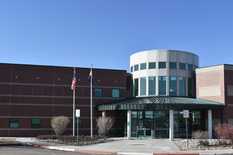
Of all the tools the Weld County Department of Public Health and Environment (WCDPHE) has to aid residents with various health issues, one of the most valuable is information — an overview of the critical health issues affecting Weld County.
Every three years, that information is gathered through a Community Health Survey. In the next edition of County Roots, learn about this survey, the work that goes into creating it and how the information it provides can help lead to positive health outcomes.
|
|
|
|
Welcome to County Roots, the official newsletter of Weld County Government. For those of us who work in county government, we think what we do is pretty interesting. So the goal of this newsletter is to highlight some of the partnerships, technology and efficiencies we are using to make government stronger and more effective for its residents.
Our goal is to establish regular communication with residents, spur interest in county projects, highlight county accomplishments and provide meaningful information to the public. In fact, our goal is to live up to the name “County Roots.” Want to know more about the meaning behind the name? Please visit our webpage, where you can also find previous editions of this newsletter.
|
|
|
|
|