|
By Jennifer Finch, Public Information Officer |
|
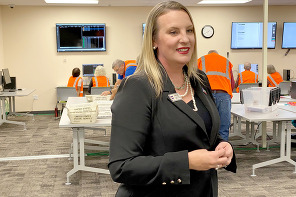
An event in 2020 caused a massive change in our collective American experience - a change we are still navigating; a change that while new to current generations is certainly not new in American history. The event - not a global pandemic but an election. The change - the volume of attention given to social media and those who question election integrity.
And while in many ways, the digital world and social media has brought us closer as a society, it has also pushed groups within our society further apart as it has never been easier for individuals to tune in to only the content they agree with, start a social media voice of their own to blast the content they disagree with, or, as in the case of a lot of people, tune out of the conversation all together.
As I stare at the ballot that sits on my kitchen counter, I decided to reach out to Weld County Clerk and Recorder Carly Koppes for her take on the current state of election security and maintaining public trust.
J: Let’s start with the easy question - what is your job as Weld County’s Clerk and Recorder?
C: As clerk and recorder, my job in elections is to be the designated election official - essentially the chief person running elections here in Weld County. It is my responsibility to have a team of highly educated election officials; to know the ins and outs of our laws, our rules, all of our equipment; to maintain our voter registration rolls to the utmost that we can. Education is a huge piece of it, making sure our voters are educated on when they're going to get their ballot, how can they return it, what are their in-person options if they don't want to cast their mail ballot.
And then, when we get everything ready and prepped and hand it over to our election judges, we make sure our volunteers from the community are properly supported by myself and my team so that we can have a successful election. By the time your ballot is counted, and by the time polls close, we’re then able to have those checks and balances in place. We're doing our daily auditing making sure everything is on the up and up.
Then, after the election, we get all of the ballots ready to go and have our big audit. Finally, we present our case to our canvas board and have them sign off on it. Then we do it all over again - and again, and again, and again.
|
Koppes, who has worked in the Weld County Clerk and Recorder’s Office now for 20 years (the past 10 as the elected Clerk and Recorder) has been part of many elections and has seen and heard many things, but in 2020 she felt a shift she hadn’t experienced before.
J: Social media – stuff just pops up and then takes off like wildfire. Can you talk a little bit about what that's been like here locally, and what that does to your team - how you're constantly fighting an uphill battle at this point?
C: It really has been an uphill battle, even prior to November 4th of 2020. In 2016 - that was really the first election cycle and presidential election – we saw where social media was going be a player in our world. Obviously since 2020, it's become even more so, because it has been very easy for people to have one, two, 20 different handles and spread things like wildfire.
You know one of the things that I kind of have PTSD about is the whole “Sharpie-gate.” It came out of Arizona, but it hit us here in Weld County. Literally, the next day - on November 5th, 2020 - I was getting hit up about Sharpies at our polls and how reports out of Arizona were saying how all these ballots were not being counted correctly, because they [voters] were forced to use Sharpies, and they swear to God that we forced them to use Sharpies here in Weld County, too. That's an interesting conversation to have, because we don't put out Sharpies at our voter-service and polling centers; so no, you didn't actually use a Sharpie here. It's a ballot marking pen - like these were made to make sure that you marked your ballot clearly. There’s a pretty big difference between a Sharpie and a ballot pen.
That was kind of the big start of an ant hill fire that spread within less than 24 hours. It started in Arizona and within 24 hours it was hitting across the nation. It’s just been snowballing ever since.
We have tried and tried to match that same level of reach [on social media], but we haven't been very successful. You know how hard it is to chase down a fire. I have found that I’ve been on a constant repeat of answering the same questions over and over and over again and having the same type of conversations over and over and over again with a lot of different people. Even with some people I would have never guessed that I would have had to have some of these conversations with, because they are very intelligent people. I've been taken aback by the level of people believing these falsehoods – these fallacies – that are not backed by actual correct information or not backed by facts, not backed by people who actually know what they're talking about.
It forces us to be constantly on the defense and not really be able to take an offensive stance – as soon as we’ve blocked them in and completely disproven one thing they've presented to us, they move that goalpost and then they move it again and again. We just never know what's next, because it just keeps evolving. It becomes more and more challenging to dissect their intricate web that they have built.
|
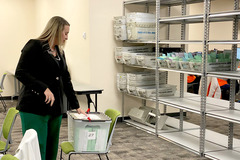
J: A few years ago, I presented at a conference for election officials and learned elections are run differently across the country. I was a little surprised – it just wasn’t something I had thought about before. I mean, you can plop down in just about any city and find the same retail stores, the same restaurants…we are pretty homogenous as a country. Do you think the fact elections are run differently across the country helps fan the flames of mis-, dis-, and mal-information?
C: I've had to learn about Arizona. I've had to learn about Pennsylvania. I've had to learn about Georgia, and other states as well, because I've had to be able to articulate essentially what they do compared to what I do here in Colorado. It has taken a lot of hours to have conversations with my colleagues in those states and understand the uniqueness of their election models and why they do it that way. I mean, you want to talk about one that is absolutely super intriguing – Alaska. There’s actually five people in the state of Alaska that run elections, and they have to work with pilots. They've got to work with ships. One person is going to have potentially 100 to 200 islands that they're going to have to try and get mail ballots to - outside of their mainland portion of voters. I mean, it's just absolutely crazy, but it's understandable why they wouldn't be able to do what Colorado does or what Georgia does.
At the end of the day, the biggest similarity we all have, though, is we're trying to meet the voters where they're at. Your state culture will kind of determine how that goes. As you know, the whole state of Rhode Island fits in our county, right? So that's a completely different system, because they’ve [Rhode Island] only got that small space to worry about. That's just one thing that makes it unique for every single jurisdiction. Your history and your culture of your state - what does your society actually look like? That all factors in to how are you going to best meet your voters. In Colorado, mail ballot has always been the best option for us, because we are so 24-hours, seven days a week now. We have a ton of people commuting all the time, so trying to go back to a one-day small precinct location is just not viable anymore, where in the eastern coast they've got smaller areas to be concerned with, right? You know, it makes more sense to have more in-person voting locations and be more in-person centric than mail ballot centric there. We all have security requirements and transparency requirements, so those main pillars of our elections are all the same [across the country]. How we meet them [voters], is where it gets unique and interesting.
|
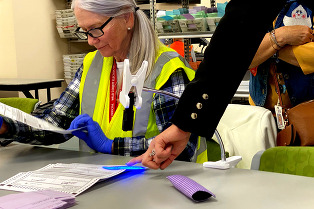
J: Speaking of unique and interesting – let’s tie technology, election information and Weld County together. Talk to me about this new GHOSTmark on Weld County ballots.
C: I have definitely come to be known as somebody who is always interested in pushing the envelope and piloting [projects]. So, we were at a clerks’ conference, and our vendor, who we've had a strong working relationship with for well over 30 years now - they have not just done ballots, but the other portion of their business actually deals with passport stuff and New Zealand currency, so they have that security aspect to them which they've been doing for decades, as well – approached me with a pilot idea. They showed me an example and a white paper they had been working on to come up with this idea of using GHOSTmark to authenticate ballots. They have all this technology. They've been a pioneer in the security aspect because of these other items that have come up since 2020, like misinformation that mail-in paper ballots used bamboo from China and were somehow pre-marked.
When they first presented the GHOSTmark feature to me, it was actually visible to the human eye on the paper. I asked if they could make it not visible to the human eye. Because of the level of intensity I've had to deal with over the last four years, the last thing I want to do is give them [conspirators] something they could spin a web on. So, we took the 2020 presidential ballot layout, and we had them do the GHOSTmark on top of our normal secure paper, and we did a whole bunch of different testing on it. When I say test, we used crayon, we used colored pencil, we used every single color of the rainbow type of pen. We did use a Sharpie. We used our normal ballot pen. I spilled water on it. I spilled coffee on it. I spilled energy drink on it. I mean, when we test – we test. Everything under the sun that we've ever seen or could potentially happen to a ballot in a person's home, we did that to those sample ballots for testing. And then we ran them through our ballot scanners to make sure it didn’t cause an issue with the scanner to be able to read how you voted.
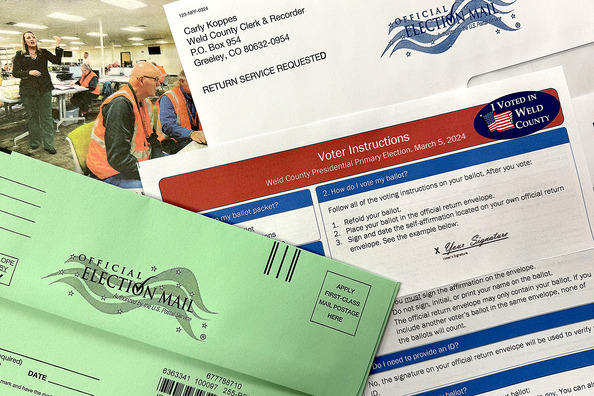
We went through all of that testing - about three rounds to get to a spot where we felt comfortable. Then we moved forward for the coordinated election in 2023. It was an absolute success for us. I can say with 100% certainty the only ballots we counted were official Weld County ballots, because we not only were able to do our normal security checks that are already on the paper, but now we have another way that I can physically show you, if you come in and take a tour. I know that this is our ballot – there isn't somebody in their basement scanning a whole bunch of ballots and then stuffing the boxes with them.
As we wrap up our conversation, Carly mentions her next interview – helping with a documentary film about elections. With a smile, she seems to embrace this other duty that now comes with the job of Clerk and Recorder.
C: It’s just another way to keep getting information out to the public; another way to educate people about elections.
|
|
|
The county's elections website is a great resource for election information including
a video series explaining the ballot counting process. |
March Presidential Primary Election Day
is March 5. Ballots must be returned
by 7 p.m. this day
to be counted. |
Have a question about the process or would like a tour of the center? Contact the Clerk and Recorder’s Office directly, and they will help you. |
|
|
miscellany: a group of or collection of different items.
- Weld County Foster Care presents monthly orientations to provide attendees with details on the foster care certification process. No commitment is required by attending; these orientations are informational, to help interested parties decide if fostering through Weld County would be suitable for them. Two orientations are available in March: March 6 at the Rodarte Center (920 A Street in Greeley), from 11:30 a.m. to 1 p.m.; and March 27 in a virtual format from 4:30 to 6 p.m. For more information and to register for an orientation, please visit https://www.weld.gov/go/fostercare.
-
Weld County’s CSU Extension Office hosts various classes and workshops throughout the year. With spring approaching, it’s the perfect time to think about getting ready to garden. Find more information on the various gardening classes hosted by extension staff from Weld and other counties across Colorado. Find a list of classes at https://www.weldmastergardeners.org/Events-directory.
|
|
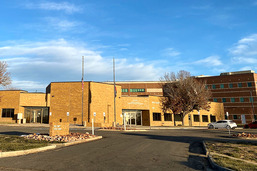
Ten years ago, the Weld County Regional Communications Center was built to house public safety communications and 911 dispatching services in Weld County. In the next issue of County Roots, we’ll explore the benefits of this building and the unique blend of technology and staff inside it that has made the award-winning center consistently one of the best in the nation.
|
|
|
|
Welcome to County Roots, the official newsletter of Weld County Government. For those of us who work in county government, we think what we do is pretty interesting. So the goal of this newsletter is to highlight some of the partnerships, technology and efficiencies we are using to make government stronger and more effective for its residents.
Our goal is to establish regular communication with residents, spur interest in county projects, highlight county accomplishments and provide meaningful information to the public. In fact, our goal is to live up to the name “County Roots.” Want to know more about the meaning behind the name? Please visit our webpage, where you can also find previous editions of this newsletter.
|
|
|
|
|