|
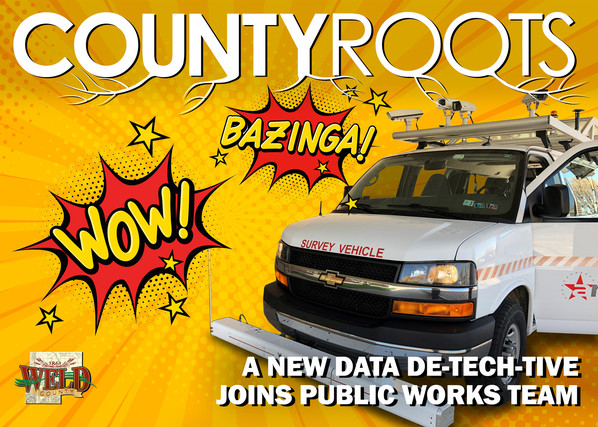
Of the many big vehicles and machines routinely presented at industry-related conferences every year, it was a van in 2012 that made the biggest impression to Josh Holbrook. While the van wasn’t physically unique, Holbrook knew the technology it housed could be a big benefit to the Weld County Department of Public Works and the many taxpayers who travel on the 744 miles of paved roads the county maintains.
“As soon as I became Public Works Pavement Management Supervisor, it was the first thing I wanted to do,” Holbrook said of making the van available for use by Public Works. “There are a lot of other municipalities that use it. It’s new to us, but not to the industry.”
Holbrook’s eagerness upon first seeing the van and eventually securing its use through a contract with AARB Group Inc. (AARB) can only be matched by how excited he is to see how it will help his team complete more thorough paved road inspections — something done every year to ensure safety while also making the county eligible to receive money from the state’s Highway Users Tax Fund. Work done annually by two Public Works employees traveling on every county road grading each as good, fair or poor based on rutting and cracking, can now be enhanced by the data collection van, which can grade the road on several other factors, including ride smoothness and shoulder drainage.
But it’s not only what the van grades that makes it beneficial. There’s also tremendous value in what it sees. Equipped with two front cameras and a profiling camera on the back, the van can capture many images of the road’s surface. When AARB uploads these images to Hawkeye software — its data reporting and analysis component — Public Works can see potential issues below the road’s surface, allowing it to plan repairs before those issues become visible on the roadway, saving drivers headaches and taxpayers money.
“The information will help us plan repairs better by giving us data to fix roads using the most cost-effective measure,” said Curtis Hall, Deputy Director of the Weld County Department of Public Works. “By seeing problems sooner, we can repair the asphalt using chip or slurry seal methods. If we didn’t have this technology, by the time we notice issues, those methods may not work, meaning our only option may be to completely rebuild or repave a road, which is much more expensive.”
There is also freedom in the new technology as the data collection van eliminates the two-month process of employees manually evaluating every paved road in the county, then entering their findings into Public Work’s reporting system before revaluating them later when creating the county’s overlay — or road repair — schedule for the following year. The van is driven by staff from AARB and the evaluations are broken down into different categories before being given to Public Works. Add in the fact that the evaluations are objective rather than subjective and the benefit is even greater.
“My staff has done a great job, but this software is so much more detailed and can pick up every single one of the cracks,” Holbrook said, mentioning how the good, fair or poor grades can be judged differently depending on who is traveling the road under certain conditions. “These results will be more consistent and will save us time, as the employees we ask to drive each road can work on other needed projects.”
While the data collection van and its accompanying technology has many great features, its use is not designed to eliminate human evaluation, but rather to strengthen it as staff will still personally evaluate problem roads identified before they are recommended for future improvements. Holbrook said he plans to seek the Board of Commissioners’ approval to use the van every three years and said personal evaluations will continue but won’t need to involve as much depth.
As with most technology, the van’s features are intended to make a difficult task easier. Public Works has found a way to make technology beneficial to taxpayers and the traveling public as well.
“It’s going to help us evaluate our transportation system and really stretch that county dollar to be used as efficiently as possible,” Holbrook said. “The data will be so detailed, and the better data you have, the better decisions you can make.”
By Baker Geist, Weld County Communications Specialist
|