|
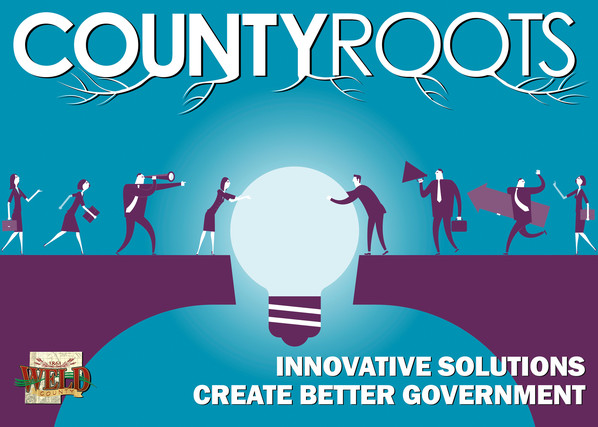
When it comes to solving problems, it’s not atypical of departments across Weld County Government to come up with innovative answers that further create efficiencies or provide exceptional customer service.
“I’ve been with Weld County since 1978, and in this time, the whole idea of finding creative and innovative solutions to problems has been built into our organizational culture,” said Don Warden, Weld County Director of Finance and Administration.
Even before Warden’s tenure, innovation was at the forefront of county decisions.
In 1976, Weld County Government adopted a Home Rule structure, one of only two in the state to do so. The Home Rule Charter gives citizens authority to manage their own government affairs. It defines the structure of government and can only be changed by citizens’ votes. Without Home Rule, the Colorado legislature determines both the form and function of county government. The charter continues to evolve. One example occurred in 2018 with the formation of a Home Rule Charter Committee. The committee, made up of nine Weld County residents, was tasked with reviewing the charter and recommending any needed changes based on review and public input.
Innovation has also occurred following the county’s darker moments. After the 2013 flood, Foreman Ron Graves and engineers from the Department of Public Works had an idea to construct temporary bridges by simplifying the complex strategy of building a permanent bridge. By using gravel instead of concrete for the driving surface, tying I-beams together instead of welding them — except for a few high-stress areas — and utilizing material already in storage to complete the bridge’s structure, the public can continue to access a road when a bridge is being repaired. Rather than dealing with a closed road or lengthy detour, residents can use the temporary bridge with little to no traveling delay. In fact, when the county was replacing the last of 200 load restricted bridges in 2019, a temporary bridge saved travelers from having to take a 23-mile detour.
“Right now, our greatest challenge is to continue to innovate and change the way government has traditionally delivered services,” Warden added. “Weld County has long worked to be a local government that has earned the public’s trust through effective stewardship of resources, improved performance and processes, and results that have a positive effect on the lives of residents.”
Just as we strive to strengthen both government and infrastructure, we also continue to look for better ways to serve residents.
Weld County’s Court Date Notification Program was established in 2016 to improve defendants’ initial appearance rates at court when issued a summons. A Department of Justice Services staff member called every defendant to remind them of their court date. These efforts increased appearance rates and saved taxpayers $50,000 in 2019 alone. Seeing the effectiveness and success of this program, the state justice system is now implementing it as an auto call and text service.
To help an underserved and too often overlooked population in Weld County, Commissioner Barbara Kirkmeyer and Department of Human Services (DHS) Director Jamie Ulrich proposed a bill in 2018 that would allow Colorado counties to spend dedicated foster care money on youth age 18-21, who until then had been “aging out” of the child welfare system and quickly finding themselves on their own and unsupported. The bill was ultimately signed into law by Gov. Hickenlooper, then became officially known as House Bill 18-1319. Now coined Resources for Independence, Success and Employment (RISE), DHS is using the funds to assist youth who have become too old to remain in foster care but still need help to succeed in life. Whether it be offering support to learn life skills, find housing, start college or anything else, Weld County ensures these young people have that first safety net of support, even if they didn’t find a forever family while in foster care.
Sometimes our innovation revolves around finding new ways to protect resources that provide jobs and a strong local economy. Following the passage of Senate Bill 19-181 in 2019, the Board of Commissioners developed the first-of-its-kind Oil and Gas Energy Department (OGED). With the goal of serving residents and the energy industry, the OGED is where industry companies file applications and get more information about 1041 Weld County Oil and Gas Location Assessment (WOGLA) permits, Location Assessment for Pipeline (LAP) permits and more. The permitting process for both LAPs and WOGLAs is overseen by the OGED and Board of Commissioners and ensures the health, safety and welfare of the public and environment, while providing exploration opportunities for the energy industry. The OGED also assists residents who have questions about oil and gas activity in Weld County.
“Balancing the provision of excellent and innovative services with the principles of good stewardship on behalf of citizens is fundamental to the county’s mission,” Warden said. “We are proud of our organization, its history and its accomplishments, and we will continue to adapt, grow and improve.”
By Shaley Dehner, Baker Geist, Megan Garziano, Weld County Communications Specialists
|