|
View as a webpage / Share
|

|
Historical Commission Corner
Boulder’s Star Light, Star Bright
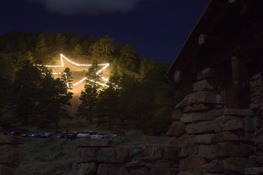
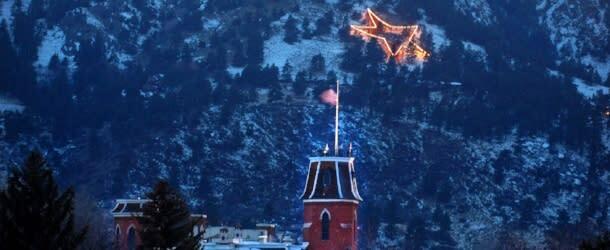
The Boulder Christmas Star on the face of Flagstaff Mountain is among the most impressive outdoor holiday exhibits in the United States. From its inaugural year of 1947 onward, the star, made up of 365 lights, has been a symbol of community for the city and surrounding area.
Sponsored by the Boulder Chamber of Commerce, this religious symbol took on other incarnations over the years. In 1951, rascals from Colorado A&M (now Colorado State University) restrung the lights and wires into the letter A for Aggies. Another guerilla squad from Golden changed the star into an M for the School of Mines. Others in the 1950s painted the bulbs red, leading some to think the act was a communist conspiracy. Then in 1969 it was changed once again, this time into a peace sign in protest of the Vietnam War.
By the 1970s some residents felt the emblem was in violation of the doctrine of separation of church and state and others thought it to be contrary to Boulder’s commitment to energy conservation. So, the city council declared all lighted displays banned. During the 1979-1981 Iranian Hostage Crisis the council relented, and the iconic symbol returned to the mountainside as an homage to the hostages and remained illuminated until their release.
The star is currently lit every year on Veteran’s Day in November staying illuminated until January. For energy conservation, it now uses LED lighting and is powered by wind energy. Area residents look forward to the re-emergence of the venerated symbol each year and welcome the spirit of community it inspires.
|
Historical Commission News
As we near the end of a very busy year, the Historical Commission is working on several projects as 2024 comes to a close.
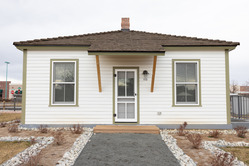
First, the Asti Park Historical Museum (110 W. Maple St.) will be open on Jan. 4 from 10 a.m. to 2 p.m.! Stop by, say hi and check out our historical artifact collections in this newly reconstructed space.
The next is the long-awaited two-part construction of the Miners Memorial in Asti Park.
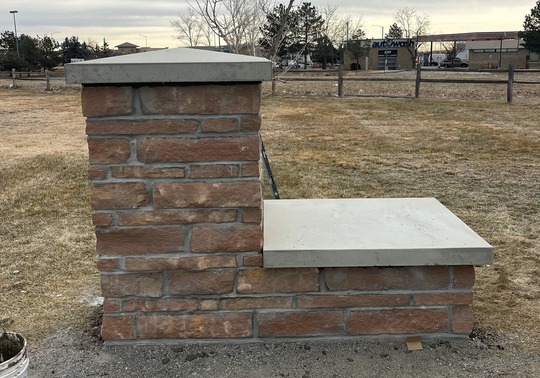
A crew recently finished the stonework, and the next steps are to install plaques listing the names of miners who lost their lives in the Superior area coal mines. At this time, we are working with eighteen names that will be featured on the monument. Once this is accomplished, part two of the project will be commissioning an artist to create a bronze statue of a miner to stand upon the stonework base.
Hopefully, this will be completed in 2025. Mining was a dangerous occupation, and this monument will preserve the memory of those who perished in that perilous environment.
|
Did you know that:
-
Superior’s Industrial Mine produced nearly four million tons of coal during its years of operation, 1895-1945?
-
The New Crown Mine was located approximately where the Louisville Home Depot is today?
-
The town of Haswell, CO, has the smallest jail in the United States? The concrete structure measures only ten feet by ten feet and, since the key has long been lost, has not been in use for quite some time.
- The popular explanation for the naming of the town is that the railroad mapmakers put on the map that the community had a well (Haswell), a needed source of water for steam locomotives? Although it is a wonderful story, it has since been debunked as a myth.
Written by Larry Dorsey with help from Dorothy Mahan and Jennifer Garner.
For more information about the Historical Commission and its activities, contact Commission Liaison Jennifer “JG” Garner at 303-499-3675, ext. 167, Commission Chair Larry Dorsey at 303-499-1969, or just click on the “Historical Commission Info” button below.
|
|