Historical Commission Corner
The Boulder Daily Camera reported recently that the City of Lafayette will soon open Waneka Lake for summer activities. Since the early '80s, this lovely oasis has been a magnet for paddle boating, fishing, hiking and more. But what is its history?
What began as a spring fed irrigation pond went through an interesting evolution involving many historic personalities of Lafayette and east Boulder County. It was started by Adolph Waneka, a member of a very important homestead family in the area. Over the years, the lake was expanded and a became a source of both irrigation and drinking water for the town of Lafayette.
A dramatic change began in 1905 with the construction of an electric power plant on the site. The Northern Colorado Power Company built a modern, state of the art (for that time) electrical power generation plant on the south shore of the lake. The site was ideal due to access to the coal resources of the local Lafayette mines (two were even on the same location as the plant) and access to the water for steam generation and generator cooling. From then on, the site was referred to as “Plant Lake.” In 1907, the Town of Lafayette was the first in the area to have electric lights in their homes. Electric power was sent to cities, mines and factories throughout northern Colorado from this plant, considered the most advanced between Chicago and Ogden.
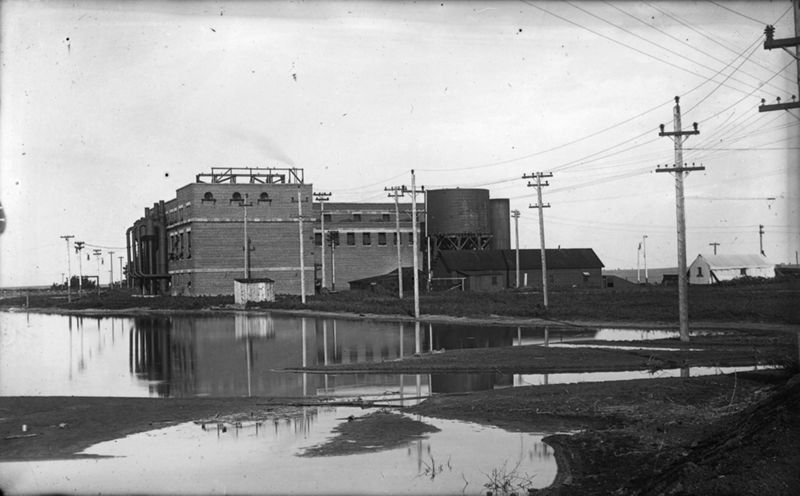 "Lafayette Power Plant in undated photo"
Courtesy of Carnegie Library for Local History, #213-2-8
The system of poles and wires also carried alternating current electricity to the Denver and Interurban (D&I) Railroad, which carried passengers between Denver and Boulder on the Colorado and Southern rails that came through Superior. The D&I promised “Denver to Boulder in about an hour” via sixteen trains a day. The line branched west of Broomfield, one going to Boulder through Louisville and the other through Superior, Marshall and the University of Colorado campus to a station on 12th (Broadway) and Pearl in the city. Waneka Lake also came to be known as Interurban Lake. The interurban ran from 1908 to 1926.
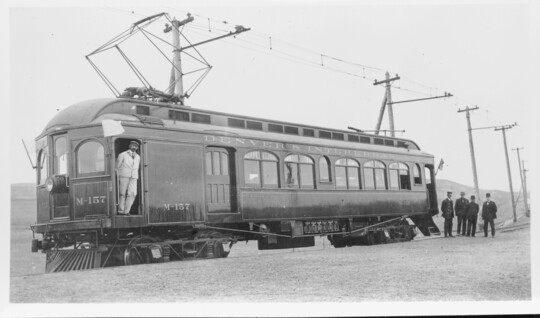 "D&I interurban car near Westminster. Note lines carrying electricity from Lafayette"
Courtesy of Superior Historical Commission
After the Valmont power plant was built in 1928, the Lafayette plant was relegated to back up for the new facility. Generating equipment was removed in 1953 and the structure demolished in 1963 due to danger to uninvited visitors. A few piles of slag, the remnants of burned coal, are still present on the south shore of the lake.
Sources:
Patten, Andrew, History of Waneka Lake, 2006.
Conarroe, Doug, Slag Pile at Waneka Lake a shadow of its Former Self, 2017.
Commission News

The Historical Commission will have a booth at the 4th of July festivities in Community Park. We invite you to stop in for a visit about our town’s past. The historic firetruck will be near the front of the parade then later on display in the parking lot.
Our new interim museum will be open on July 1 from 10:00 a.m. to 2:00 p.m. We continue to add to our collections and expand displays.
|
Did You Know That:
-
On July 11, 1954, the thermometer hit 114 degrees at Sedgwick, tying the state record until broken later?
-
A Central City inventor developed and built an experimental submarine in 1898? Loaded with about 1,500 pounds of rock ballast, it promptly sank to the bottom of Missouri Lake, a few miles north of Central City. The Nautilus was recovered in 1943.
-
Saguache County’s Cochetopa Pass is a Ute word meaning “pass of the buffalo?” The pass was an ancient Native American and buffalo trail into the San Luis Valley.
Written by Larry Dorsey, proofed by Dorothy Mahan.
For more information about the Historical Commission and its activities, contact Commission Liaison Jennifer Garner at 303-499-3675, Commission Chair Larry Dorsey at 303-499-1969, or just click on the “Historical Commission Info” button below.
|