Historical Commission Corner
Progress continues at the Historical Museum site.
The debris has been removed by Meyers Services and now the concrete basement is being removed because of the heat damage to the concrete. The Commission hopes to establish the interim Museum in the Grasso Bungalow once the Town Building Department has vacated it. After that happens, we will adapt the space to a museum configuration and open it to the public.
Lately, we have been the beneficiaries of some very generous donations from some great people and would like to take this opportunity to thank:
Jim Lastoka – various coal mining tools
Lynn Swearengen – booklet on mining lamps
Mary Jane Kreiman – Underwood typewriter
Robley Williams – antique kerosene lamp
Roger and Chris Wecker – farm and mining implements
Broomfield Depot Museum – vintage household items
What was it like for automobile travel in our area before US 36 came into existence?
To drive from Boulder to Denver, the motorist would drive east on Arapahoe which carried Colorado Highway 7, meeting U.S. Highway 287 at Nine Mile Corner. At this point, a right turn to the south took them to Baseline Road which they followed east to Lafayette’s Public Road followed by another turn southbound, eventually making Broomfield. From there the route went east on today’s 120th Avenue to Federal Boulevard and then on into Denver.
There were several ninety degree turns in those days. When the county’s highway system was developed in the 1920’s, the roads often were simply rural dirt roads that followed the zig zag created by the patchwork of farmlands.
Not only was there no US 36 back then, but there was also no McCaslin Boulevard or State Highway 128. Consequently, driving from Superior to Boulder or Denver was challenging for the motorist. One access to Boulder was a short drive north to Marshall Road, then west to Highway 93 which led to a southern access to the city. A similar route would be to head west on South Boulder Road. Denver bound Superior residents would go east on what is now named Dillon Road, picking up US 287. It is important to note that these country roads were all unpaved adding to the difficulty and uncertainty of early auto travel.
All this changed on January 19, 1952, with the christening of the Boulder – Denver Turnpike. This new road, called "Tomorrow’s Highway Today," followed a diagonal route from 28th and Baseline in Boulder some 17 miles to Federal Boulevard in Westminster. There was only one other interchange located in Broomfield. That is also where the toll was paid: 10 cents for Boulder to Broomfield, 15 cents Broomfield to Denver or 25 cents for the entire Boulder to Denver. Later, the road was connected to the newly constructed Valley Highway freeway which would eventually become Interstate 25.
When the road was paid off, the toll was removed, and it remains the only toll highway in the United States to do so. After, the state highway number designation was changed to US 36 and the Colorado road became a part of the federal highway system.
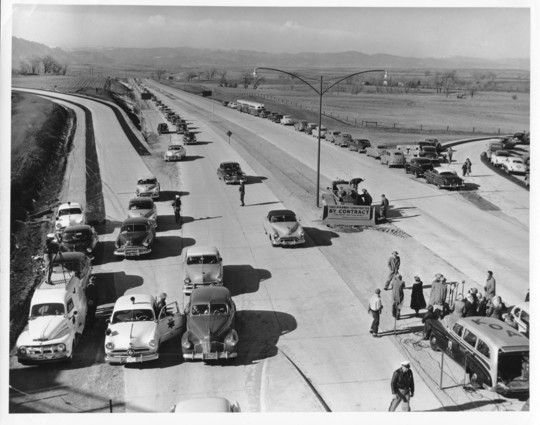 Dignitaries are gathered in front of the KOA radio vehicle for the Boulder-Denver Turnpike ribbon cutting ceremony at Broomfield January 19, 1952.
-Photo courtesy Carnegie Library for Local History, Boulder
Did you know that:
- At just over 50 miles in length, Colfax Avenue is considered the longest continuous commercial street in America?
- US 287 is the shortest route from Denver to DFW?
- Boulder County’s Nine Mile Corner is (guess what?) situated nine miles from central Boulder to US 287. The hill above the Valmont power plant on Arapahoe was the original scenic overlook offering a spectacular view of the Boulder Valley and Back Range?
For a more complete story on the Boulder-Denver Turnpike, see the spring 2006 issue of the Superior Historian accessible on the Town of Superior web site.
The Historical Commission currently has three vacancies, so applications are welcome. For more information, contact Lydia Yecke at 303-499-3675 or Commission Chair Larry Dorsey at 303-499-1969 or you can click on the button below to find more information.
Text by Larry Dorsey, proofed by Dorothy Mahan.
|