Historical Commission Corner
Historical Museum Update: A recovery company will soon be extracting debris from the Museum basement. Commission members and volunteers will examine items to see what might be salvageable. We also are looking into opening a museum in the old house that survived the fire known as the Building Department bungalow.
Examples of Boulder County’s coal mining legacy are still around us today. Two prominent illustrations are the Monarch school campus and the two monuments just east of Autrey Park. The Monarch #2 Mine was located along Carbon Road just east of 95th Street and the new apartment complexes and auto dealerships. Its place in history is forged in tragedy.
On a crisp January morning in 1936 the whistle at the Monarch signaled trouble in the depths. Fear spread through the Mine Camp and miners in Louisville assembled a rescue crew. A huge explosion had occurred in the shafts below and miners of the overnight graveyard shift were still beneath the surface. The Monarch had a reputation as a “dirty mine”, meaning one that was prone to an abundance of coal dust and the mine company had a reputation for not properly attending to the accumulation of the dust. A spark from an unknown source set off the explosion that would take eight lives and leave one victim entombed forever.
Two miners ran “like rabbits” 400 feet through a tunnel and then climbed out of the mine via a 300-foot air shaft. Another predicted the disaster when he said, “One of these mornings you’re going to see the Monarch blow.” The rescue teams eventually recovered the bodies of seven deceased miners. The body of the stable boss who tended to the mules that toiled down in the mine, Joe Jaramillo. was never recovered. Eventually the mine company was found negligent in not properly treating the coal dust issue.
The monuments in Varra Park (City of Broomfield) along Rock Creek east of Autrey Park recognize the January 20, 1936, tragedy, one for Joe Jaramillo and the second for the others lost that fateful day. The Jaramillo monument was put in place in the 1940’s and was visible from the Boulder-Denver Turnpike. It was originally located about a quarter of a mile to the south and displaced by building the Flat Iron Crossing.
Tom Stevens – Louisville
Ray Baily – Broomfield
Oscar Baird – Rickard’s Camp
Tony Di Santis – Louisville
Steve Davis – Louisville
Kester Novingger – Broomfield
Leland Ward – Monarch Camp
Joe Jaramillo – Monarch Camp
The Monarch PK-8 and high school were so named in deference to the tragic loss of life decades ago. For a more detailed account of this story, see the Superior Historian from 2006 accessible through the Town of Superior website.
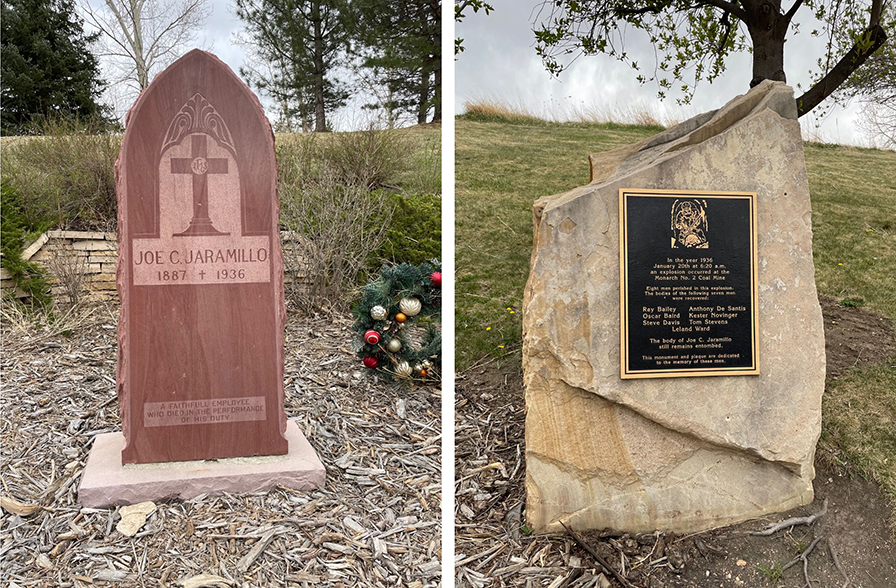 Monuments
(Photo courtesy Larry Dorsey)
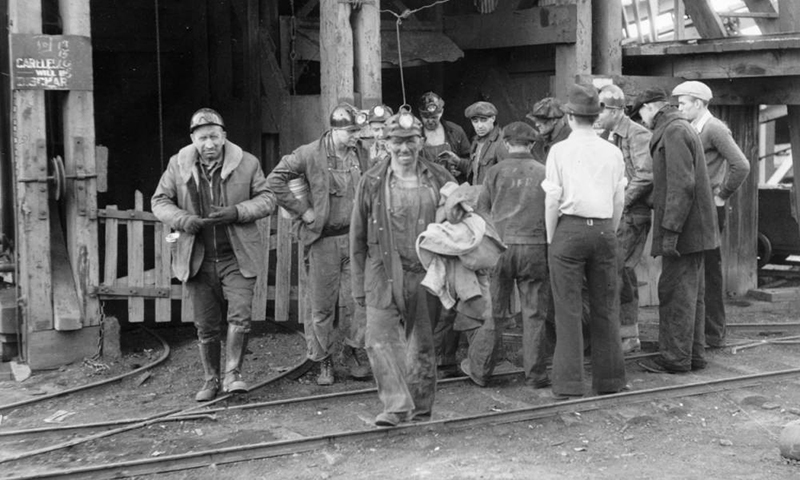 Most likely the rescue team coming out of the Monarch #2 Mine,
January 20, 1936.
(Image z-3978 - Photo courtesy Denver Public Library Western History Collection)
DID YOU KNOW THAT...
- Early screen star Douglas Fairbanks, was born in Denver on May 23, 1883?
- Mts. Harvard, Yale, Princeton, and Oxford are in the Collegiate Peaks in the Arkansas River district north of Salida?
- On May 14, 1896, the lowest U.S. temperature in May of -10 F was recorded at Climax, Colorado?
For more information contact Lydia Yecke, Historical Commission Staff Liaison, at 303-499-3675 or Larry Dorsey, Commission Chair, at 303-499-1969. This and the March edition written by Larry Dorsey and proofed by Dorothy Mahan.
|