|
Learning & Development for the
State of Colorado
|
|
In this Issue:
- State of Learning: A Community of Practice
- Quarterly Forum Recap
- Trainer Spotlight
- My Favorite Habit
- External Stakeholder Training
|
|
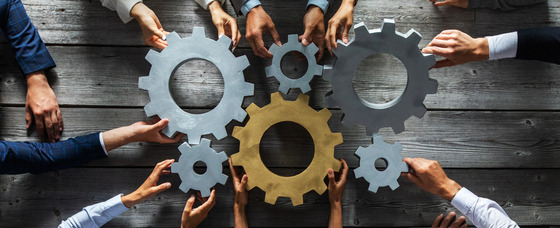 Purpose Statement: The State of Learning is a voluntary, collaborative community of practice designed to empower and support learning and development across the State of Colorado. Its purpose is to act as a mechanism for peer-to-peer knowledge and resource sharing, collective problem-solving, and advancing the professional practice of learning and development. The Community of Practice brings together professionals across State agencies who champion training, learning, development, and skill-building efforts for their teams.
State of Learning builds on the existing Learning Leader Quarterly Forum and reflects a shift toward shared ownership of learning culture across State agencies. LDC's Community of Practice formalizes what many learning and development leaders across the State are already doing: exchanging ideas, learning from peers, and addressing common training challenges.
Rather than functioning as a traditional update meeting, the Community of Practice emphasizes participation, shared expertise, and collective leadership. Employees interested in participating can fill out the State of Learning: Community of Practice Interest Form. Additional information is also available on our website at dhr.colorado.gov/ldc/communityofpractice.
LDC will continue to convene and support the community while partnering with the Community of Practice to collaboratively develop meaningful learning experiences statewide.
Participants can expect follow-up communications with opportunities to provide input, share practices, and participate in upcoming sessions as the State of Learning community continues to grow.
|
|
LDC Quarterly Meeting Recap |
|
|
LDC held its first quarterly meeting of the year on Jan. 15, with much of the time dedicated to introducing the State of Learning. Participants broke into small groups to discuss guided prompts related to the State of Learning’s purpose and future vision, then shared key themes during a full-group report-out.
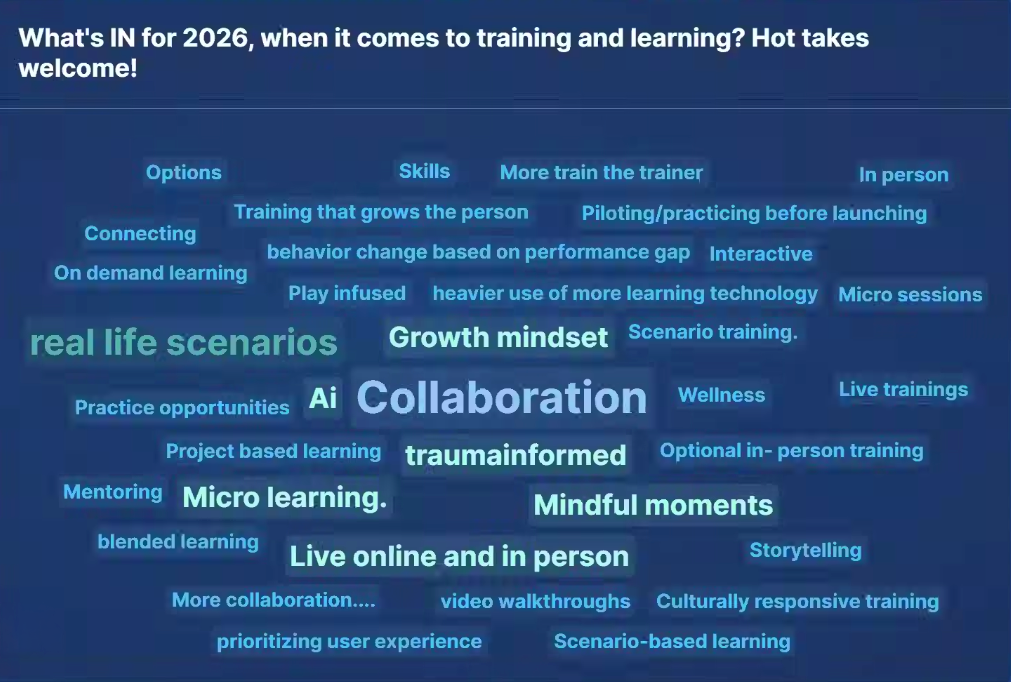
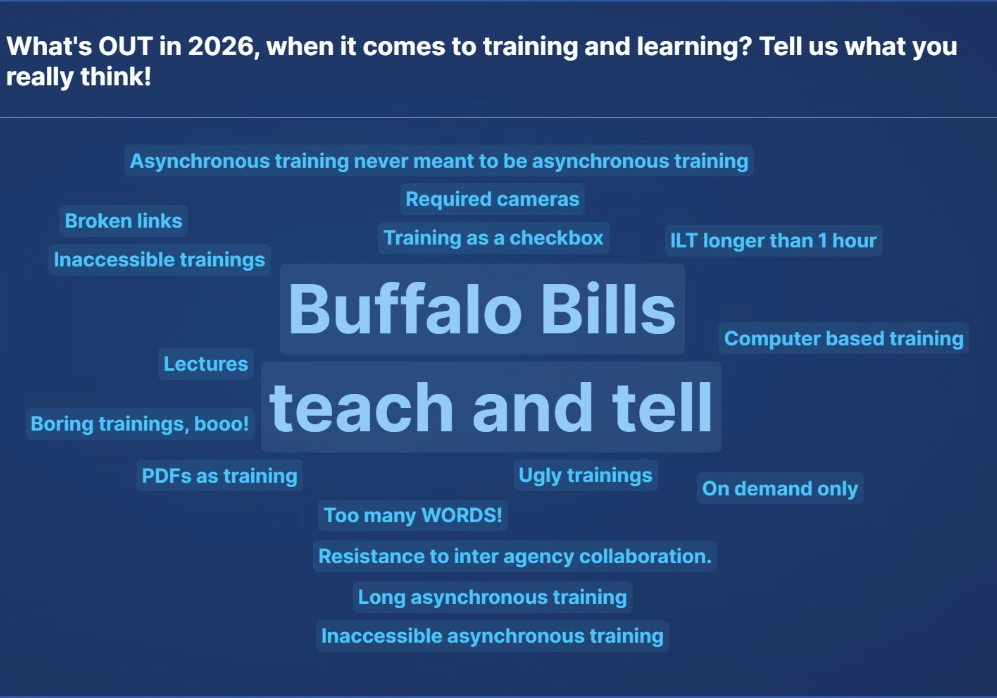
Participants also shared what is “in” and “out” for 2026 when it comes to training and development. See the word clouds below for what the group identified. (And yes, the group was right about the Broncos sending the Buffalo Bills home in the NFL playoffs!)
|
|
|
Tell us a bit about yourself.
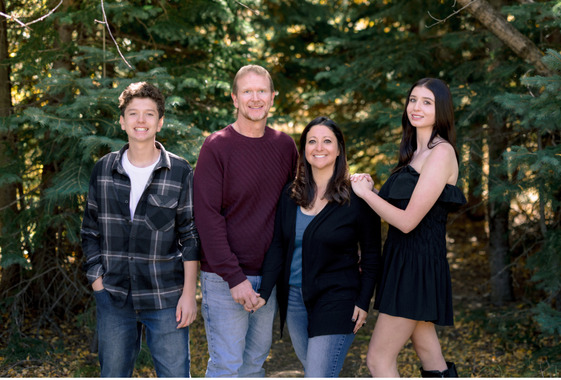
I just celebrated 20 years of marriage to my beautiful wife, Nicole. We have two kids, ages 17 and 14, and I am an all-animal lover. I have more replacement parts than a ’58 Ford — and like that old Ford, I’m still runnin’!
I’ve been with the State for just over five years. I began my State career as an HRBP at CDHS and later moved into a Training Specialist role with CDHS Learning, Engagement, and Development following a reorganization. I am now celebrating just over one year as part of DPA’s Employee Labor Relations team as a Training Specialist.
Before joining the State, my background included more than three decades in retail, spanning HR, people leadership, and business management. While it was a great experience, I’m thankful my career changed lanes. The State and my supervisors have taught me a great deal about self-care — something that was not part of the retail culture.
 What do you enjoy doing in your free time?
Anything that involves my family. We are a tight-knit tribe for sure. I coach my son’s travel baseball team, listen to good music (lots of hair metal — or at this stage, “used-to-have-hair metal”), enjoy craft brews around the fire pit (no IPAs!), bang on my bass, and love going for walks with my wife. You never know when you might not be able to enjoy simple pleasures like these, so I try to embrace the moments when I can.
Tell us about a unique travel experience you’ve had.
We went out on a fishing boat in the Gulf of Mexico while visiting South Padre Island, Texas. We got into the water to swim with and feed the fish, but conditions got rough very quickly. My daughter, who was about 9 or 10 at the time, panicked and nearly pulled both herself and my poor wife under. It was scary as heck — but here we are.
I also once spent three hours curled up at the bottom of a fishing boat in Hawaii. I have never been so seasick. Needless to say, I avoid boats now. Ha!
What is your favorite tool to use when supporting employees with their professional development, and why?
This is such an interesting question. Does my voice count? I believe in the saying, “use your voice to make a change.” I feel I have both the ability and the responsibility to truly help people learn about labor relations and beyond when they attend our LR trainings.
Learning is empowerment. It gives people confidence and, I hope, a sense of happiness in their work. We are all trying to help make someone’s day better, and we each have a role in that. My role happens to be a Training Specialist, and I use my voice to empower others and help build their confidence — and I love it.
We should never forget that what we do matters. I truly believe all of us have a role in making a difference in someone’s life each and every day, and I do not take that lightly.
If not my voice, I would say the LXP. It is a great training resource that is still underused by many.
What was your dream job as a kid, and how has that changed?
I had a few dream jobs: a pro football player, a rock musician, and a law enforcement officer. I also wanted to drive a semi, a big, beautiful Peterbilt, and see the country. Then I drove in Denver and Washington, D.C., and that was it. I decided my talents were better served by helping people in a different way, and here I am. And with commuting in and around Denver only getting worse, I think I made the right choice.
What’s your go-to song when you want to have a solo dance party?
Well, to be honest, I don’t have solo dance parties (sorry, Billy Idol — some will get that nod). But when I listen to music, I go for everything from Cash and Willie to Judas Priest and Metallica, to Bonamassa and Hiatt. I’m a dyed-in-denim-and-leather rock-and-roller with an old-country heart and a working-class background that appreciates just about anything authentic. It depends on the moment, but absolutely no “pop country” for me — sorry, Beyoncé and Shaboozey fans. Give me authentic and I’m happy. Maybe a good one would be “Nothin’ But a Good Time” by Poison. I’ll have to test that out.
|
|
|
Socrates Mouskos - Leadership Development Program Administrator
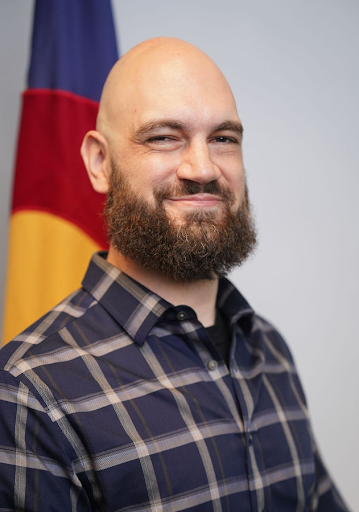
I’ve been facilitating the Statewide Emerging Leaders Certificate Program for over a year now and I’d like to share with you my favorite habit from the 7 Habits of Highly Effective People. Of all the habits, Sharpen the Saw is the one that quietly determines whether the rest actually work.
We live in a world that rewards constant motion, quick responses, and packed calendars — so it’s easy to treat rest, learning, reflection, and self-care as optional luxuries. They aren’t. One of my favorite ways to describe this habit is with the question: “have you ever been too busy driving to fill up your car with gas?” Most of us haven’t — because we understand that no matter how urgent the trip is, the vehicle won’t go far without fuel. The same is true for people. When we neglect renewal, we don’t just feel tired - our judgment slips, our patience shortens, and even our best skills become unreliable.
Habit 7 reframes renewal as a responsibility to those around us, not a personal indulgence. When we consistently invest in ourselves — physically, mentally, emotionally, and spiritually — we show up with more clarity, resilience, and credibility. Over time, this habit sustains every other habit, allowing us to lead, collaborate, and solve problems at a higher level for the long term. In a culture that celebrates burnout as commitment, Sharpen the Saw is the habit that keeps performance sustainable and leadership effective.
As many of us set New Year’s resolutions, Habit 7 offers a timely reminder: focus less on dramatic short-term change and more on sustainable daily practices — not the spectacle of improvement, but the practices that make improvement last.
|
|
|
Creating Training for External Stakeholders
|
|
|
By Stephanie Johnson, M.E.d - Statewide Trainer/Coordinator, Pre-Employment Transition Service and Employment First, CDLE
I work as a Statewide Trainer/Coordinator for the CDLE Division of Vocational Rehabilitation (DVR) Youth Services Team. My role provides me with opportunities to create and deliver training to our internal DVR staff, external partners, and the people we serve. I particularly enjoy the creativity it requires when I create external training because I get to work with and learn from different people in various roles with unique requests and needs. With that creativity also comes flexibility, as external training doesn’t always necessitate the same training requirements or styles as internal training. Here are some key considerations I keep in mind when creating training for external stakeholders.
Get Input and Feedback
Getting feedback from stakeholders is vital to creating a successful training experience. Be sure to get input from partners throughout the entire process. Most people only ask for feedback at the end, when the training is complete, but it can be a time-waster to start something only to realize you were heading down the wrong path from the beginning. Receiving feedback during the process allows for quick and simple edits as you go, resulting in greater efficiency. On that note, you’ll also want to facilitate easy access to the training for input. Few things are more frustrating than being unable to do what someone has asked, so make sure the way to receive feedback is user-friendly, or provide explicit instructions on how to access it. Be available to step in and support your partners throughout this process.
Consider Accessibility Early
Accessibility should be at the forefront of every external training you create. (If we’re being honest, it should be part of every training, but that’s not what this article is about.) Because external stakeholders bring a wide range of experiences, roles, and abilities to the table, it’s important to design training that works for all kinds of people and disabilities from the start—not as an afterthought. This might include using plain language, providing captions or transcripts, ensuring materials are screen-reader friendly, and offering multiple ways to access content. When accessibility is built in early, it not only reduces barriers but also signals respect for your audience and their diverse needs. Accessible training benefits everyone, leading to stronger engagement and better outcomes.
Create Engaging Content
Engagement is key when working with external stakeholders, especially when you may not have ongoing or repeated contact with them. Using a variety of modalities (such as videos, visuals, interactive activities, discussion prompts, or real-world examples) helps meet different learning preferences and keeps participants interested. It can be easy to think only of the stakeholders you're communicating with when creating the training, but it is important to remember who will be taking the training. Throughout the process, it’s essential to keep the end user at the center of everything you design. Asking yourself who the training is for, what they need, and how they will use the information ensures the content remains relevant and meaningful. When learners feel seen, and the training reflects their reality, they are more likely to stay engaged and apply what they’ve learned.
In conclusion, creating engaging training content for external stakeholders isn’t nearly as daunting as it sounds! Just be sure to get stakeholders involved early and keep them involved throughout the whole process, keep accessibility at the forefront of your mind when developing any and all content, and create engaging training that keeps the end user in mind. Have some fun with it and use your creativity to inspire others!
|
|
|
|
|