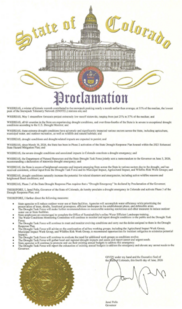
On Thursday, June 4, 2026, the Governor activated Phase 3 of Colorado’s Drought Response Plan in response to record-low snowpack and prolonged warm temperatures across the state.
To view the official Proclamation, please visit the following link:
Statewide Drought Emergency Declaration
In response, HOA boards and community managers are seeing more lawns and yards that are not maintained in accordance with the standards set forth in the governing documents of the community. Consequently, the HOA Information and Resource Center has seen an increase of complaints related to homeowners receiving violation notices from their HOAs about their un-watered lawns.
The Colorado Common Interest Ownership Act (“CCIOA”), which is the state law that governs the formation, operation, and management of HOA communities, directly addresses this issue at section 38-33.3-302(k)(II), C.R.S. CCIOA states:
The association may not levy fines against a unit owner for violations of declarations, bylaws, or rules of the association for failure to adequately water landscapes or vegetation for which the unit owner is responsible when water restrictions or guidelines from the local water district or similar entity are in place and the unit owner is watering in compliance with such restrictions or guidelines. The association may require proof from the unit owner that the unit owner is watering the landscape or vegetation in a manner that is consistent with the maximum watering permitted by the restrictions or guidelines then in effect.
Upon initial review, the statute appears to prohibit HOAs outright from fining unit owners for not watering their lawns during a drought; however, closer examination reveals that HOAs may still fine HOA unit owners if the unit owner is not in compliance with the water restriction or guideline from the local water district.
As an example, if the local water district issued a water restriction stating lawns may only be watered Tuesdays and Fridays in order to conserve water, HOAs may require proof that unit owners are watering at a minimum, every Tuesday and Friday in accordance with that restriction. If the unit owner cannot demonstrate that they are in compliance with the local water district’s watering guidelines, the HOA may still be able to fine the unit owner under this section for non-compliance with landscaping standards, even if a local watering restriction is in effect.
A common question the HOA Center receives relates to what may constitute proof in these scenarios. Unfortunately, the statute does not contemplate what might be considered adequate “proof”. As a result, unit owners and boards are advised to consult with legal counsel to understand what may constitute proof, but examples might include photographs or videos showing the irrigation system is operating on the days and at the times permitted by the local watering restrictions.
Boards and community managers should still realize that, even if a unit owner is not watering in accordance with the current watering restrictions, Colorado is in one of its worst droughts in its history, and efforts should be made to effectively communicate with homeowners regarding the statewide drought and any watering restrictions currently in place with the local watering district. State law, particularly section 38-33.3-302(k)(II), C.R.S., still permits communities to establish a baseline watering schedule even during periods of intense drought.
If boards and community managers are unsure about their ability to levy fines for failure to adequately water a landscape, they should consult with a licensed Colorado attorney.
-HOA Information and Resource Center-
|