|
Quarterly Newsletter
—
Winter Edition, January 2026
|
|
Real Estate - Public Calendar
|
|
Stay Up To Date With Us!
Division Meetings and Events
|
|
Sign Up For A Webcast
 The Division of Real Estate makes an effort to have all public meetings and educational opportunities live and accessible to the public by signing up for a webcast.
Find the meeting or event you want to attend on the Division Calendar, click on the “more details” and follow the directions to sign up for the webcast.
DRE YouTube Channel
Have you checked out our YouTube channel yet? You can find webinar recordings, educational videos, bite-sized advisory videos and watch various LIVE hearings and board & commission meetings.
Watch & Subscribe at @DORADivisionRealEstate and never miss our most current content!
FREE Live HOA Forums

The HOA Information & Resource Center hosts free webinars each month on a variety of topics. Join the conversation and learn about helpful resources regarding your rights and obligations in an HOA community. Topics change monthly, so check the Division calendar to sign up!
Unable to attend? View the HOA Information & Resource Center's past webinar recordings HERE
|
|
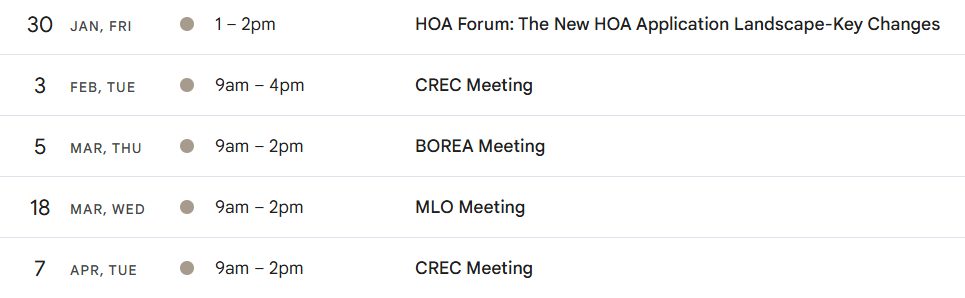
Upcoming Meetings:
HOA Forum: The New HOA Application Landscape - Key Changes:
Colorado Real Estate Commission (CREC) Meeting:
Board of Real Estate Appraisers (BOREA) Meeting:
Board of Mortgage Loan Originators (MLO) Meeting:
Colorado Real Estate Commission (CREC) Meeting:
|
|
|
Changes to the Qualifying and Continuing Education Requirements for Appraisers
Beginning January 1, 2026, all credentialled appraisers are required to complete a course that meets the AQB (Appraisal Qualification Board) Valuation Bias and Fair Housing Laws and Regulations Outline, every two years. The first time a licensee completes the continuing education requirement for this course, the licensee must complete the seven (7) hour course. Once the seven (7) hour course is completed, licensees are required to complete a four (4) hour course on Valuation Bias and Fair Housing Laws and Regulations every two calendar years. The inclusion of the Valuation Bias and Fair Housing Laws and Regulations course is part of the twenty-eight (28) hours of continuing education that a credentialled appraiser must complete for each license cycle. A list of courses approved for continuing education can be found here.
Applicants for new appraiser licenses must complete an eight-hour course in Valuation Bias and Fair Housing Laws and Regulations as part of their qualifying education. If a licensee has completed the eight (8) hour course as part of their qualifying education, they have satisfied that portion of their continuing education requirement for the new license that was issued. Depending on when the license is issued will determine what continuing education will be required. If the license is issued prior to July 1, then fourteen (14) hours of continuing education must be completed before the license can be renewed. Initial licenses that are issued after July 1 do not have any continuing education required before the license can be renewed.
New Position Statement Issued by the Board of Mortgage Loan Originators
Several individuals have inquired as to whether a mortgage loan originator’s license is required to offer or negotiate home equity contracts (also referred to as home equity agreements, shared appreciation agreements, and shared appreciation loans) in Colorado. On January 21, 2026, the Board of Mortgage Loan Originators issued Position Statement – MLO 2.0 – License Requirements for Originating Home Equity Contracts to clarify when a mortgage loan originator’s license is required for taking an application, offering or negotiating the terms of a home equity contract when the contract meets the definition of a residential mortgage loan. If the home equity contract qualifies as a residential mortgage loan, a mortgage loan originator’s license is required to take an application, offer or negotiate the terms. A copy of the position statement can be found here.
|
|

About the Director: Marcia Waters
Marcia Waters has been with the Colorado Division of Real Estate since August 2005. Ms. Waters started with the Division as a Criminal Investigator for the Real Estate Commission and was promoted to Chief Investigator in 2006. In 2007, she was promoted to the position of Investigations and Compliance Director. In that capacity, she managed the investigatory and settlement programs for the Division. On October 15, 2010, she was promoted to the position of Division Director. The Division of Real Estate licenses and regulates approximately 75,000 real estate professionals. Ms. Waters serves as the administrator for the Real Estate Commission, the Board of Real Estate Appraisers, the Board of Mortgage Loan Originators, and the HOA Information and Resource Center.
Ms. Waters manages the Division’s $9 million budget, oversees a staff of approximately 60 full-time employees, and establishes the direction of Division programs based on market and industry trends.
|
|
|
|
From time to time, the Division of Real Estate receives information from industry partners that is important to share with licensees and the public. Below, please find an article prepared by the Land Title Association of Colorado (LTAC).
|
|
What Realtors Need to Know About FinCEN’s New Real Estate Reporting Rule

As part of our ongoing commitment to consumer protection and regulatory transparency, the Land Title Association of Colorado (“LTAC”) would like to share important information regarding a new federal reporting requirement issued by the U.S. Department of the Treasury’s Financial Crimes Enforcement Network (FinCEN). This new rule went into effect December 1, 2025 but reporting will not be enforced until March 1, 2026, and will impact certain residential real estate transactions nationwide, including those in Colorado.
Our goal in sharing this information is to help real estate professionals understand what the rule is, why it exists, how it may affect buyers and sellers, and how you can help facilitate a smooth transaction experience while remaining compliant with the law.
What Is the New FinCEN Rule and how does it differ from the current GTO (geographic targeting orders)?
The new FinCEN rule requires reporting of certain non-financed residential real estate transfers to be reported to the federal government. These reports are intended to identify the beneficial owners behind real estate purchases made through entities such as LLCs, corporations, partnerships, or trusts. In short, the rule focuses on who ultimately owns or controls the purchasing entity.
Unlike our current GTOs, which apply only in designated geographic areas and are triggered by specific purchase-price thresholds, this new rule establishes a permanent, nationwide reporting requirement. It is not limited by location or dollar amount and applies based on the structure of the transaction rather than where the property is located or financial consideration.
How Does This Affect your Buyer and Seller clients?
For many traditional, lender-financed transactions, the impact may be minimal. However, buyers and sellers should be aware of the following key points:
- Certain transactions will require additional information to be reported, including details about the individuals who ultimately own or control the purchasing entity.
- Very broadly, this new rule applies to 1. residential property that 2. does not include a lender with an anti-money laundering program and has a 3. transferor/buyer that is an entity or a trust.
- There are exemptions and nuances to the rule that must be strictly followed. For more guidance and specifics, be sure to reach out to your local title company.
- Information may include names, addresses, dates of birth, bank account information and identification details for beneficial owners.
- Reporting is federal, mandatory, and time sensitive.
- Title companies may choose to delay a closing until the required information is received from the parties to the transaction.
- Title companies may also charge an additional fee if the rule applies to the transaction being insured.
- The information is submitted to FinCEN and is not public, nor recorded in county land records.
What can you do?
While Realtors are not responsible for filing FinCEN reports, you play a critical role in helping clients understand what to expect.
Realtors can help by:
- Setting expectations early with buyers and sellers, particularly when an entity is involved.
- Encouraging clients to be prepared to provide required information promptly.
- Reinforcing that these requirements are federal law, not discretionary or optional.
- Coordinating closely with title companies, attorneys, and settlement professionals who will be assisting with compliance.
In Summary
This new FinCEN reporting rule represents a meaningful shift in federal oversight of certain residential real estate transactions. Early awareness and clear communication will be essential to helping buyers and sellers understand what to expect, minimizing delays, and supporting a smooth closing process.
By staying informed and setting expectations early, Colorado real estate professionals can continue to serve as trusted advisors while helping clients navigate these regulatory changes with confidence and clarity. LTAC appreciates your professionalism and partnership as we work together to support transparency, consumer protection, and a strong real estate marketplace in Colorado.
View a PDF version of this LTAC Article HERE
|
|
|
Division Updates & Notes

|
|

New Contracts and Forms
For Use January 1, 2026
Most years, the Colorado Real Estate Commission approves updates and changes to the Commission-approved real estate contracts and forms. For 2026, 21 forms were updated and the Commission created 2 new forms, as well.
Updated Commission Contracts and Forms:
- Agreement to Revive Contract
- Closing Instructions
- Contract to Buy and Sell Real Estate (Commercial)
- Contract to Buy and Sell Real Estate (Income-Residential
- Contract to Buy and Sell Real Estate (Land)
- Contract to Buy and Sell Real Estate (Residential)
- Contract to Buy and Sell-Residential (Foreclosure)
- Exclusive Right To Buy Listing Contract
- Exclusive Right To Lease Listing Contract
- Exclusive Right To Sell Listing Contract
- Exclusive Tenant Listing Contract
- Extension or Termination of Contract
- Inspection Objection Notice
- Manufactured Home Addendum
- Manufactured Home Contract to Buy and Sell (Lease Lot Only)
- Post-Closing Occupancy Agreement
- Seller Association Authorization
- Seller's Property Disclosure (Residential)\
- Seller's Property Disclosure Supplement (Additional Structure)
- Seller's Property Disclosure (Commercial)
- Seller's Property Disclosures (Land)
New Commission Contracts and Forms:
- Agreement to Revive Contract-Manufactured Home
- Manufactured Home Extension or Termination
Each of these forms can be viewed and downloaded for use on the Division of Real Estate’s website at:
|
|
|

Take the 2026 Annual Commission Update Now
As every seasoned Real Estate Broker knows, all broker licensees are required to take the Annual Commission Update course (the “ACU”) each year as part of their continuing education requirements. To facilitate this compliance requirement, the 2026 ACU course is now available for real estate brokers. The course, whether taken in-person, live online, or on demand, is designed to be a 4-hour course.
When Can You Take It?
The ACU can be taken throughout the 2026 calendar year, but it is strongly recommended that all licensees take the course as early in the year as possible. The ACU covers important practice changes, updated laws, and updated contracts and forms that, if you wait until the end of the year, may be out of date.
For clarity, it is important to address that recently, the Colorado Real Estate Commission conducted a Rulemaking Hearing. At that hearing, the Commissioners voted to change the ACU requirements, BUT NOT UNTIL 2027. Starting in 2027, the ACU will only be available for the first half of the year. The Division of Real Estate will release more information on this topic and other rule changes in the near future.
Where Can You Take The Course?
The course may be taken through authorized providers. Approved 2026 ACU providers, as well as a comprehensive list of other approved continuing education courses, can be located on the Division’s website:
|
|
|

Legislative Session Begins
On January 14, 2026, the second regular session of the seventy-fifth General Assembly convened. Every legislative session addresses new challenges facing Colorado. Whether you are a real estate broker, a real estate appraiser, a mortgage loan originator, an HOA unit owner, an HOA board member, or a member of the general public, the legislative session is bound to be a busy one. Bills affecting numerous topics, including bills affecting the real estate industry, can be followed through the Colorado General Assembly’s website, because an informed citizenry is an empowered citizenry.
|
|
|
2026 Colorado Real Estate Manual Released
Each year, the Division of Real Estate prepares an updated Colorado Real Estate Manual. This publication covers important real estate topics for pre-licensure, licensure, and members of the general public, helping understand the current law, as well as the rights and obligations of parties during real estate transactions. The Unabridged Version of the Colorado Real Estate Manual is available for purchase directly from the publisher, LexisNexis, at the link below. Importantly, when you purchase the print version, it comes with an eBook download at no additional charge.
You can order yours today here:
|
|
|
Important Reminder to Renew Your Errors & Omissions Insurance Policies
The Division of Real Estate has contracted with Rice Insurance Services Center (RISC) as its errors and omissions insurance carrier.
The end of the calendar year is busy for everyone, so if you missed this important step for your continued real estate practice, licensees should carefully review their policies and renew.
In February of each year, the Division conducts a full E&O audit of Real Estate Brokers to ensure compliance with the E&O insurance requirement, so coverage is imperative.
If you are renewing a policy that expired on December 31, 2025, you must purchase the renewal before January 31, 2026, and the policy must be effective January 1, 2026, to be considered compliant.
|
|
Real Estate Appraiser Continuing Education Audit

Each year, on behalf of the Colorado Board of Real Estate Appraisers, the Division of Real Estate conducts a continuing education audit on renewing real estate appraisers. Like many professions, continuing education is an important component in the process of obtaining and maintaining competency for real estate appraisers. Knowledge, skills, and abilities are imperative. BOREA Rule 7.2 states that each licensee, except for certain initial licensees, applying for the renewal of a license must complete 28 hours of real estate appraisal continuing education during the two years proceeding expiration of their license. Licensees may be subject to an audit by the Division of Real Estate and the Board of Real Estate Appraisers. Notices will be delivered via email soon if you are selected for an audit.
Whether you are selected for an audit or not, you might be interested in reviewing the BOREA Continuing Education Audit website:
|
|
|

New Real Estate Appraiser Rules Take Effect March 2, 2026
January 8, 2026, was the Division of Real Estate’s first rulemaking hearing of 2026. At this public hearing, held by webinar, the Board of Real Estate Appraisers voted to adopt changes to certain rules found at 4 CCR 725-2.
The Board considered changes to Board Rules 9.2 and 11.3, which pertain to service member and service member’s spouse credentialling, and revisions to an existing rule to further clarify what is considered to be appraisal consulting. The board members approved changes to Rule 9.2, regarding service member and service member spouse credentialing, but voted to keep Rule 11.3 unchanged. The effective date of the new rules is March 2, 2026.
As always, current and past versions of the rules governing real estate appraisers can be viewed at the following link:
|
|
|
Consumer Advisory: Interested in Becoming a Colorado Appraiser?
Ensure Your Supervisor Is Properly Credentialed
Are you considering a career in the real estate industry? Countless reports and articles will discuss the benefits of working in the industry. In short, whether you are curious about a career as a real estate broker, a real estate appraiser, or a mortgage loan originator, the Division of Real Estate has developed several resources that help introduce the public to these professions. Most importantly, those interested should review the following:
|
New Broker Handbook:
New Appraiser Handbook:
New Mortgage Loan Originator Handbook:
In addition to these handbooks, which are updated by the Division periodically, it is important to discuss a special consideration for real estate appraisers. Real estate appraisers are required to obtain a large number of hours of experience prior to application. Depending on the credential sought, between 1,000 and 3,000 hours of experience are required before application. The Division has previously discussed a viable alternative method to obtain experience through the Practical Applications of Real Estate Appraisal (PAREA) program in a Licensee Advisory. However, PAREA may not be for everyone, and applicants may seek real estate appraisal experience through a Supervisor/Trainee relationship.
(Read More)
|
|
Real Estate Brokers: New Year, New Rules,
New Position Statements

The end of 2025 was a busy time of year for real estate brokers in Colorado. The Colorado Office of Policy, Research and Regulatory Reform (“COPRRR”) released is Sunset Report of the Division of Real Estate and the Colorado Real Estate Commission, new contracts and forms were reviewed and approved over the course of two Colorado Real Estate Commission meetings, changes were made to the Commission-approved Position Statements, and the Commission held a Rulemaking hearing on December 2, 2025 where the Commission adopted a variety of amendments to the existing rules.
Real estate broker licensees should carefully review the following resources to ensure they are aware of these important matters:
|
|
|
The Colorado Board of Mortgage Loan Originators’ Regular Meeting and Rulemaking Hearing
On January 21, 2026, the Colorado Board of Mortgage Loan Originators held a public regular meeting and rulemaking hearing. The specific purpose of the rulemaking was to modify the administrative rules to eliminate the incorporation of federal law into the definition of a bona fide nonprofit organization, which is contrary to Colorado law. An additional purpose of the rulemaking is to delete the reference of the tangible net benefit disclosure. On January 8, the Division of Real Estate held a Stakeholder Engagement meeting where the Division introduced the rulemaking process, discussed the proposed rule changes, and solicited comments from the public. On January 21, 2026, the Board of Mortgage Loan Originators unanimously approved the proposed rule changes and Position Statement MLO 2.0-License Requirements for Originating Home Equity Contracts. While the Position Statement takes effect immediately, the newly adopted rules will take effect March 17, 2026.
Current MLO Rules can be found at:
Current Mortgage Loan Originator Board Position Statement can be found at:
|
|
HOA Information & Resources Center
The HOA Information & Resource Center offers HOA Forums monthly and are open to both licensees and the public. Stay tuned to the Division of Real Estate's Calendar for future HOA Forums and join us for our future webinars. You can also check out our recently published HOA Forums or our YouTube Channel.
Recent HOA Forums YouTube Channel
|
|

January HOA Forum:
The New HOA Application Landscape and Key Changes
In 2025, the Colorado General Assembly passed House Bill 25-1043, which added new requirements to the type of data that associations must report annually to the Colorado Division of Real Estate. Previously, associations were required to report relatively basic information about the community, such as the name and physical address of the HOA. With the new law, associations are now required to report delinquency information about the community, which may prove challenging for boards and managers to complete.
The HOA Information and Resource Center hopes you will join us for a presentation and Q&A session about the key changes implemented by the new legislation on the Division’s HOA registration application on Friday, January 30, 2026, at 1:00 PM (MT). All are welcome to attend.
Presentation Details:
- Date: Friday, January 30, 2026
- Time: 1:00 p.m. - 2:00 p.m. (MT)
- Location: Online Webinar Only
Register here:
|
On behalf of the HOA Information & Resource Center, we look forward to you joining us.
-HOA Information & Resource Center-
|
|
|
The Division of Real Estate uses the Zoom platform for webinars. If you have not joined the HOA Information & Resource Center for an HOA Forum before, please consider logging in a few minutes early to ensure that you have the latest version of Zoom installed on your device.
Note: If you are unable to attend, the HOA Information & Resource Center posts a recording of the webinar within a few days following the presentation at the following link: https://dre.colorado.gov/recent-hoa-forums
|
|
HOA Center Advisory:
Check Your Association’s Registration Status
n Colorado, most homeowners’ associations (“HOAs”) are required to register and renew with the Colorado Division of Real Estate on an annual basis. This includes Property Owners’ Associations (“POAs”), Condominiums, Planned Communities, Cooperatives, and road associations. The registration requirement is defined in the Colorado Common Interest Ownership Act (“CCIOA”), at section 38-33.3-401, C.R.S.
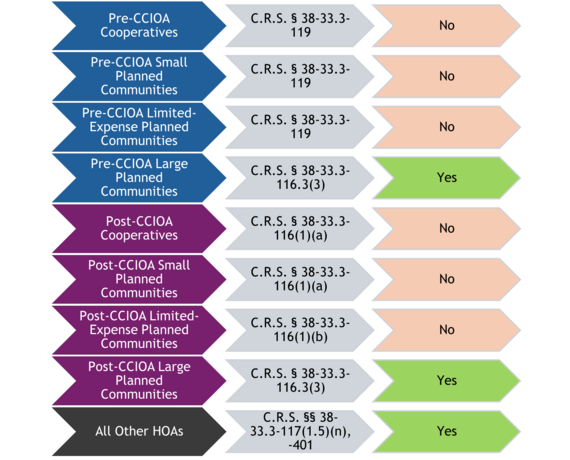
Some HOAs, such as those identified in the infographic below are not required to register, even though it may still be beneficial to register. Registration with the Division of Real Estate helps the Division track critical information regarding unit owner compliance with assessment obligations and association enforcement activities. This information, in turn, is used by Colorado lawmakers to consider new policy and amendment to existing laws.
Another reason to register is that, for some associations, including most pre-CCIOA limited expense planned communities, registration is free. Those communities which (1) have annual revenue of less than five thousand dollars or (2) are not authorized to make assessments and have no revenue are not required to pay a fee. The registration process is simple. Board members and community managers can register their associations by visiting the Center’s Registration Services Help Page.
In considering the various types of HOA communities in Colorado and whether an HOA should register, the HOA Information and Resource Center has provided a helpful decision tree for board members and Community Association Mangers to use when discussing these issues with legal counsel:
HOA Type Legal Authority Required to Register
 In addition, board members and Community Association Managers should consider using the beginning of each calendar year as an opportunity to review and ensure that the contact information for the association’s registration is current. This is essential because the HOA Center will issue renewal notices by email approximately one (1) month before the registration expiration each year. If contact information is invalid, the association will not receive these important notifications.
For unit owners and members of the public, registration information is public information. You may look up an association’s registration information. To do so, search the Division's registration database: Division of Real Estate Licensee Lookup (use the "Business Name/DBA" search field). If you determine that any information is inaccurate, you can address the inconsistency with the board or the Community Association Manager, if the association has one. The association’s Designated Agent can update this information at any time free of charge.
Please note that The HOA Information and Resource Center is unable to provide legal advice. Therefore, if you have questions about whether your association needs to register or questions pertaining to the impact of failing to register, the HOA Center encourages you to consult with your legal counsel.
|
|
The Division of Real Estate Staff
Sarah Halloran - The Division is pleased to announce that Sarah was promoted from her role as an Investigations Team Lead to Deputy Director for the Division on December 1, 2025.
To view a list of all Division staff, visit: Division Staff & Resources page
|
|

Quarterly Discipline
This serves to inform the public of the current and/or most recent disciplinary action taken against the individuals listed. It does not, nor should it be intended to, serve as a complete listing of any and all discipline taken against the individual licensees.
Find the program you want to view by toggling through the tabs at the bottom of the spreadsheet.
To obtain a complete public disciplinary history for a specific licensee, visit the Division's Records Management System and search a licensee's personal record by name or license number.
|
|
|
|
|
|