New Release: Colorado Population Summary
 On Feb. 19, the Colorado State Demography Office (SDO) published the Colorado Population Summary, an interactive report including charts and maps summarizing vintage 2024 data, including population estimates up to 2024 and projections from 2025 to 2060.
Census Bureau Releases Vintage 2025 Population Estimate for Colorado
On Jan. 27, the U.S. Census Bureau published its vintage 2025 estimates for state populations as of July 1, 2025. These estimates are considered the “official” Census Bureau population estimates for years between the decennial census counts.
Vintage 2025 county population estimates will be published in March, and municipal estimates in May 2026. The State Demography Office incorporates information from these estimates into their annual population estimates, which will be published in late October 2026.
U.S. Census Data: Key Takeaways
Six million and counting. Colorado’s population reached and exceeded six million in the first half of 2025, reaching 6,012,561 by July 1, 2025. Colorado’s population continues to grow, increasing 0.4% over prior year levels. Comparatively, the nation as a whole grew 0.5% over the same period.
Population growth was driven primarily by an increase in births. The number of births in Colorado between July 1, 2024 and June 30, 2025 was 65,380, which is a 4.6% increase over the 2023-2024 time period, and is the highest amount since 2017. Deaths remained near prior year levels, up 59 (0.1%).
Net domestic and international migration. Colorado had slower migration growth similar to the majority of U.S states. Net international migration fell considerably from 2024 levels. Net domestic migration was negative (more outs than ins) in 2025 for the first time since 2004.
Colorado Net Migration
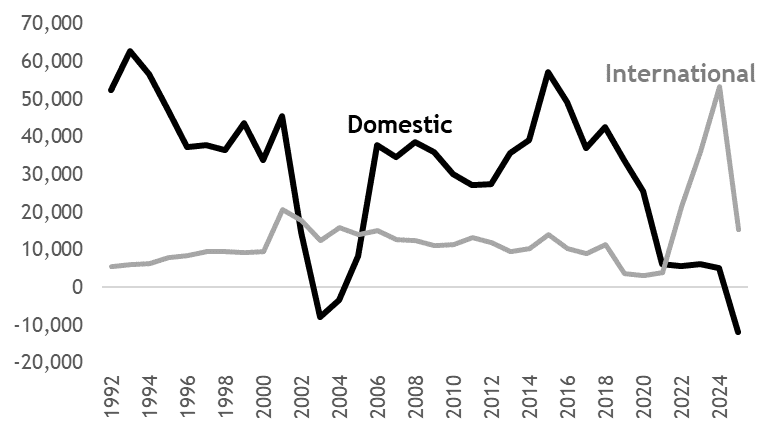 Source: U.S. Census Bureau, Population Estimates Program. Note: A positive value represents more ins than outs, negative means more outs than ins.
- Lower levels of net migration contributed to slowing of growth across a majority of US states. “Every state except Montana and West Virginia saw their growth slow, or their decline accelerate,” the Census Bureau noted. This is largely due to a historic decline in net international migration across the country.
- 12,100 more domestic migrants left Colorado than arrived between July 1, 2024 and June 30, 2025.
- 15,356 more international migrants arrived in Colorado than left between July 1, 2024 and June 30, 2025.
- Colorado’s total net migration, accounting for both domestic and international migration, was 3,256 over this period.
- Notably, once an international migrant has entered the United States, any future moves to other states (secondary migration) is counted as domestic migration. The large influx of international migrants to Colorado between 2022 and 2025 has been largely composed of humanitarian migrants, some of whom did not intend Colorado to be their final destination within the United States. At least some portion of the domestic out-migration from Colorado is made up of recently arrived international migrants.
Revisions to prior years. The vintage 2025 estimates include relatively large upward revisions for prior years, in particular for net international migration in 2022 through 2024.
Learn more in the Census Bureau press release and vintage 2025 tables.
State Demography Office Website Updated with Latest ACS Data
The State Demography Office website has been updated with the latest American Community Survey (ACS) 2020-2024 5-Year data release from the U.S. Census Bureau.
Updated data sets and web applications include:
Census Bureau Revises 2026 Test Sites
On Feb. 2, the U.S. Census Bureau announced changes to the 2026 Census Test, reducing the number of test sites from six to two. The test will now focus operations in two of the planned test site locations, Huntsville, Alabama, and Spartanburg, South Carolina.
These operations include evaluating the use of the U.S. Postal Service in various capacities typically performed by Census Bureau field workers and limited activities for in-field enumeration.
While actual data collection will not be conducted in Colorado for the 2026 Census Test, field representative positions are open to Colorado residents. To apply, visit the USAJobs position listing.
ACS 2024 State-to-State Migration Flows
 On Jan. 21, the U.S. Census Bureau released new state-level statistics on geographic mobility and place of birth in 2024. Geographic mobility refers to the movement of people within and across boundaries.
The State-to-State Migration Flows tables include:
-
State-to-State Migration Flows. This table provides estimates of the number of people moving between the 50 states, the District of Columbia and Puerto Rico and to the United States from abroad.
-
State of Residence by Place of Birth. This table provides estimates of people currently living in the 50 states, the District of Columbia and Puerto Rico by place of birth.
These tables are based on the 2024 American Community Survey 1-year estimates, and provide a general sense of interstate migration trends.
Colorado Data
To view Colorado's migration estimates, use the Colorado State to State Migration map on the SDO website, or the “Look-Up Tool” sheet in the State-to-State Migration Flows Excel file available from the Census Bureau.
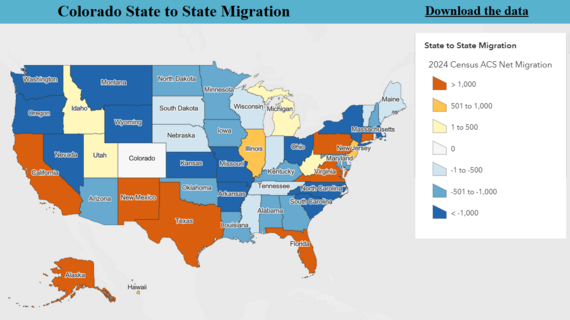 Warm colors show positive net migration, with Colorado gaining residents from those states, while cool colors show negative net migration, with Colorado losing residents to those states.
Visit the State Demography Office website for more.
|