From the Director
Happy New Year. Thank you all for helping make 2024 a safe and memorable year, I am optimistic that 2025 will be even better. Like many of you, we continue to implement a hybrid work environment and have kept our doors open to serve walk-in customers throughout the year. While we had several virtual meetings in 2024, including all the monthly Petroleum Storage Tank Committee meetings, we have also had many in-person stakeholder meetings. It’s always great to meet in person.
We have some amazing staff, and in 2024, we said goodbye to some who retired (Scott Simmons, Rich Holcomb, and Dan Likes), and we hired several new talented persons across our Petroleum Program. I am sure you will get to meet them, and I hope you recognize their commitment to providing Outstanding Public Service. Zach Hope continues to manage all of our Petroleum Programs with Robert Schlegel (Compliance Inspection Supervisor), Scott Wagner (Weights and Measures Supervisor) and Mary White (Remediation and Fund Supervisor) all reporting to him. Jennifer Calkins who has done an amazing job managing the Fund is now working as OPS’s Budget and Finance Manager.
In 2024, we had several stakeholder meetings to work on revisions to our Petroleum Storage Tank Regulations, which among other things included adopting current ASTM standards, updating soil RBSLs and implementing new compliance incentives which allow for 10% deductible on the first $100,000 in lieu of a standard $10,000 deductible. The revised regulations have been adopted and take effect January 1, 2025.
We continue to manage a very solvent Petroleum Storage Tank Fund. In 2024, we paid out around $28 million in cleanup reimbursement. This lower annual reimbursement amount is not surprising, but indicative of the high (93%) technical compliance rate for UST systems, which have resulted in earlier detection of releases, and more effective and timely cleanups. The number of open cleanup sites continued to decline in 2024 as we continue to close more sites than were opened. Our petroleum inspectors have been busy throughout the year, completing almost 2,500 facility inspections.
Many of our staff were involved in leadership roles nationally, and were invited to speak about our program at EPA, Brownfield and ASTSWMO meetings. Zach Hope and Mary White represent Region 8 on ASTSWMO’s Release Prevention and Leaking Underground Storage Tank Task Forces. Bill Hickman has been actively engaged on the EPA National Workgroup on Leak Detection Evaluations as well as on NFPA 30 and NFPA 30A, while Wayne Reinert has represented us on the NFPA 58 code development committees. Scott Simmons and Scott Wagner have served in leadership roles at the Western Weights and Measures Association. This past year, I have continued to be involved with various national organizations including the National Conference on Weights and Measures (NCWM) and the NIST Office of Weights and Measures.
In 2025, we will continue to work on enhancements to the Registered Environmental Professional program. At the legislature, we hope to introduce a bill to give OPS oversight of Retail EV Charging Stations, directing us to promulgate rules to ensure equity in the marketplace, just like we do at all other fueling stations.
Thanks to all of your diligence ensuring compliance with our regulatory requirements and your engagement with us, we are in a great place filled with optimism for 2025. Best wishes for a Happy, Healthy and Prosperous New Year.
Mahesh
Petroleum Storage Tank Regulations
OPS revised the Colorado Petroleum Storage Tank Regulations (7 CCR 1101-14) in 2024, with an effective date of January 1, 2025. The updates included:
- the adoption of current ASTM International and National Institute of Standards and Technology (NIST) fuel quality codes and new volatility requirements for Colorado fuels,
- the clarification of periodic system testing requirements while in temporary closure,
- the alignment of aboveground storage tank rules with National Fire Protection Association (NFPA) codes,
- the introduction of Certified Aboveground Storage Tank Installer requirements,
- revisions to the definitions of confirmed and suspected releases,
- updates to our soil and soil vapor cleanup standards, and
- the introduction of a percent deductible for reimbursement.
Proposed revisions were emailed to stakeholders on July 1, 2024, and introduced during the July 8, 2024 Stakeholder Meeting (virtual). An in-person stakeholder meeting was held on July 30, 2024, and public comments were accepted through September 13, 2024.
OPS adopted the final version during a public hearing on November 4, 2024, at the OPS office. If you have any questions about the revised regulations, please contact Zach Hope at zach.hope@state.co.us.
Welcome OPS’s Newest Inspector
OPS is pleased to welcome Brandon Fagerberg as the newest member of our inspection team. Brandon comes to us with a rich background in the petroleum industry having served in a managing role at Don's Maintenance for 10 years with an additional four years as a Service Manager and Lead Service Tech with Patriot Petroleum Services and Poudre Valley Co-Op. Brandon will be assuming the northeast compliance territory, the northern LPG territory, an active role in truck meter testing, and statewide responsibility for CNG/LNG inspections. Brandon's future growth will include a role with the Fuel Quality Lab as an octane engine operator and maintenance tech. In addition to his extensive depth of knowledge, Brandon also brings an incredible service-focused attitude. Brandon is excited to assume his new role and begin meeting everyone.
Recent Retirement
We would like to congratulate Petroleum Inspector Dan Likes on his retirement at the end of December 2024. Dan Likes had been with the Division of Oil and Public Safety since January of 1993. Thank you Dan for three decades of service and commitment to the Division and to the citizens of Colorado!
 |
|
Compliance Status Update – Fourth Quarter 2024 (as of 12/31/2024)
Storage Tanks Installed: 34 (includes liquefied and compressed gas storage)
Storage Tank Closures/Removals: 28
Technical Compliance Rate for USTs: 90.8%
|
New Release Reporting Form LIVE!
Per the new Petroleum Storage Tank Regulations that went into effect January 1, 2025, releases can now be reported to OPS online through our new Release Reporting Form, 24 hours a day, 7 days a week. Our technical assistance line is still available (303-318-8547), but we are excited to offer a new and convenient way to report releases! You can find the Release Reporting Form here: Report a Release to CDLE-OPS
Fraud Leading to Some Quick Changes
Based on recent news reported in November through one of our “sister” agencies, ECMC affirms public safety after evaluating falsified data submitted by contractors; OPS now requires laboratories to secure their PDF reports. Lab reports should be digitally secured before being sent to consultants and submitted to OPS through our FTP site. On December 18, 2024, OPS notified all affected by this change, but if you have questions or have issues, please contact Mary White at marykv.white@state.co.us, who will assist you.
OPS relies on the integrity of lab results and all other data submitted to our office. This ensures public health safety and the ability to make technically sound decisions. Failure to submit accurate data to OPS will result in enforcement to the fullest extent of the law.
Aboveground Storage Tank (AST) Permanent Closures
When owners/operators are ready to permanently close their AST systems, they must complete the Notice of Intent to Permanently Close or Change Service of Tanks (NOI) Form and return to cdle_technical_assistance@state.co.us at least 10 days prior to beginning closure activities. Fire departments and other regulatory agencies must be notified and all applicable regulations followed. Tanks must be cleaned, all liquids and sludges must be removed and the closure inspection form completed. Be sure to retain all annual compliance documents up to the date of closure.
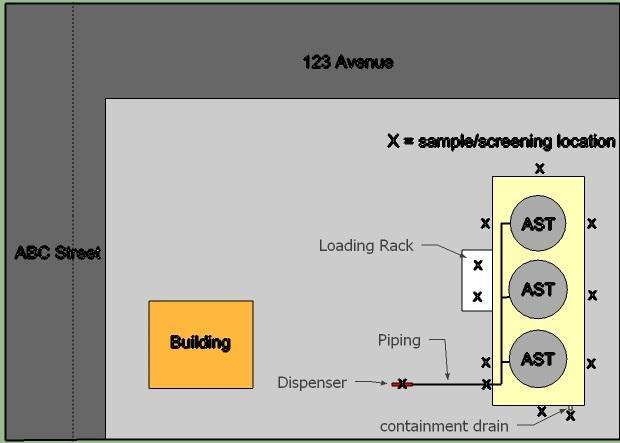
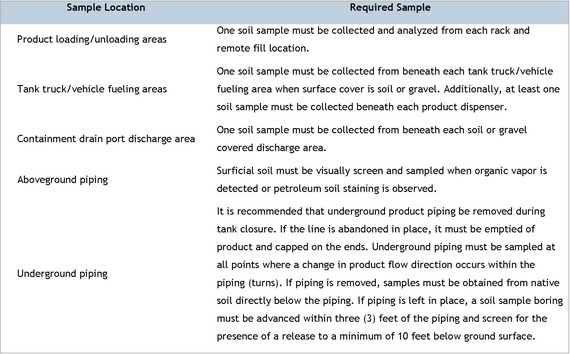
It is the responsibility of the tank owner/operator to have a site assessment conducted and a Tank Closure Assessment Report (TCAR) submitted to the office within 30 days of closure, regardless of release status. The purpose of a Tank Closure Site Assessment is to measure for the presence of a release where contamination is most likely to be present at the storage tank site. For all AST system closures, the following samples are required:
 |
For assessments during AST system removal on a concrete slab or within concrete or similar secondary containment, soil samples must be collected adjacent to the center of each side or adjacent to the corners of a tank foundation slab or containment if no staining is present. If staining is present, samples of the stained soils must be collected. If staining is present on a slab or containment structure, sampling must be conducted in the native soil adjacent to the staining. Samples must be collected beneath areas of the slab or containment that has been compromised.
It’s possible to eliminate the need for any tank-related sampling if all the conditions below are true:
- ASTs are double-walled or are located within secondary containment.
- All fill connections and dispensers are located on the top of the tank.
- Complete monthly release detection records are available.
- No visible staining is present.
If the above conditions cannot be met, OPS requires tank-related sampling. If you seek to potentially eliminate tank-related sampling, appropriate recent pictures of the tank system indicating no evidence of visible staining and 12 consecutive months of visual inspection release detection records showing no indication of a release leading up to the tank closure date are required with the submission of the NOI.
Soil Sampling Procedure Updates
There has been a lot of talk (and perhaps groaning) about collecting soil samples using the SW-846 Method 5035. We have all heard the saying “bad data in, bad data out.” At OPS, we are trying to ensure that the decisions made by both the REPs and OPS are based on sound data, and the only way to do that is to ensure that soil sampling methods are not based on erroneously low results. It has been proven in a study published by Jackson and Thomey (1) that in soil samples collected under bulk procedures, even when held at 4⁰C, benzene concentrations in soil decreased by over 80% within four (4) days. Factors that affect the accuracy of bulk sampling are:
- Type of soil
- Microbe content of soil
- Grit on threads of jar
- Time to collect sample
- Air space in jar
- Ambient temperature
- Excessive hold time before sample prep & analysis
- Time spent in lab subsampling for 5.0 g sample
Studies conducted by Turriff et al. (1994, 2) provided evidence that the preservation of soil samples at the time of collection in methanol allowed for more than 30 days holding with no significant loss in contaminant concentrations. Method 5035 was implemented in 1996, and is now required by the majority of the states in the U.S.
Over the next year (2025), OPS will be moving forward with requiring Method 5035 sampling methodology for soil sample collection in the field. We will work with you, our consulting partners, to collaborate on best practices in the field and guidance writing over the next year to ensure a successful implementation. If you are interested in starting this sampling methodology early and assisting OPS with some field guidelines, contact Mary White at marykv.white@state.co.us.
In the meantime, there are online resources to assist: *https://www.qedenv.com/products/soil-sampling/
*OPS does not endorse any company or product. The link is provided for information purposes only.
Sources:
- Degradation of Hydrocarbons in Soil Samples Analyzed Within Acceptable Holding Times, Jackson, J.; Thomey, N, May 1991
- Studies of Sampling, Storage and Analysis of Soils Contaminated with Gasoline and Diesel, Turriff, D. and Klopp, C., August 1994.
Remediation Status Update – Fourth Quarter 2024 (as of 12/31/2024)
Confirmed Releases: 32
Closed Release Events: 46
Total Open Release Events: 554
|
|
|
Nozzle Inspection
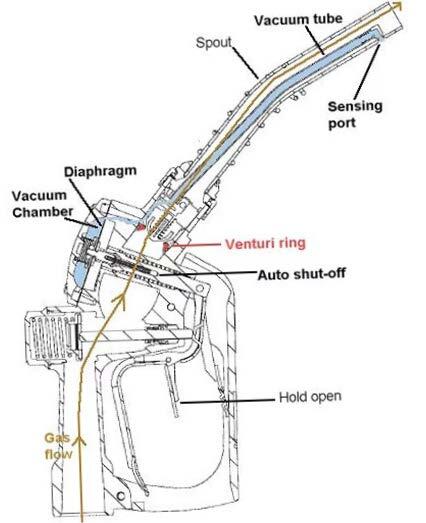
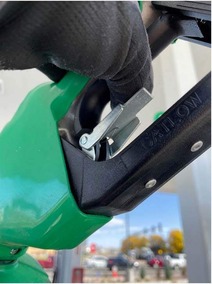
The nozzle is a critical component in safe and functional fueling operation. A thorough inspection of the nozzle is part of a successful monthly inspection. Retail/commercial fueling nozzles should be pressure sensitive and constructed with automatic shut off functionality. The modern nozzle is UL 842 or UL 2586 listed and approved to meet the requirements of the fire code to reduce the risk of spill and fire. These nozzles are rather sophisticated and consist of many parts and components including diaphragms, valves, springs, vacuum changer, vacuum tube and other moving parts and components including diaphragms,
|
 |
|
valves, springs, vacuum chamber, vacuum tube and other moving mechanisms that over time and daily usage can become damaged and subject to wear that can lead to fuel leak and failure. The automatic shut off equipment requires a minimum flow rate of approximately 6 gallons per minute (gpm) to function properly. If the flow rate drops below the 6 gpm threshold due to filter clog or other system issues, it may lead to spills at the dispenser. Check for missing parts such as springs on the automatic shut off-hold open latch. The combination of missing auto shut off-hold open latch spring and malfunctioning automatic equipment is a recipe for a large-uncontrolled fuel spill at the dispenser. |
Labeling Requirements for Renewable Diesel and Biodiesel
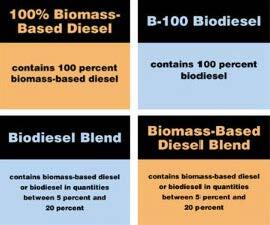
With the adoption of the 2024 edition of NIST Handbook 130 in the Colorado Petroleum Storage Tank Regulations (7 CCR 1101-14) on January 1, 2025, Renewable Diesel (also known as Biomass-based Diesel) and Biodiesel must meet retail dispenser labeling requirements in accordance with 16 Code of Federal Regulations part 306.12. Examples are shown below:
|