|
|
Note: This email may be shortened by your inbox. To see the full message, please scroll to the bottom and click 'View entire message.'
Banner featuring a photo of diverse young children holding hands and playing outside in a circle, alongside the Colorado Universal Preschool logo and the text "CO UNIVERSAL PRESCHOOL NEWSLETTER MARCH 2026".
Haga clic para leer en español
In this Issue:
-
Important Universal Preschool Reminders
-
What Families Should Know Right Now
-
Around Colorado
-
Springing Into Success
-
Supporting Math with Patterns
-
Early Literacy Through Art
-
The Spring Growth Jar: A Family Reflection Activity
-
Cook's Corner Recipe
-
Colorado Universal Preschool Resources & Quick Links
 A purple banner with a subtle dot pattern and white text that reads "IMPORTANT UNIVERSAL PRESCHOOL REMINDERS".
Important Universal Preschool Reminders
Second Round Timeline:
March 16, 2026, by 5 pm - CDEC runs the second family-to-provider matching round. Families who have applied by 11:59 pm MST on March 15, 2026, will be included in the second matching round.
March 24 - March 31, 2026 - Families notified of second round matches. Families must accept or decline by 11:59 pm MST on March 31, 2026.
- If the choice is to decline, the family should reach out to providers or their LCO for support in enrolling with a provider who has an open seat.
- If the choice is to accept, the family will then work with the provider to complete enrollment.
Direct Enrollment: Takes place April 1, 2026, until the end of the 2025–26 program year
- Families enroll directly through providers.
- Families who missed the initial application rounds or prefer to work directly with their chosen provider can take advantage of the Direct Enrollment process. This allows for a more streamlined connection between families and local preschools.
To ensure you don't miss any critical milestones for the upcoming program year, please stay informed of all deadlines.
To view the full schedule here:
 A green banner with a subtle dot pattern and white text that reads "WHAT FAMILIES SHOULD KNOW RIGHT NOW?".
What Families Should Know Right Now?
 A father and his two young children playing and drawing together on the floor with colorful building blocks and markers.
What if my child qualifies for additional hours?
Beyond the universal 15 hours awarded for all households, some children may qualify for up to 30 hours of tuition-free preschool based on specific eligibility factors (such as low income, dual-language learners, or children in foster care). Families should ensure all qualifying information and supporting documents are uploaded to their profile in the Family Portal for verification.
What if I move after matching?
If you move to a new area after receiving a match, you should determine if your current provider still works for your child. If not, contact your current Local Coordinating Organization (LCO) and the LCO in your new community. They will assist you in updating your address in the system and help you explore available openings with providers in your new location.
Can I change providers later?
Yes, families can request a change, though availability is not guaranteed and depends on whether the new provider has open seats. We recommend contacting your chosen provider or your local LCO to discuss the transfer process and ensure a smooth transition for your child.
|
|
 An orange banner with a subtle dot pattern and white text that reads "AROUND COLORADO".
|
|
|
A young toddler in a floral dress stands on their tiptoes, reaching for a colorful book on a library shelf.
It’s National Reading Month!
March is National Reading Month! Celebrate the joy of reading with your child by visiting your local library. Many libraries across Colorado are hosting special storytimes, reading challenges, and family-friendly events throughout the month.
|
|
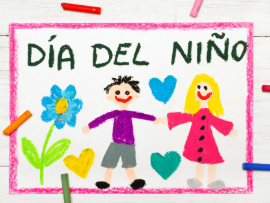
A child's crayon drawing of a boy and a girl holding hands, surrounded by a blue flower and colorful hearts, with the text "DÍA DEL NIÑO" written across the top.
Día del Niño at Denver Art Museum
Celebrate children and creativity at the Denver Art Museum’s annual Día del Niño celebration on April 26, 2026, from 10 am - 5 pm MST. Families can enjoy art activities, performances, and interactive experiences designed to inspire young learners and celebrate childhood.
|
|
 A three-part banner graphic. On the left, a teacher helps two young students solve simple math equations on a chalkboard. In the center, a bright pink background with subtle dots features the white text "SPRING INTO SUCCESS". On the right, a close-up of a child's paint-covered hand as they fingerpaint on paper.
Spring Into Success
March 20th marks the first day of spring! An ideal time to pause and celebrate your child's growth journey since the fall. Take a moment to look back at where they were a few months ago compared to where they are now. For more detailed information on your child's developmental milestones, please refer to the Colorado Early Development Guidelines. Let’s use this month to support learning at home with some fun, spring-themed ways to keep the progress blooming!
Supporting Math with Patterns
Patterns help children develop early math skills and logical thinking. They support a child's ability to recognize sequences- what comes, what goes first, and what comes after. Skills that are useful in everyday life. These activities provide a hands-on way for your child to learn:
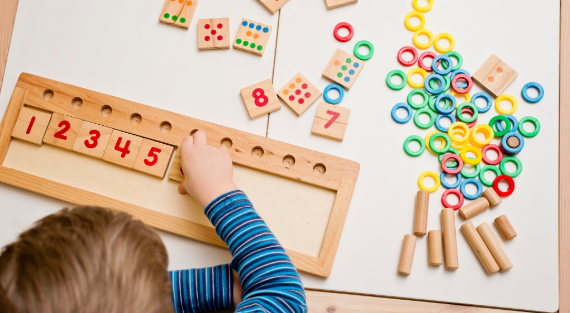 An overhead view of a child in a blue striped shirt playing with educational wooden math toys on a white table, including number blocks, wooden pegs, and colorful plastic sorting rings.
-
Patterns: Find beads, buttons, or small objects that you may have around the house and create simple ABAB patterns (e.g., red, blue, red, blue). Once your child is comfortable, increase the complexity with ABC (red, blue, yellow) or AABB (red, red, blue, blue) patterns. You can even incorporate shapes or cultural colors as well. Whenever your child finishes a pattern, ask: "How did you know that one came next?" Hearing them explain their logic is often more important than them getting the pattern "right."
-
Nature walk: Go on a walk around the block or at your neighborhood park. Collect sticks, rocks, leaves, and flowers. Support your child in creating a pattern (rock, stick, rock, stick). Encourage your child to predict what comes next in the pattern and to create new patterns to share with you.
-
Music Rhythm Pattern: Make music and work on motor skills by having your child follow you through a musical pattern. Create a sequence such as Clap, Stomp, Clap, or Clap, Clap, Stomp, Stomp, and play around with the speed of these patterns as your child participates. Increase the challenge! You can even include a homemade shaker (rice in a container) or another instrument in the pattern.
Early Literacy Through Art
For a preschooler, a scribble isn't just a scribble—it’s a message!
-
Celebrate the "Story" in the Scribble: We often want to see our kids writing their names perfectly, but the real magic starts with oral language. When your child shows you their art, try saying, "Tell me the story of what's happening here!" Act as their "scribe." As they explain their art, write that exact sentence at the bottom of the page. For example, if they say their green scribble is a "dragon hiding in the spring grass," write that exact sentence at the bottom of the page. This shows them that their spoken words have power and can be turned into written text. It’s a huge "aha!" moment for their literacy development.
-
Story Telling: You don't always need a book to practice reading skills! Try starting a story like, "Once there was a tiny seed named Sam..." and then let your child continue it. This builds narrative skills and vocabulary, which are the strongest predictors of future reading success. It helps them understand how stories are built with a beginning, middle, and end. Extend the learning by having them draw their story and write their own book!
-
Spring Activity: Grab some sidewalk chalk or crayons and ask your child to draw "the wind" or "the sun waking up the flowers." These abstract ideas encourage them to use more descriptive words as they explain their masterpiece to you.
 An overhead view of a smiling young girl sitting cross-legged on the asphalt, looking up at the camera. She is surrounded by pieces of chalk and her colorful sidewalk chalk drawings of spirals, shapes, and houses.
The Spring Growth Jar: A Family Reflection Activity
You can make your child's growth "visible" at home. This activity is a wonderful way to sit down with your child, look back at their week, and celebrate how much they are growing.
How to Start Your Growth Jar:
- Find Your Garden: Use a clean glass jar, a clear bowl, or even a shoe box. Let your child decorate it with stickers, colors, ribbons, and paper.
- Prep the Petals: Cut out strips of colorful paper.
- The Daily Look and Listen: Once a day, look for a 'growth moment. Did they identify letters on a food package? Get their jacket and backpack on independently? Explain a doodle using a new vocabulary word?
- Write down their Success: Ask your child to tell you what they did. Write their exact words on the paper strip.
- Fill the Jar: Let your child fold the paper and drop it in.
- Celebrate: Once the jar is full, sit down as a family, empty the jar, and read each slip of paper aloud. It’s a powerful way for your child to celebrate and see their own progress.
Why This Matters:
When we do this, we are teaching children Self-Reflection. By saying, "I noticed you worked really hard to write your name today," you are building their confidence and showing them that their effort is what makes them grow.
Cook’s Corner Recipe:
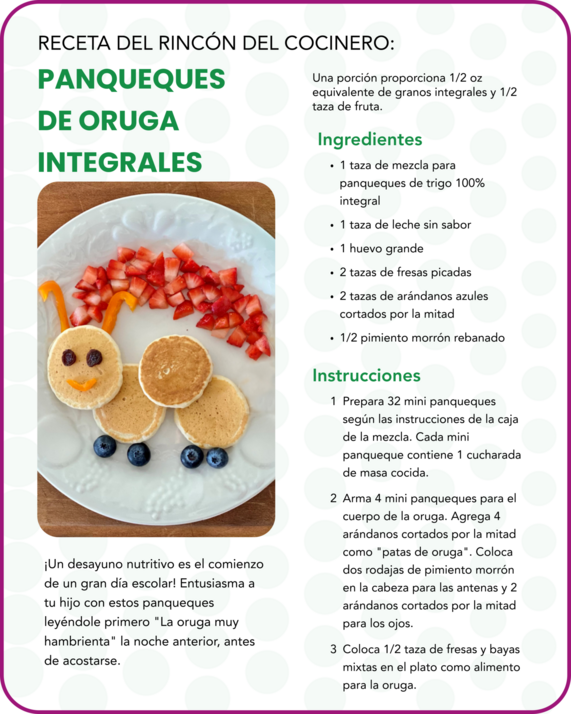
Whole Grain Caterpillar Pancakes
 Recipe card for "Whole Grain Caterpillar Pancakes" showing a photo of mini pancakes arranged like a caterpillar decorated with fresh berries, alongside the ingredients list and step-by-step instructions.
|
|
Español
En esta edición:
-
Recordatorios importantes sobre el Preescolar Universal
-
¿Qué deben saber las familias ahora mismo?
-
Alrededor de Colorado
-
Saltando hacia el éxito
-
Apoyando las matemáticas con patrones
-
Alfabetización temprana a través del arte
-
El tarro de crecimiento de primavera: una actividad de reflexión familiar
-
Receta del Rincón del Cocinero
-
Recursos y enlaces rápidos del Preescolar Universal de Colorado
 Recordatorios importantes sobre el Preescolar Universal
Cronograma de la segunda ronda:
16 de marzo de 2026, antes de las 5 pm - CDEC realiza la segunda ronda de asignación entre familias y proveedores. Las familias que hayan presentado su solicitud antes de las 11:59 pm (MST) del 15 de marzo de 2026 serán incluidas en esta ronda.
Del 24 al 31 de marzo de 2026 - Las familias recibirán la notificación de su asignación de la segunda ronda. Deben aceptar o rechazar antes de las 11:59 pm (MST) del 31 de marzo de 2026.
- Si deciden rechazar, deben comunicarse con proveedores o con su LCO para recibir apoyo en la inscripción con un proveedor que tenga cupo disponible.
- Si deciden aceptar, trabajarán directamente con el proveedor para completar la inscripción.
Inscripción directa: del 1 de abril de 2026 hasta el final del año programático 2025–26
- Las familias se inscriben directamente con los proveedores.
- Las familias que no participaron en las rondas iniciales de solicitud o que prefieren trabajar directamente con un proveedor de su elección pueden aprovechar este proceso. Esto permite una conexión más ágil entre las familias y los preescolares locales.
Para no perderse fechas importantes del próximo año programático, manténgase al tanto de todos los plazos.
Para ver el programa completo, haga clic aquí:
 ¿Qué deben saber las familias ahora mismo?
 ¿Qué pasa si mi hijo califica para horas adicionales?
Además de las 15 horas universales que reciben todos los hogares, algunos niños pueden calificar para hasta 30 horas de preescolar sin costo, según ciertos criterios de elegibilidad (como ingresos bajos, estudiantes que aprenden en dos idiomas o niños en cuidado de crianza). Las familias deben asegurarse de subir toda la información y los documentos necesarios en su perfil del Portal Familiar para su verificación.
¿Qué pasa si me mudo después de recibir una asignación?
Si se muda a otra área después de recibir una asignación, debe evaluar si el proveedor actual sigue siendo una buena opción para su hijo. Si no es así, comuníquese con su Organización Coordinadora Local (LCO) actual y con la LCO de su nueva comunidad. Ellos le ayudarán a actualizar su dirección en el sistema y a explorar opciones disponibles con proveedores en su nueva zona.
¿Puedo cambiar de proveedor más adelante?
Sí, las familias pueden solicitar un cambio, aunque la disponibilidad no está garantizada y depende de si el nuevo proveedor tiene cupos disponibles. Se recomienda comunicarse con su proveedor actual o con su LCO local para hablar sobre el proceso de cambio y asegurar una transición sin problemas para su hijo.
|
|
 ¡Es el Mes Nacional de la Lectura!
Marzo es el Mes Nacional de la Lectura. Celebra el gusto por la lectura con tu hijo visitando tu biblioteca local. Muchas bibliotecas en todo Colorado están ofreciendo horas de cuentos, retos de lectura y eventos familiares durante todo el mes.
|
 Día del Niño en el Denver Art Museum
Celebra a la niñez y la creatividad en el evento anual Día del Niño del Denver Art Museum el 26 de abril de 2026, de 10 a. m. a 5 p. m. (MST). Las familias pueden disfrutar de actividades artísticas, presentaciones y experiencias interactivas diseñadas para inspirar a los más pequeños y celebrar la infancia.
|
|
 Saltando hacia el éxito
¡El 20 de marzo marca el comienzo de la primavera! Es el momento ideal para hacer una pausa y celebrar el crecimiento de tu hijo desde el otoño. Tómate un momento para reflexionar sobre cómo se encontraba hace unos meses y compararlo con cómo se encuentra ahora. Para obtener información más detallada sobre los hitos del desarrollo de tu hijo, consulta las Pautas de Desarrollo Temprano de Colorado. ¡Aprovechemos este mes para apoyar el aprendizaje en casa con algunas ideas divertidas y primaverales para que el progreso siga floreciendo!
Apoyando las matemáticas con patrones
Los patrones ayudan a los niños a desarrollar habilidades matemáticas tempranas y el pensamiento lógico. Favorecen su capacidad para reconocer secuencias: qué viene, qué va primero y qué viene después. Habilidades útiles en la vida cotidiana. Estas actividades ofrecen una forma práctica para que su hijo aprenda:
-
Patrones: Busca cuentas, botones u objetos pequeños que tengas en casa y crea patrones ABAB sencillos (por ejemplo, rojo, azul, rojo, azul). Una vez que tu hijo se sienta cómodo, aumenta la complejidad con patrones ABC (rojo, azul, amarillo) o AABB (rojo, rojo, azul, azul). Incluso puedes incorporar formas o colores culturales. Cada vez que tu hijo termine un patrón, pregúntale: "¿Cómo supiste que ese venía después?". Escucharle explicar su lógica suele ser más importante que que acierte el patrón.
-
Paseo por la naturaleza: Da una vuelta a la manzana o al parque de tu barrio. Recoge palos, piedras, hojas y flores. Ayuda a tu hijo a crear un patrón (piedra, palo, piedra, palo). Anímalo a predecir qué viene después en el patrón y a crear nuevos patrones para compartir contigo.
-
Patrón rítmico musical: Crea música y trabaja la motricidad haciendo que tu hijo te siga en un patrón musical. Crea una secuencia como "Aplauso, pisotón, aplauso" o "Aplauso, pisotón, pisotón" y experimenta con la velocidad de estos patrones mientras tu hijo participa. ¡Aumenta el desafío! Incluso puedes incluir una maraca casera (arroz en un recipiente) u otro instrumento en el patrón.
Alfabetización temprana a través del arte
Para un niño en edad preescolar, un garabato no es sólo un garabato: ¡es un mensaje!
-
Celebra la "Historia" en el Garabato: A menudo queremos ver a nuestros hijos escribir sus nombres a la perfección, pero la verdadera magia comienza con el lenguaje oral. Cuando tu hijo te muestre su arte, intenta decirle: "¡Cuéntame la historia de lo que está pasando aquí!". Actúa como su "escritor". Mientras explica su arte, escribe esa frase exacta al final de la página. Por ejemplo, si dice que su garabato verde es un "dragón escondido en la hierba primaveral", escribe esa frase exacta al final de la página. Esto le demuestra que sus palabras tienen poder y pueden convertirse en texto escrito. Es un gran momento de revelación para su desarrollo de la lectoescritura.
-
Narración de Cuentos: ¡No siempre necesitas un libro para practicar la lectura! Intenta empezar una historia como: "Había una vez una semillita llamada Sam..." y deja que tu hijo la continúe. Esto desarrolla habilidades narrativas y vocabulario, que son los mejores predictores del éxito lector en el futuro. Le ayuda a comprender cómo se construyen las historias con un principio, un desarrollo y un final. ¡Amplía el aprendizaje pidiéndole que dibuje su historia y escriba su propio libro!
-
Actividad de primavera: Toma tizas o crayones y pídele a tu hijo que dibuje "el viento" o "el sol despertando las flores". Estas ideas abstractas lo animan a usar palabras más descriptivas al explicarte su obra maestra.
El tarro de crecimiento de primavera: una actividad de reflexión familiar
Puedes hacer visible el crecimiento de tu hijo en casa. Esta actividad es una forma maravillosa de sentarte con él, repasar su semana y celebrar cuánto está creciendo.
Cómo empezar tu Frasco de Crecimiento:
-
Encuentra tu Jardín: Usa un frasco de vidrio limpio, un recipiente transparente o incluso una caja de zapatos. Deja que tu hijo lo decore con pegatinas, colores, cintas y papel..
-
Prepara los pétalos: Recorta tiras de papel de colores.
-
El Observar y Escuchar Diario: Una vez al día, busca un momento de crecimiento. ¿Identificó las letras en un paquete de comida? ¿Se puso la chaqueta y la mochila solo? ¿Explicó un garabato usando una palabra nueva?
-
Anota su Éxito: Pídele a tu hijo que te diga qué hizo. Escribe sus palabras exactas en la tira de papel.
-
Llena el frasco: Deja que tu hijo doble el papel y lo coloque dentro.
-
Celebra: Una vez que el frasco esté lleno, siéntense en familia, vacíenlo y lean cada trozo de papel en voz alta. Es una manera poderosa para que tu hijo celebre y vea su propio progreso..
Por qué esto es importante:
Al hacer esto, les enseñamos a los niños la autorreflexión. Al decirles: "Me di cuenta de que te esforzaste mucho hoy para escribir tu nombre", fortaleces su confianza y les demuestras que su esfuerzo es lo que los impulsa a crecer.
|
|
|
|
|