|
|
Now Taking Applications: Sponsors & Exhibitors for the 2025 Statewide Community Corrections Conference |
Sponsorship
- Your generous sponsorship allows us to continue to provide renowned keynote speakers, conference swag, prizes for employee awards and gamification, and offer other opportunities to complement the attendee’s experience.
- If you are interested in learning more about sponsorship opportunities, please see the Sponsorship Information pdf and complete the Conference Sponsorship Submission form.
Exhibitor
- Your organization can purchase an exhibit table to provide information about your services/products during this two-day conference. This is an opportunity for businesses and organizations in the community to provide information about the helpful resources available to criminal justice professionals and individuals transitioning back into the community.
- If you are interested in learning more about purchasing an exhibitor table, please see the Exhibit Table Information pdf and complete the Conference Exhibitor Submission form.
We truly appreciate your support and contributions to the Conference's success! For questions or further information about sponsorship opportunities or reserving an exhibit table, please contact Chrystal Owin ( chrystal.owin@state.co.us ). For general conference questions, please contact Kate Coates ( kate.coates@state.co.us )
 |
|
Save The Date! |
October 21st - 22nd, 2025 OCC Conference - Empowering Change
Dates: October 21st - 22nd, 2025
Location: Delta Hotels Denver Thornton 10 E 120th Ave, Northglenn, CO 80233, USA
More information to come!
 |
|
Welcome to the team - Derek Ruder |
By Tahnee Santambrogio
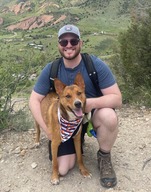
OCC's newest team member Derek Ruder!
Derek will be a part of our Core Security evaluation team bringing a variety of experience in juvenile corrections and social work. He is originally from Indiana and loves to travel, enjoying all Colorado has to offer including adventuring in the outdoors with his wife and their dog, Max.
We are excited to have him as a part of the OCC Crew!
|
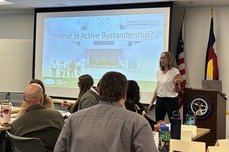
Active Bystandership Training:
A Step Toward a Stronger Workplace
By Katie Ruske & Kellen Lemos
On April 29, 2025, staff from across the Division gathered at 690 Kipling for a day of learning and connection during the Active Bystandership Training, led by experts from Heroes Active Bystandership Training.
The training focused on a vital but often overlooked skill: the ability to intervene in the moment — especially when something doesn’t sit right. Whether it’s witnessing a policy infraction, a mistake, or a moment that called for support or redirection, we’ve all experienced situations where we wished we had spoken up or stepped in. This training helped us turn that instinct into action.
Throughout the day, participants explored real-world scenarios, learned practical tools, and reflected on the role we each play in fostering accountability, integrity, and a supportive workplace culture.
This investment in professional development reflects DCJ leadership’s ongoing commitment to building a workplace where we not only serve our community with excellence but also show up for each other with courage and care.
We’re proud of everyone who participated and look forward to continuing this important work together.
|
 |
|
We are hiring!
Training and Technical Assistance Specialist
|
The position is responsible for the external training and quality assurance services of the Office of Community Corrections in the Division of Criminal Justice. Duties include complex analysis of community corrections program performance data and other information, the creation and facilitation of statewide training for community corrections programs and boards including formal programs in SOA-R The position also serves as a liaison and staff to the the House Bill 10-1352 Advisory Committee, and as a liaison between the Office of Community Corrections and representatives of various criminal justice agencies and stakeholders including, but not limited to, the Department of Corrections, Office of Behavioral Health, and State Judicial Branch (Probation).
- Apply by: 6/30/2025 5:00 PM Mountain
- Salary: $70,140.00 - $96,768.00 Annually
- This position is a hybrid model with a minimum of two days in the office.
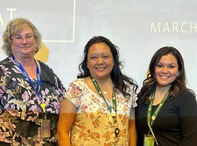
A Day of Learning and Connection: 17th JD’s Annual Community Corrections Retreat
By Johanna Siens
On March 20th, the 17th JD Board staff hosted a retreat for the Community Corrections Board, Screening Committee, and Program Providers — an annual event designed to support ongoing education and build stronger connections across our community.
This year’s retreat covered a range of important topics, including lived experience, data sharing, and unconscious bias. We were grateful to have Chrystal Owin and Morayma Trejo from the OCC join us to lead an insightful discussion on Unconscious Bias, sparking great conversation among attendees.
One of the highlights of the day was a powerful panel featuring current community corrections residents who shared their personal journeys and experiences within our programs. Their stories added depth and heart to the day’s learning.
We wrapped up with a networking activity that gave everyone a chance to connect, reflect, and recharge. The retreat also provides board and screening committee members with valuable training hours — and we’re happy to report it was a big success!
|
 |
|
Critical Incident Reminders |
By Wendy Bacchi
As prescribed by CCC-020 in the 2022 Colorado Community Corrections Standards, programs shall notify the local community corrections board, referral agencies and the OCC by email within 24 hours of critical incidents involving clients and staff either in the program or in the community that qualify based on the list below.
Please keep in mind that an incident may not initially present as critical, but as it evolves, may end up meeting the qualifications for notification. Please do not hesitate to send the incident report if/when a situation evolves into something more serious.
Please make sure you are using the most recent version of the standardized Incident Notification reporting form that has been developed for programs to use to help with this data collection.
As a reminder, the notification must clarify the status of the incident and any action(s) being taken to resolve the situation. Additionally, any information relevant to the status or outcome of the incident at the time of resolution also needs to be sent to the OCC as a follow-up. The OCC may require additional information upon request.
The types of incidents regarding clients and/or staff members that require written notification to referral and oversight agencies shall include, but are not limited to:
(a) The occurrence of any communicable disease that poses a significant threat to staff or clients;
(b) Any criminal offense alleged to have been committed by a client or staff member on or off grounds;
(c) Any altercation, on or off grounds, involving a client and resulting in injury and/or law enforcement involvement;
(d) The death of a client*;
(e) Use of force by a staff member;
(f) Any event that has compromised or may compromise the provision of supervision and safe care, including but not limited to: damage to the facility, employee strike, interruption in food service, and/or protracted interruption in utilities;
(g) Any event that has the potential for media coverage;
(h) Occurrences in which a client, staff or visitor is transported by ambulance, treated in an emergency department or admitted to a hospital due to serious bodily injury, overdose or there is a significant risk of loss of life.
- There is one exception to this incident type. Emergency transports for routine health conditions need not be reported to the OCC.
*Please note that client death notifications may also need to be reported as part of the Death in Custody Reporting Act (DCRA; Public Law 113-242).
 |
|
Reentry with Dignity: How Funding is Reducing Recidivisim |
By Paula Vargas
Reentering a community after incarceration isn’t the finish line, it’s the starting point. And without stable housing, that first step can feel impossible.
With initial grant funding from the Colorado Division of Criminal Justice (DCJ), the Boulder County Sheriff's Office launched its first Transitional Housing Program in 2021 to meet a challenge with compassion, strategy, and care. The program provides more than just housing after completing jail sentencing; it offers wraparound support, reentry planning, and the chance to move forward with dignity. From sober living to residential treatment to assisted living, the program meets people where they are, helping them rebuild their lives.
Since its launch, the program has supported over 150 individuals with an 84% success rate in keeping people out of jail.
 |
|
The Quality Assurance Audit Tools Should Be Released Soon! |
By Mindy Miklos & Shawna Nichols
The Office of Community Corrections (OCC) has been working on building quality assurance audit tools to assist Community Corrections Boards with auditing Standards and Operational Requirements that are not reviewed during a PACE or Core Security audit. We believe you will find these audit tools user-friendly and give you the opportunity to review other areas of program practice. We are excited to be releasing these soon!
How Colorado is Helping Crime Survivors Heal
By Paula Vargas
When someone experiences trauma, the road to healing often begins with one caring voice, someone who shows up, listens without judgment, and helps make sense of what comes next.
At the Division of Criminal Justice (DCJ), we help make that possible. Through VOCA, the federal Victims of Crime Act grant program, we fund vital programs across Colorado that provide support when it's needed most.
In the City of Longmont, that means advocates from the Longmont Police Department's Victim Services Program are there to respond to domestic violence, child abuse, human trafficking, fatal accidents, and other deeply traumatic events. They provide crisis response, explain victims' rights, connect people to bilingual services, and walk alongside survivors through every step of the process.
Take a moment to hear from the voices on the front lines and hear how DCJ funding is making a difference.
|
|