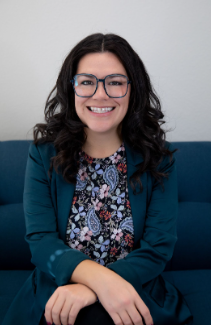
Please welcome our newest Board member representing Mental Health Professionals, Lauren Rivas.
Lauren is a Licensed Professional Counselor (LPC) and an SOMB full-operating treatment provider, evaluator, and clinical supervisor. She has worked under the auspice of the SOMB since 2010, both at community-based treatment providers and inpatient treatment. She earned her Bachelor of Arts (BA) in Psychology at Regis University and Master of Arts in (MA) Forensic Psychology at John Jay College of Criminal Justice. Concerning SOMB involvement, Lauren has assisted with several committees and work groups and currently is a member of the Application Review Committee (ARC) and is the Adult Standards Revisions co-chair. She also provides expert testimony. Additionally, Lauren is an Approved Clinical Supervisor (ACS).
|
In March 2025, the SOMB reviewed the proposed policy regarding the Use of Interns by SOMB-Approved Treatment Providers and Evaluators. Following changes to the Mental Health Practice Act, 12-245-271 states that “Students who are enrolled in a school program and are practicing as part of a school practicum or clinical program” are exempt from the requirement to be listed or licensed with DORA. Interns are expected to work under the supervision and license of a clinical supervisor, and the Board has agreed we should be consistent with those expectations.
The SOMB recognizes that there are Approved Treatment Providers and Evaluators who are qualified and approved through their licensing boards to provide clinical supervision to interns. These individuals may also not always hold the status of SOMB Clinical Supervisor. Interns may be supervised by SOMB-approved providers as their internship supervisors, although all work products completed by the intern (i.e., Treatment plans, discharge summaries, evaluations, etc.), are required to be reviewed and signed by an approved SOMB clinical supervisor. In addition, should an Internship Supervisor not be an SOMB Clinical Supervisor, the supervision agreement shall be signed by both parties. The approved SOMB Clinical Supervisor shall ensure that any work product completed complies with SOMB standards.
All Application documents, Section 4: Qualifications of Treatment Providers, Evaluators, and Polygraph Examiners working with Sex Offenders/ Juveniles who have Sexually Offended and the SOMB Administrative Policies will be reviewed to ensure consistency with this updated policy. Any Standards revisions will be brought to the Board for review and final approval. Please feel free to contact erin.austin@state.co.us or paige.brown@state.co.us
In March 2025, the SOMB reviewed suggested language approved by the Colorado Attorney General's Office to update the Qualification Standards, Section 4 regarding Provider and Applicant criminal history. These sections of the Standards are intended to provide language that expands the definition of “conviction” to be consistent with other licensing boards and to help ensure Applicants and Providers are appropriate to deliver work with individuals who have committed sexual offenses.
Some noticeable changes include:
- Applicants and Providers will have to disclose any court-martial convictions.
- Applicants and Providers will have to disclose a deferred prosecution agreement, a deferred adjudication, a juvenile adjudication as well as any criminal record which has since been expunged and/or sealed.
- Not be party to any civil dispute that is related to the ability of the Applicant or Provider to practice under the Standards.
- To not use drugs or alcohol in a manner that would compromise the ability to practice under the Standards.
- Notification within 10 days in writing of any issuance of any arrest, is now extended to also receiving a summons.
These proposed revisions were approved by the Board and public comment was open for two weeks. The Application Review Committee and the Best Practices committee will be reviewing the public comment before this goes back to the full Board for final approval and ratification. Please feel free to contact raechel.alderete@state.co.us with any questions regarding these proposed revisions.
SOMB Providers, please ensure the address and information listed in the addresses tab of the Provider Data Management System (PDMS) is correct. You may list multiple counties, locations and agency names as long as you are able to provide in-person services at the listed location. We also have a new feature that allows you to select “publish” to publish your business email address on the Approved Provider List. You asked for it and we listened! For further questions, please contact SOMB staff.
Now Available: 2025 SOMB Annual Legislative Report – Highlights from PDMS Data Collection
The 2025 Annual Legislative Report is now live on the SOMB website under the Research section. In our previous newsletter, we shared key findings from our recidivism study of adults and juveniles receiving treatment under SOMB standards. In this edition, we’re excited to spotlight insights from the fifth year of PDMS aggregate data collection, featured in Appendix C of the report.
Key Highlights from the 2024 PDMS Data
Service Volume Trends
Providers across Colorado delivered a high volume of evaluations, treatments, and polygraph examinations in 2024. However, overall numbers showed a modest decline compared to 2023.
Client Consent for Future Data Matching
Consent rates for data sharing to support future recidivism research varied by service type, ranging from 54% to 75% for adults and 30% to 73% for juveniles. Encouragingly, most categories saw an upward trend in consent rates, supporting more robust long-term outcomes analysis.
Risk Reduction Over Time
More than half of all clients were assessed as low risk at discharge from treatment. Among adults, 35% to 52% demonstrated a reduction in risk level during treatment (in addition, 22% began treatment at the lowest level). Juvenile clients showed even stronger outcomes, with 62% to 100% lowering their assessed risk by the end of treatment. Very few clients increased in risk level, suggesting either emerging clinical concerns or improved understanding of their baseline risk through treatment.
Successful Discharges by Initial Risk Level
Clients assessed as low risk at intake had the highest rate of successful discharge (58%), while those initially assessed as high risk had the lowest (29%). These findings reinforce the value of early and accurate risk stratification and efforts to engage and maintain those at higher risk in treatment.
Polygraph Utilization and Findings
The majority of polygraphs conducted were for maintenance and monitoring, with the fewest for instant/index offense disclosure. Among adult clients, 43% of exams yielded clinically significant disclosures. Additionally, 23% of maintenance/monitoring and sex history exams showed signs of deception or significant physiological reactions. Only a small number of polygraphs were administered to juvenile clients.
We encourage you to explore the full report for more in-depth findings and trends relevant to your work. Your continued partnership and commitment to data-driven practice are key to advancing the effectiveness of Colorado’s treatment and management strategies.
Read the full 2025 report and Appendix C
2025 Summit in the Rockies on Domestic Violence and Sex Offender Management
We are happy to announce that our Annual Conference will be held July 8-11, 2025 in Breckenridge, CO! The theme of the 2025 conference is "Evolving through Reflection: Teamwork, Compassion, Innovation." Registration will open April 28, 2025 and Early Bird Pricing will end May 31st.
SOMB Roundtable / SOMB 102: Advanced Series: Standards and Policy Implementation
This advanced training will be geared towards the implementation of the Standards regarding the use of the polygraph for members of the CST/MDT. It will provide information on how Supervising Officers, Evaluators, Treatment Providers, Polygraph Examiners, and Victim Professionals should be interacting when a client is being referred for a polygraph. Specifically, how teams should be formulating question areas, responding to results, processing information gained, and planning for next steps.
Following an in-depth look at the Polygraph Standards, the afternoon will include a roundtable discussion between professional members of CST/MDTs. The hope is to highlight 'Issues, Concerns, Opportunities, and Sustains' regarding the use of the polygraph within CST/MDTs, which will enhance collaboration and increase positive outcomes for community safety.
Please refer to our TRAINING POLICY for more information on who may attend this training.
WHEN: June 9, 2025
WHERE: Boulder Justice Center
1777 6th Street, Boulder, CO 80302
TIME: 8:30 AM - 3:30 PM
FORMAT: In Person Only
COST: Free
CEU: 6 hours
AUDIENCE: This training is open to treatment Providers who work with the 20th judicial district, supervision officers, and other professional members of Community Supervision or Multidisciplinary Teams.
The SOMB would like to recognize April as Sexual Assault Awareness Month. The SOMB honored Sexual Assault Awareness Month with a presentation highlighting a survivor speaker and a presentation from Wings director, Jenny Stith around the reality of delayed reporting. Board members and attendees were also able to engage with posters featuring quotes from an article shared by the SOMB Victim Advocacy Committee, She waited decades to report her abuse. At 81, police say, he confessed. Please reach out to paige.brown@state.co.us if you would like a PDF copy of this article.
Additionally, Board members were encouraged to participate in Colorado Denim Day 2025. Colorado Denim Day 2025 is Wednesday April 30th, 2025. Please see below for a statement on the origins of Denim Day from CCASA.
“In 1999, a case in Italy came to worldwide attention when a young woman accused her 45-year-old driving instructor of brutally raping her during a driving lesson. He was sentenced to 34-months in prison before the case made its way to the Italian high court, where the sentence was overturned. The Chief Judge released a statement arguing that because the victim wore tight jeans, he assumed that she must have helped her perpetrator remove her jeans and, therefore, consented.
Enraged by the verdict, the women in the Italian Parliament launched into immediate action and protested by wearing jeans on the steps of the Italian Parliament building. This was the beginning of what has become a worldwide event and movement to wear jeans as a visible means of protest against misconceptions that surround sexual assault.”
The SOMB encourages all to seek out Sexual Assault Awareness Month events in your communities and further learn how you can remain victim centered and support survivors of sexual violence.
|