|
|
OCC: Highlights from the 2024 Annual Conference! |
By Kate Coates
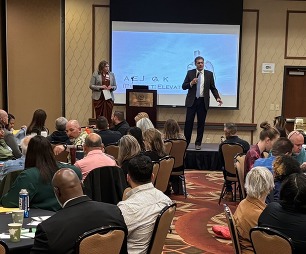
The 2024 Statewide Community Corrections Conference: “Building a Safer Community Together” was held October 23 to 24. Over 320 attendees, 58 presenters, 27 breakout sessions, 12 vendors, and 8 sponsors. This is OCC's largest conference.
The growth we have seen is a testament to each of you and the dedication and passion you have for building a "Safer Community Together".
The conference hosted 27 breakout sessions and two principal keynote speakers. The feedback received about the content of the presentations and presenters has been outstanding. Participants shared their appreciation for the wide variety of presentation topics that were very helpful, in depth, and rich in discussion. The conference also hosted many vendors who provided information and resources about therapy providers, re-entry support, and safety monitoring
The prize drawing game was a highlight of the conference. The game encouraged participants to attend and participate in breakout sessions and network with their peers, speakers, and vendors. Over 18 sponsors from the field and the community donated prizes to show their appreciation for corrections staff. Several prize drawings were held rewarding staff for their participation at the conference.
A very special thank you to our sponsors; Dominion Diagnostics, Scram Systems, EMBRAVE, Thrivur Health, Advantage Treatment Centers, GEO, Colorado Community Corrections Coalition, and Mainstream.
The Office of Community Corrections thanks all of our attendees, speakers, sponsors, and exhibitors for an exceptional conference and we look forward to seeing you in 2025!
|

Upcoming Training Opportunities
Jan/Feb/March 2025
|
JANUARY
FEBRUARY
MARCH
*NEW* VIRTUAL TRAINING “Recognizing the Signs and Symptoms of Drug Use and Withdrawal in Community Corrections Clients” with David Tyler Coyle MD, MS
This two hour virtual training will be offered on two different dates for staff to choose what best fits their schedule. The training will also be recorded so staff who cannot attend either time can have access to the information. Please click on your preferred date below to register.
This training is appropriate for all types of community corrections staff. Participants will learn about how to recognize active drug use and indicators of withdrawal in clients. Presenter David Tyler Coyle will share his experience and expertise in working with people struggling with Opioid Use Disorder, providing resources and information that will support staff and clients as they navigate this challenging epidemic. Each session will end with time for Q&A.
David (Tyler) Coyle MD, MS is an associate professor and co-director of the Division of Addiction Science, Prevention, and Treatment in the Department of Psychiatry at the University of Colorado School of Medicine. He is board-certified in both Public Health & General Preventive Medicine (PHGPM) and Addiction Medicine. He specializes in the medical management of opioid use disorder, seeing patients weekly at CU’s Addiction Research & Treatment Services Adult Outpatient Program.
After earning his medical degree from Columbia University, Dr. Coyle completed his residency training in PHGPM at the University of Maryland, Baltimore, where he also earned a master’s degree in Epidemiology. Following residency, Dr. Coyle worked at the U.S. Food & Drug Administration as a medical pharmacoepidemiologist specializing in the non-medical use of drugs. He is the Program Director for CU’s PHGPM Residency since 2021 and was president of the Colorado Society of Addiction Medicine from 2023-2024. Dr. Coyle has led projects funded by private, state, and federal grants at CU.
Thank you,
The Office of Community Corrections
For More Information, Please Visit: OCC Training Calendar
For Training Questions: Joe Maes (joe.maes@state.co.us)
For Technical Assistance & Security Code: Kellen Lemos (kellen.lemos@state.co.us)
 |
|
Reminder: ASUS-R Retirement December 31, 2024 |
By Chrystal Owin
This is a reminder that the final day the ASUS-R (Adult Substance Use Survey - Revised) assessment can be used is December 31, 2024. All community corrections SOA-R (Standardized Offender Assessments - Revised) trainers were trained on the interim solution in October by the Office of Community Corrections and they, in collaboration with our office, have until 12/31/24 to train the interim solution to all staff who are already SOA-R trained. The interim solution must be utilized starting January 1, 2025, and not prior. For those new and future staff who have not yet been trained in the SOA-R, SOA-R trainers will be given an updated training outline and PPT by 12/31/24 to begin using as of 1/1/25.
A long-term solution is currently being evaluated and we will keep the field updated with our progress and implementation plan in the near future.
For questions, please contact Joe Maes, Training and Technical Assistance Specialist, at joe.maes@state.co.us.
By Ellen Dawson
The use of a specialized designation in CCIB is intended for clients who meet criteria as outlined in the Scopes of Work for the following treatment programs: Intensive Residential Treatment (IRT), Residential Dual Diagnosis Treatment (RDDT), and Sex Offender Supervision and Treatment in Community Corrections (SOSTCC).
This designation allows for the program to receive an additional daily per diem for that client. The purpose of the additional per diem is to support and finance the specialized services the client will be receiving while in the treatment program, such as IRT, RDDT, or any sex offense specific services required by the client’s sentence.
For a client to receive a SXO treatment designation in CCIB, they must be sentenced to community corrections for a sex offense, be required to attend offense specific treatment and engage in polygraphs and evaluations. Clients who are in a designated SXO treatment bed cannot receive funding for these services from another source.
If you have any questions regarding specialized funding or requirements, please do not hesitate to reach out to our office.
By Wendy Bacchi
CTF and SOS funds can be used to help pay for treatment services for clients who meet the criteria for these funds. CTF and SOS funds cannot be used for treatment being provided through a specialized bed. For example, if there is a client in a specialized SXO bed, they cannot receive funds to pay for SXO treatment. They may be eligible to receive funds for mental health or substance use treatment if it is indicated by their assessments. Below is a quick guide for determining if your client is eligible to receive either CTF or SOS funds to assist with treatment costs.
CTF Fund Criteria:
- TXRW must be Level 3 or Higher
- Diversion & Transition Clients
- IRT and RDDT Clients cannot use this fund for their bed specific treatment
- Substance Use Treatment is allowed
- Mental Health Treatment is allowed
- DUI 4+ is allowed
- Can be used sparingly for Non-Res (although they should be learning to pay for their treatment themselves when they are out on non-res.)
SOS Fund Criteria (Specialized Offender Services (SOS) Funding Guidelines):
- Diversion Only
- SXO Clients in a specialized SXO bed cannot use this fund for offense specific treatment
- Must submit a request to OCC (Specialized Offender Service Funding Application-Fillable PDF Form)
- No Substance Use Treatment
- Mental Health Treatment Allowed as long as there is no Active Substance Use Treatment
- Domestic Violence Treatment Allowed
- Anger Management Treatment Allowed
- Cognitive Behavioral Groups Allowed on a limited basis
- Can be used sparingly for Non-Res (although they should be learning to pay for their treatment themselves when they are out on non-res.)
Please reach out to our office if you have any questions regarding these funds and your client’s eligibility to use them.
When: January 24, 2025
Time: 10:30 am - 1:00 pm
Where: 710 Kipling Street, Denver, CO, 80215, 2nd Floor Conference Room
GAC's Mission: The Governor's Community Corrections Advisory Council advises and assists the Division of Criminal Justice in analyzing and identifying problems or needs, recommending policy modifications or procedural changes and developing strategies for the community corrections system. They also serve as a forum to address issues in community corrections brought forth by Council members or other stakeholders. Council members represent various units of government and private interests and are appointed by, and serve at the pleasure of, the Governor and receive no compensation for their participation.
|