|
Next Lunch-MAR: SJV Water Resilience Outcomes
The next Lunch-MAR presentation will feature Laura Ramos, Director of the California Water Institute at Fresno State. She will discuss the numerous positive outcomes generated at San Joaquin Valley (SJV) Water Resilience Summit held last May at Fresno State. The summit served as a collaborative working forum focused on translating water policy reports into practical, actionable results for the region. This hour-long webinar begins at 12:30 p.m. on Wednesday, September 2. Registration is not required to attend.
|
New Recharge Readiness webinar series kicks off on August 27
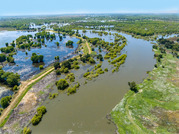
With “Super El Niño” threatening California with a very wet 2026–2027 winter season, a collaborative community of researchers across the state have been working to create a variety of new advances to managed aquifer recharge (MAR). A new recharge readiness series will share information about recently completed guidance, projects, and case studies to help recharge project planners, growers, and local agencies prepare for the wet season ahead. Co-hosted by DWR, Sustainable Conservation, and the Flood-MAR Network, these webinars will be held twice monthly, on the second and fourth Thursdays at 11 a.m., through next February. The series kicks off this week with its first webinar, “Site Selection and Recharge Potential,” on August 27. Registration is open now. To see the list of topics to be covered over the next 10 webinars, visit the “2026–2027 Recharge Readiness Webinar Series: Expanding Recharge and Preparing for Wet Weather” webpage.
|
COEQWAL launch event at CNRA building on September 3

Collaboratory for Equity in Water Allocation (COEQWAL) is a new resource empowering all Californians to envision a more equitable solution to California’s diverse water needs. The California Natural Resources Agency (CNRA) will celebrate the public release of the COEQWAL web platform and reflect on the partnerships that have made this project possible. This in-person event will be held at the CNRA headquarters building in Sacramento on Thursday, September 3, from 1 to 6 p.m. Space is limited, so please RSVP if you plan to attend. This event will also be livestreamed via Zoom. Registration is open now for the Zoom stream. More information, including an agenda, is available on the COEQWAL launch webpage.
|
August 27: WSN-hosted workshop to cover Water Code 1707

Watershed Solutions Network (WSN) will host a virtual workshop on Thursday, August 27, from noon to 2 p.m. “Keeping Water in Our Streams” will focus on instream flow dedication as defined by California Water Code Section 1707. Section 1707 was amended into the water code in 1999 to preserve the water right for the water rights holder who wishes to leave their water in stream. This protection allows a water rights holder to benefit from instream uses without running the risk losing their rights or having that water diverted by someone downstream before the instream flow serves its purpose. Register now to join the conversation about the potential of Water Code 1707 instream flow dedications, the challenges of making them work, and the opportunities to improve access for water rights holders across California.
|
Article reviews 30 years of machine learning applications in Delta

DWR’s Senior Engineer Kevin He and Supervising Engineer Prabhjot Sandhu recently published a paper in Water (vol. 18, no. 14) entitled “Machine Learning for Water and Environmental Modeling in the Sacramento–San Joaquin Delta of California: A 30-Year Retrospective and Future Prospects.” The paper reviews 30 years of machine learning applications in California’s Sacramento–San Joaquin Delta, from early neural networks for salinity estimation to modern deep learning and physics-informed models. Machine learning now supports water quality, ecosystem monitoring, risk assessment, and infrastructure resilience, including integration with tools like CalSim. Operational adoption remains limited by interoperability, generalizability, interpretability, and implementation challenges. To help overcome these limitations, the authors propose standardized protocols, multimodal data, digital twins, generative artificial intelligence (AI), explainable AI, and AI agents.
|
California Water Quality Monitoring Council meeting, August 27

The California Water Quality Monitoring Council will hold its third quarterly meeting of 2026 on Thursday, August 27, from 9:30 a.m. to 3 p.m., in Sacramento. As with all Council meetings, this meeting is open to the public. See the meeting agenda for in-person and online participation details. Registration for this event is required and is open now.
|
|
|
|
|
|