California surpasses 21,000 megawatts of battery resources supporting the state’s electric grid
For Immediate Release: August 7, 2026
Contact: mediaoffice@energy.ca.gov
Phone: (916) 654-4989
WHAT TO KNOW: California has built the nation’s largest battery energy storage fleet, with more than 21,000 megawatts of capacity to strengthen grid reliability. Batteries leverage the state’s renewable energy portfolio, including its solar use, which has surpassed natural gas use for the first half of 2026.
SACRAMENTO – California's battery energy storage resources now exceed 21,000 megawatts (MW), making the state’s battery fleet one of the largest in the world. In under a decade, batteries have evolved from an emerging technology into a cornerstone of California’s clean energy transition. By storing electricity produced during periods of abundant solar generation and delivering it back to the grid when demand remains high, batteries are reducing reliance on natural gas and strengthening grid reliability.
When Governor Gavin Newsom took office in 2019, less than 700 MW of battery storage served the grid. Today, total battery storage capacity is 21,112 MW, an increase of more than 2,500% in just seven and a half years. That’s equivalent to roughly one-third of the statewide peak demand, which exceeded 63,000 MW during the September 2022 heat wave.
Governor Newsom highlighted the battery storage milestone Friday as he unveiled a new ZEV rebate program aimed at lowering costs for Californians:
“While Donald Trump is hellbent on burning more expensive fossil fuels and raising costs for Americans, California is proving there's a better way—from new instant rebates putting thousands of dollars back in the pockets of first-time electric car buyers, to an arsenal of batteries across the state that just topped 21,000 megawatts, the nation's largest, helping power the world's fourth-largest economy,” Newsom said. “California is showing the world what real economic security looks like. It’s one that can't be held hostage by foreign conflicts and Big Oil. The Golden State is leading the charge on building a reliable, affordable clean future.”
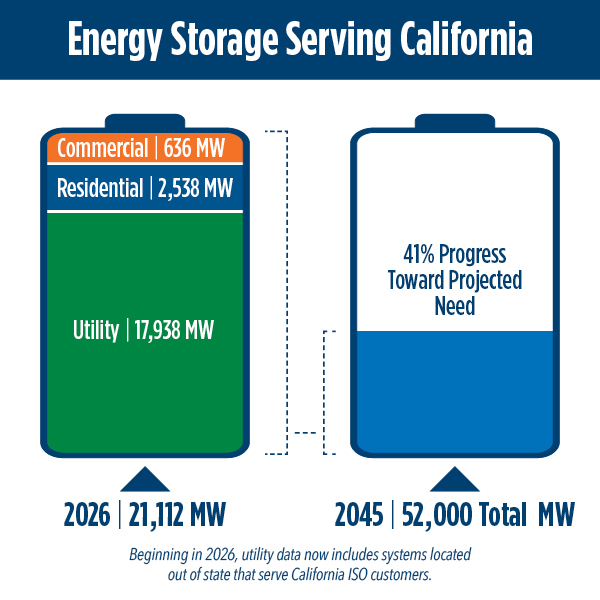 Of the total 21,112 MW of battery storage serving Californians, nearly 16,000 MW comes from 310 utility-scale battery systems located within California, and an additional 2,000 MW comes from utility-scale battery facilities located in Nevada and Arizona. These resources are part of the California Independent System Operator (CAISO) grid, which serves about 80% of Californians.
Another 3,000 MW comes from more than 300,000 smaller battery systems installed at homes, schools, farms, businesses, and industrial facilities across the state. These smaller systems can provide backup power during outages, store rooftop solar energy for later use, and help reduce strain on the grid during periods of high demand.
Unleashing the power of solar
Battery storage is transforming how California uses clean energy. By storing electricity produced by solar during the day and delivering it later when demand remains high, batteries make it possible for clean energy to serve a larger share of California's electricity needs and accelerate the state's transition to a 100% clean energy future.
Before batteries were deployed at scale, natural gas plants were relied upon to rapidly ramp up in the late afternoon and evening as demand peaked and solar production declined. Today, batteries increasingly absorb a portion of that ramp, displacing costly natural gas generation during one of the grid’s most critical periods of the day.
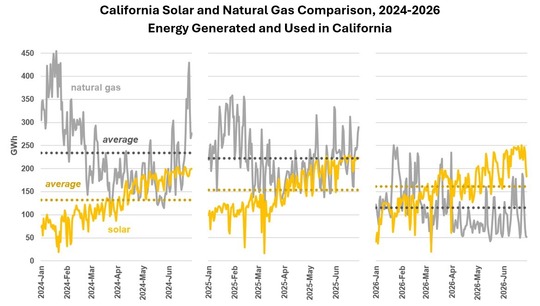
The results are visible across California's grid. For the first time, Californians used more solar than natural gas during the first half of 2026.
 Source: California Energy Commission analysis
Comparing January through June of 2024 to that same stretch in 2026, solar power usage grew by 22%, while natural gas usage dropped by 51%, according to the California Energy Commission’s (CEC) analysis of state grid data. Meanwhile, battery storage capacity on the grid grew by 80% over that same period, giving solar power somewhere to go even after the sun sets.
“California has always prioritized innovation, investing in the science and technology of the future and advancing the goalpost on what is possible,” said CEC Chair David Hochschild. “Seeing solar surpass gas on the grid is proof that our vision of a 100% clean energy future is absolutely possible.”
While seasonal factors play a role—solar production is strong and electricity use is relatively moderate in spring—the trend highlights how the growing contribution of solar and battery storage are changing the way California's grid operates.
This shift reflects years of investment in clean energy infrastructure. Since 2019, California has added more than 37,000 MW of clean and renewable energy resources to the grid, leading the nation in deployment of new electricity resources and transforming the state’s electric system.
California competitive advantage
California’s battery storage fleet is a national leader not only due to total capacity, but also because of the duration of energy it can deliver. While Texas has a similar amount of total installed battery capacity, its systems are designed to provide shorter duration discharges, typically two hours or less. California's fleet is dominated by four-hour duration battery systems, so it can deliver stored energy for approximately twice as long as Texas's fleet.
Not only is clean energy good for the grid, but it’s also good for the economy. California leads the U.S. in total clean energy jobs, with 552,300 workers employed across clean energy technologies—and nearly twice as many as the second ranked state (Texas), according to a 2025 report. California’s clean energy workforce added nearly 7,300 new workers in 2024, adding jobs more than three times faster than the rest of the state’s economy.
The growth of renewables also makes business sense. The price of solar has dropped 97% in the past 25 years, from $5 per watt in 2001 to just 15 cents per watt in 2025. Battery storage has seen similarly dramatic cost declines, with lithium-ion battery prices falling more than 90% over the past decade, enabling their deployment at unprecedented speed and scale.
Looking ahead
California estimates more than 52,000 MW of battery and long-duration energy storage will be needed by 2045 as electricity demand grows from continued electrification of transportation, buildings, and industry operations. With this update, California is now 41% of the way toward its goal.
Batteries are essential to California achieving 100% clean electricity retail sales by 2045. The latest numbers, from end of 2024, show remarkable progress: 67% of retail electric sales come from clean energy.
This progress is increasingly evident on the CAISO grid. Last year, clean energy resources met 100% of grid demand for at least some portion of the day on 279 days. For the first half of 2026, the CAISO grid has hit that mark on 92% of the days.
The state is committed to rolling out clean energy infrastructure as quickly and safely as possible. The CEC’s Opt-In Certification Program, California’s accelerated permitting program for clean energy infrastructure, has approved 1,850 MW of battery storage and 1,450 MW of solar generation in the past year, with more than 3,000 MW in the queue and more being added. These projects undergo rigorous environmental and safety review by the CEC and include agreements that provide benefits to the communities in which projects are located.
###
About the California Energy Commission
The California Energy Commission is the state's primary energy policy and planning agency, leading the state to a 100% clean energy future for all. It has seven core responsibilities: advancing state energy policy, encouraging energy efficiency, certifying power plants, investing in energy innovation, developing renewable energy, transforming transportation, and preparing for energy emergencies.
|