Lunch-MAR webinar today at 12:30 p.m.

Today’s Lunch-MAR meeting will feature executive team members from the Groundwater Demand Management (GDM) Network. Their presentation, “Groundwater Demand Management in California: An Overview of Case Studies, Implementation, Economics & Policy,” will examine real-world case studies across the state related to GDM. The discussion will compare measurement methods, funding mechanisms, and the key elements that define successful GDM communities, and explore lessons learned and strategic wins in basin-scale implementation. This hour-long webinar begins at 12:30 p.m. today. Registration is not required to attend.
|
Flood-MAR Network 2026 Engagement Survey
The Flood-MAR Network is asking all Network members to complete the Flood-MAR Network 2026 Engagement Survey. Your input will directly inform future programming, collaboration opportunities, and Network activities, including the upcoming Flood-MAR virtual workshop, “A New Era of California Water Planning,” scheduled for Thursday, September 17. Please share projects that you’re working on, how you’d like to participate in Flood-MAR endeavors, and what resources or connections would be most valuable to you. The survey is open now through Friday, August 21.
CEDEN 2.0 public launch scheduled for August 17

Back in August 2010, the State Water Resources Control Board (State Water Board) launched the California Environmental Data Exchange Network (CEDEN), which serves as the State Water Board’s official repository for California surface water quality data. Now, 16 years later, the State Water Board will launch CEDEN 2.0 on August 17. Like its predecessor, CEDEN 2.0 will continue to provide a centralized platform for collecting, sharing, and accessing information on the condition of the state’s streams, rivers, lakes, estuaries, and coastal waters. Water quality, aquatic habitat, and wildlife health will continue to be monitored by numerous organizations across California to support species protection. CEDEN brings these datasets together in a single, accessible system, making them available to environmental managers, researchers, and the public. CEDEN 2.0 offers a better user-friendly interface; a new data submission portal; and a modern, secure data system that can be continually updated. These features, among others, will lead to improved understanding of water quality. More information, including data submission guidance, is provided on the CEDEN 2.0 webpage.
|
August 18 webinar on new AWO water data platform
Finding water data in Arizona just got easier thanks to the Arizona Water Observatory (AWO), a centralized, open-source web platform that provides actionable, up-to-date water data across Arizona. The new water data platform is designed to streamline the process for quicker, data-backed water decisions. Arizona State University and the Center for Geospatial Solutions will host a webinar on Tuesday, August 18, at 10 a.m., to officially launch the AWO. The discussion will explore the tool, including standardized data, map-based visualizations, and a modernized user-interface, and how it will continue to improve water data interoperability in Arizona. Registration for this event is open now.
|
A 12-year study on the Colorado River Delta and lessons learned
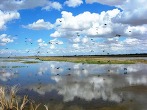
In June, a group of four scientists released their report on a 12-year study of environmental flow impacts on the Colorado River Delta. The State of the Colorado River Delta: Effects of Environmental Water Deliveries, 2014–2025 summarizes years of monitoring observations and measurements recorded by scientists on a 40-member team to document the hydrological, biological, and social effects of the environmental water deliveries mandated by the U.S.-Mexico Water Treaty of 1944, a pact that controls how the U.S. and Mexico share water from the Colorado River, Tijuana River, and the Rio Grande. The report highlights birds and other wildlife attracted to the 1,381 acres of restored riparian vegetation, downstream rises in groundwater levels, 39 river-miles of flowing river, and community benefits, including employment, recreation, and engagement. It warns, however, that these successes are not self-sustaining. The report concludes with recommendations, based on the lessons learned during this 12-year period, for how to support the restoration sites and river channel in the future.
|
|