|
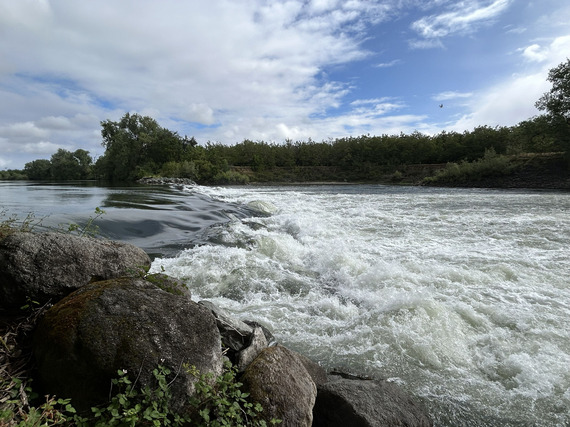
The Feather River flows near Sunset Weir in Sutter County. Photo courtesy of WCB staff.
WCB Approves $80.4 Million for Wildlife Connectivity, Salmon Recovery, Biodiversity and Public Access Projects
Funding Will Protect Biodiversity Hotspots and Expand Access to Nature Across California
The Wildlife Conservation Board (WCB) approved $80,450,797 in grants for 23 projects across 16 counties to protect biodiversity, restore wildlife habitat and expand public access to nature. The board met today at the California Natural Resources Agency headquarters in Sacramento.
Among these, seven projects advance the California Salmon Strategy for a Hotter, Drier Future, restoring floodplains, improving stream function and enhancing habitat for coho salmon, Chinook salmon and steelhead trout. Projects also include investments in wildlife corridors, wildfire resiliency, wildlife-oriented recreation and butterfly pollinators.
WCB’s grants advance Gov. Gavin Newsom’s goal of conserving 30 percent of California’s lands and coastal waters by 2030, a globally adopted target known as 30x30. The initiative seeks to protect biodiversity, expand access to nature for all Californians and adapt to climate change.
Investing in the Governor’s Salmon Strategy
- A $29.3 million grant to the California Department of Water Resources (DWR), in cooperation with the Sutter Extension Water District (SEWD) and the California Department of Fish and Wildlife, will remove the Sunset Weir on the Feather River near Live Oak in Sutter County. The project will restore fish passage to 28.5 miles of upstream habitat for Central Valley Chinook salmon, steelhead and green sturgeon. It will also restore more natural flow patterns, reconnect sediment movement and improve overall river function. Additional work includes fish screens, diversion upgrades and bank stabilization.
“We’ve talked about removing Sunset Weir for decades. This funding and our partnership with SEWD will finally make it possible,” said James Newcomb, deputy director of natural infrastructure and ecosystem resilience with DWR. “This project restores more natural river function while continuing to support local water management needs.”
- A $4 million grant to California Trout Inc. (CalTrout) will restore approximately 500 acres of historic tidal marsh on the Cannibal Island Unit of the Eel River Wildlife Area in Humboldt County. The project will reconnect the site to tidal flow by removing fill and outdated infrastructure, improving habitat for coho salmon, Chinook salmon, steelhead and other native species while increasing resilience to sea level rise.
“The Eel River estuary is one of California’s most important coastal ecosystems for native fish and local communities, and Cannibal Island sits right at its heart,” said Christine Davis, North Coast regional manager of CalTrout. “With WCB’s investment, we can restore tidal flow, improve flood resilience and rebuild the habitat juvenile salmon and steelhead need to recover.”
- A $2.96 million grant to the Watershed Research and Training Center (WRTC) will restore 27 acres of floodplain and riparian habitat on Salt Creek in Trinity County, a tributary to the Klamath River. The project will reconnect the creek to its floodplain, improve habitat complexity for salmonids and reduce erosion risks to nearby infrastructure while improving groundwater and summer baseflow conditions. The Yurok Tribe Construction Corporation will conduct all heavy equipment grading and construction tasks.
“Restoring cool summer baseflow, fish passage, groundwater connectivity and floodplain function at the mouth of Salt Creek are foundational elements for improving salmon and steelhead habitat throughout the watershed,” said Joshua Smith, watershed stewardship program director for WRTC. “This site has been heavily damaged by mining, but it represents one of the largest groundwater recharge opportunities for salmonids in the basin, and WCB support is crucial.”
Enhancing Biodiversity, Resilience and Public Access at Park Ranch
- An $8 million grant to Western Rivers Conservancy (WRC) and Alpine County will acquire 1,688 acres near Markleeville to protect wet meadows, springs, riparian habitat, mixed conifer forest and sage-steppe in the Eastern Sierra. The property provides habitat for Lahontan cutthroat trout, Sierra Nevada red fox, western bumblebee and monarch butterfly, while improving connectivity with nearby public lands. Alpine County plans to manage the property for conservation and year-round public access, including hiking, fishing, hunting and winter recreation. Continued grazing will help reduce fuel loads and support wildfire resilience.
“We are deeply grateful to the Wildlife Conservation Board for its commitment to the East Fork Carson River, Alpine County and all who depend on and care about this outstanding river,” said Nelson Mathews, president of WRC. “Conserving Park Ranch will help protect cold water for native fish, safeguard an important migration corridor for mule deer and other wildlife, build wildfire resiliency and preserve the scenic character that makes the East Fork Carson such a special place.”
“This funding will create a permanent, community-managed wildlife preserve that reduces wildfire risk through compatible grazing and expands public access for future generations,” said Samuel R. Booth, Alpine County executive officer.
Protecting Connected Landscapes in Southern California
- A $5.9 million grant to the Endangered Habitats Conservancy (EHC) will acquire 1,226 acres near Jamul in San Diego County to protect habitat supporting species including Hermes copper butterfly, Quino checkerspot butterfly and California red-legged frog. The property strengthens a regional wildlife corridor linking conserved lands across eastern San Diego County and expands long-term habitat protection within the Skyline conservation complex.
“The Skyline North Phase II project will conserve a large, biologically diverse and beautiful landscape of oak woodland, riparian and chaparral communities,” said Michael Beck, executive director of EHC. “This acquisition protects a critical regional wildlife linkage supporting threatened species including the Hermes copper butterfly, southwestern pond turtle and California red-legged frog.”
Expanding Pollinator Habitat and Landscape Connectivity
- A $1.87 million grant to the Sierra Resource Conservation District (SRCD) will restore 100 acres of pollinator and riparian habitat and establish more than 26,000 linear feet of hedgerows across Fresno County. The project supports monarch butterfly conservation while improving habitat connectivity across agricultural and urban landscapes.
“Immense habitat loss and ecosystem disruption throughout the San Joaquin Valley threatens our region’s resiliency and quality of life. Cultural knowledge of these ecosystems and how to steward them is at risk of being lost,” said Leierin Carney, restoration projects manager for the Sierra Resource Conservation District. “By expanding habitat across farms, school sites and county parks, and supporting trainings rooted in Traditional Ecological Knowledge, this project will help build the next generation of land stewards.”
About the Wildlife Conservation Board
Established in 1947, the Wildlife Conservation Board protects, restores and enhances California’s spectacular natural resources for wildlife and the public’s use and enjoyment. WCB works in partnership with Tribes, conservation groups, government agencies and the people of California to safeguard biodiversity and expand access to nature.
For more information about WCB, visit wcb.ca.gov. To explore the newly funded projects, visit WCB’s StoryMaps pages.
###
|