|
Section 1
COURTESY OF THE CALIFORNIA DEPARTMENT OF WATER RESOURCES |
|
Section 3
Inaugural Advisory Committee Meeting May 13 & 14
The first 2028 California Water Plan Advisory Committee meeting will take place on Wednesday, May 13 (1 to 5 p.m.), and Thursday, May 14 (8:30 a.m. to 12:30 p.m.) in Sacramento at the DoubleTree by Hilton Hotel. Meetings on both days will be livestreamed (links: Day 1, Day 2). Day 2 will include a public comment period. Comments can be submitted via email to cwpcom@water.ca.gov by Thursday, May 14, 5:00 p.m. (Please note that comments sent by email will be reviewed by DWR staff and will be included in the Advisory Committee meeting summary for consideration by the committee at the next quarterly meeting.) All meeting materials are now available online, including the agenda, draft committee charter, and the draft California Water Plan Roadmap for 2028 and 2033. The Advisory Committee’s role is to assist and provide input on the development of the California Water Plan consistent with Senate Bill (SB) 72 and SB 659. The Advisory Committee is an appointed body, and all committee meetings are open to the public. If you plan to attend in person, please RSVP.
|
SJV Water Resilience Summit next week at Fresno State

The California Water Institute at California State University, Fresno, will host the San Joaquin Valley Water Resilience Summit next Wednesday and Thursday, May 12 and 13, at the university’s Resnick Student Union. Themed “From Reports to Results,” the summit is not a conference, but a structured leadership convening designed to build a near-term, shared 2025–2030 resilience roadmap for the San Joaquin Valley and create a structure to sustain momentum. The two-day event will also include a Wednesday evening social, an opportunity to strengthen relationships and continue cross-sector dialogue in an informal setting. Detailed information is available online. Registration is open now.
|
Annual Salton Sea Management Program Workshop, May 20
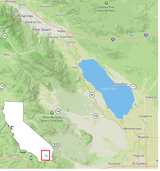
Every year, the California Natural Resources Agency provides an update on progress made on its Salton Sea Management Program. This update is reported to the State Water Resources Control Board (State Water Board) at the Annual Salton Sea Management Program Workshop. The workshop also serves as an opportunity for interested parties to provide input on the status of the Salton Sea Management Program. Input can be provided by submitting written comments in advance or providing oral comments during the workshop. This year’s annual workshop is scheduled for Wednesday, May 20, at 9 a.m. Those interested can participate in person or online. There also will be a watch-only webcast option. For details on the meeting location and login instructions, visit the public notice about this meeting. More information about the Salton Sea Management Program is also available online.
|
Upcoming BCX webinar: Mapping deep aquifer salinity

The next DWR Basin Characterization Exchange webinar will take place on Tuesday, May 19, at 12:30 p.m. “Groundwater Salinity Mapping in California’s Central Valley” will feature Research Hydrologist Michael Stephens from the U.S. Geological Survey. He will discuss recent advances in deep groundwater salinity mapping and outline ongoing salinity mapping efforts in the Central Valley. The usability of groundwater found in deep aquifers is largely controlled by natural salinity, which typically increases with depth. Advances in research make it possible to map aquifer salinity by combining water well samples with geophysical data from oil and gas wells. These newly developed methods fill critical data gaps, reveal salinity patterns and groundwater flow, and support evaluation of deeper aquifers as sustainable future water resources. These methods are now being applied across the Central Valley to model the 3D distribution of deep groundwater salinity and better evaluate the potential use of deeper groundwater resources. More information about this hour-long webinar is available online. Registration is open now.
|
New study estimates groundwater depth with high precision
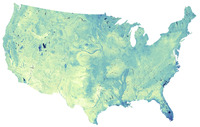
Researchers from Princeton University and University of Arizona have created the most detailed map yet of groundwater depth across the continental U.S. Using machine learning and environmental data, the new study estimates groundwater depth with precision down to areas of about 100 feet wide, improving on older maps that relied on broad regional averages. The findings are especially important to California as much of the state likely faces a drought year. Researchers found that groundwater depth can vary sharply over short distances, particularly in arid regions where communities depend heavily on underground water during droughts. In addition to providing the most statistically accurate groundwater estimate available, the project also helps raise awareness about hidden water resources. Researchers say the publicly available map can help water managers plan for drought and prevent overuse of already-stressed aquifers as climate change intensifies, especially across the West.
|
Spring 2026 CFCC Funding Fair begins next week
The California Financing Coordinating Committee (CFCC) is hosting its spring 2026 online funding fair next Thursday, May 21, and on Wednesday, June 9, from 9 a.m. to noon each day. The CFCC combines the resources of 12 State and federal funding agencies to provide a one-stop shop for available grants, loans, and bond financing for infrastructure projects. Since 1998, the CFCC has conducted free funding fairs statewide each year to educate the public and offer potential customers the opportunity to meet with financial representatives from each agency and learn more about their currently available funding programs. CFCC members facilitate and expedite the completion of various types of infrastructure projects by helping customers combine the resources of different agencies. Project information is shared between members so that additional resources can be identified. Presentations will be held from 9 to 11 a.m. and participants can visit virtual booths from 11 a.m. to noon to meet with representatives. Registration is free but required.
|
CDFA Strategy commits to improving agricultural community
The California Department of Food and Agriculture recently released the Climate Resilience Strategy for California Agriculture (Strategy). The 156-page comprehensive framework provides an overview of State actions designed to help the prepare for, respond to, and thrive under the many conditions imposed by climate change, from uncertainty about water supply and drought to extreme weather events, wildfires, and flooding. The Strategy highlights climate-related agricultural challenges, policies, and actions across State government; identifies areas of opportunity for further action; explores connections with local, State, federal, and private-sector initiatives; and provides equity principles that help State agencies ensure that their programs are accessible to California farmers. The Strategy also includes important context, strategies and actions, and implementation plans to support agricultural communities, including ranchers and farm workers. The Strategy is available online or for reading or download.
|
|
|
|
|
|