California Water Commission meeting, Jan 21, in Sacramento
The next California Water Commission (CWC) meeting will be held on Wednesday, Jan 21, 9:30 a.m., at the California Natural Resources Building in Sacramento. The meeting will also be available via Zoom and webcast on the CWC website. Registration is not required. Among the agenda items is an overview of DWR’s proposed framework for organizing the 2028 California Water Plan update, roll out of Senate Bill (SB) 72, and coordination and consultation with the CWC. As part of the 2028 California Water Plan update, SB 72 directs DWR to modernize the California Water Plan by building a data-driven playbook; quantifying water-supply gaps at the statewide and watershed level; identifying effective water management actions with economic analyses; and setting measurable statewide and watershed-level targets, including an interim statewide goal of nine million acre-feet of additional water, water conservation, or water storage capacity by 2040. Details about agenda items and meeting information are available on the CWC meeting webpage.
|
DWR releases 2023 Tribal Water Summit Summary
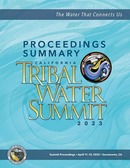
DWR recently released the 2023 California Tribal Water Summit Proceedings Summary. The Tribal Water Summit (Summit) is held every five years (since 2009) and ultimately serves to inform updates to the California Water Plan, which is updated every five years. Over three days in April 2023, more than 400 representatives from California Tribes and organizations, federal, State, and local agencies collaborated to identify, discuss, and document Tribal concerns and priorities that should be incorporated into California water planning. Themed “The Waters that Connect Us,” the Summit built on the legacy and the critical importance of Tribal issues for the holistic human, environmental, and cultural management of water in California. The 2023 California Tribal Water Summit Proceedings Summary provides a daily overview of events and documents in detail each day’s presentations, panel discussions, speakers, and key takeaways, highlighting the continuing success of partnerships between California Tribes, DWR, and other State and federal agencies.
|
"Tribal Leaders in Conversation" workshop, Jan. 29
Watershed Solutions Network will host a virtual workshop featuring Tribal leaders Emily Burgueno, Trina Cunningham, and Jazzmyn Gegere; they will discuss the challenges and opportunities of partnering with non-tribal leaders and organizations. “Tribal Leaders in Conversation: Collaboration Challenges and Opportunities” will open with a candid discussion, creating space for reflection and shared learning. The second half of the workshop will focus on a Q&A session and participants will break into groups to discuss what they learned and how their learning can inform their work. This virtual workshop will be held on Thursday, Jan. 29, noon to 2 p.m. Registration is open now and closes on Monday, Jan. 26. Please note: Registration is required to receive the workshop Zoom link.
|
2026 Tribal FHAB Monitoring Training Series
The State Water Resources Control Board’s SWAMP Freshwater and Estuarine Harmful Algal Bloom (FHAB) Program, in partnership with Tribal Advisory Committee members, will offer a FHAB Monitoring Training Series throughout 2026. This training series supports California Tribes in developing programs in the areas of harmful algal bloom monitoring and response, data analysis, and data use processes. Courses in this series will provide Tribes and other Tribal monitoring groups with guidance and resources to incorporate into their environmental monitoring programs and to more easily partner with the SWAMP FHAB Program and California Cyanobacteria and Harmful Algal Bloom (CCHAB) Network. Registration is now open for the first three courses, which will be held on Thursday, Jan. 29; Wednesday, Feb. 25; and Thursday, Mar. 26. Registration links, contact information, and more details are available on the FHAB Monitoring Training Series webpage.
|
New international GARRP program to study atmospheric rivers
Atmospheric rivers — long, moisture-rich bands of air that can cause beneficial rain or destructive flooding — are a global phenomenon that is expected to grow more intense as climate change worsens. To better understand and predict them, scientists are launching a major international effort called the Global Atmospheric River and Reconnaissance Program (GARRP), expanding the long-running Atmospheric River Reconnaissance project. Led by UC San Diego’s Scripps Institution of Oceanography and the National Oceanic and Atmospheric Administration, GARP will coordinate aircraft, buoys, and balloon-based observations across the Pacific and Atlantic oceans to improve forecasts of extreme precipitation. To read more about how UC San Diego’s Atmospheric River Reconnaissance program joins forces with research programs across the world to improve forecasts of extreme weather events, visit UC San Diego Today to read “Atmospheric River Research Flights Go Global.”
|
Webinar to examine climate change-driven mobility in California

In partnership with the UC Disaster Resilience Network and the Berkeley Institute for Security and Governance, the California Council on Science & Technology (CCST) will host “Climate Change, Human Mobility, and Community Resilience in California” tomorrow, Jan. 15, at noon. This hour-long webinar, the fourth in a series on climate change and human mobility, examines how communities and local and regional governments in California are addressing the growing challenge of climate-induced human mobility and displacement. Panelists will share best practices for building resilience across sectors, including expanding healthcare access for communities, leveraging data systems to anticipate migration patterns and coordinate resources, and developing adaptive infrastructure that balances immediate needs with long-term sustainability. This series is part of CCST’s Disaster Resilience Initiative. Registration for this event is required.
|
To subscribe to California Water Plan eNews, visit the DWR email subscription page and select the “California Water Plan eNews” option.
Subscribe to the Save Our Water newsletter.
|