DWR releases Bulletin 161-2025 summary report
DWR’s Water Use Efficiency Branch has published its 2025 Annual Water Supply and Demand Assessment Summary Report (Bulletin 161-2025) spotlighting local, regional, and statewide water supply conditions. Bulletin 161-2025 provides a snapshot of California urban suppliers’ readiness to keep taps flowing, even in challenging years. This year’s annual report offers supplier-level insights into potential local water shortage; regional and statewide analyses of supply conditions; and a review of how suppliers are implementing their water shortage contingency plans to prepare for and respond to potential shortages. To learn more, visit DWR’s Annual Water Supply and Demand Assessment webpage.
|
Flood-MAR at the 8th Annual Western Groundwater Congress
Hosted by the Groundwater Resources Association of California, the 8th Annual Western Groundwater Congress (WGC) will take place in San Diego, Monday–Thursday, Oct. 6–9. Kicking off the event will be the Flood-MAR Network’s preconference workshop: “Scaling Recharge Together: A Hands-On Workshop to Shape the Future of Flood-MAR.” This workshop will feature four themed stations: Willing Farmers & Social License; Technical Assistance & Tools; Incentives & Funding Opportunities; and Quantifying Recharge & Water Quality Considerations. For more information about the conference and the preconference workshops, visit the WGC conference webpage.
In other Flood-MAR-related news, today’s Lunch-MAR webinar features a discussion on the importance of actively managed water for wetland habitat. This presentation will address climate change and how less snow and more variable rainfall forces wetland and floodplain managers to strategize new ways to capture, store, and distribute water based on ecological goals and water year conditions. The hour-long webinar begins today at 12:30 p.m.
|
7th International Symposium on River Science coming to Davis

The International Society for River Science (ISRS) will hold its 7th International Symposium on River Science at the University of California, Davis, Monday–Thursday, Oct.6–9. The ISRS is a global society that fosters and develops scholarship in disciplines that contribute to knowledge and wise stewardship of rivers and streams. Previous symposiums have been held in New Zealand, Austria, and Norway, among other places. This is first time the symposium will be held in California. This year’s event will feature 3 keynote addresses, 12 special sessions, more than 150 oral presentations, and 40+ presentations. The conference also offers a full-day opportunity to participate in one of seven local field trips followed by an evening dinner. Full registration for the symposium includes lunch each day with coffee breaks, a field trip ticket, and a banquet dinner ticket. To register or to learn more, visit the ISRS 7th International Symposium website.
|
Annual Water Supply and Demand Assessment info available
DWR’s Annual Water Supply and Demand Assessment webpage offers information for urban water suppliers on submitting mandatory Annual Shortage Reports. In an effort to increase drought resilience and to improve communication of water shortage response actions, the California Legislature, in 2018, enacted into law new requirements for urban water suppliers to prepare an Annual Water Supply and Demand Assessment and submit an Annual Shortage Report to DWR on or before July 1 each year. Suppliers’ assessments and reports are important for drought response as these exercises help proactively prepare for anticipated water shortages in the coming year. Learn more by visiting DWR’s Annual Water Supply and Demand Assessment webpage.
|
Water data at your fingertips, thanks to IoW
CDFA releases Regulatory Alignment Study for public comment
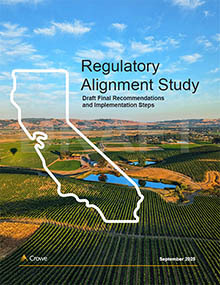
The California Department of Food and Agriculture (CDFA), in partnership with CalEPA and the State Water Resources Control Board, has released a draft report on the Regulatory Alignment Study. Funded by the 2022 Budget Act, the study's core objective is to find ways to better align California's food safety and water quality regulations to support the agricultural community while maintaining strong public health and environmental protections. In short, the goal is not to lower standards but to make the regulatory system work better for everyone. Regulatory alignment involves the strategic coordination of processes and systems across programs, agencies, and their respective scopes. Part of that effort ultimately involves public participation by way of reviewing and commenting on the draft final recommendations and implementation steps. Feedback on the draft report may be sent via email to RegulatoryAlignmentStudy@crowe.com by 5 p.m., Wednesday, Oct. 15. To learn more about this report, visit the CDFA Regulatory Alignment Study webpage.
|
To subscribe to California Water Plan eNews, visit the DWR email subscription page and select the “California Water Plan eNews” option.
Subscribe to the Save Our Water newsletter.
|