|
Monitoring Monday – Monarch Butterflies in our Watersheds
Join us Mondays as the Clean Water Team shares information and resources on watersheds and water quality monitoring. Let's take a look monarch butterflies in our watersheds in recognition of National Learn About Butterflies Day (March 14).
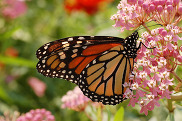
Pollinators and pollination are crucial in the functioning of almost all terrestrial ecosystems because they are in the front line of sustainable productivity through plant reproduction. Pollinators are bioindicators as individuals and populations in that they can be used to monitor environmental stress brought about by introduced competitors, diseases, parasites, predators as well as by chemical and physical factors, particularly pesticides and habitat modification.
One of the most visually recognized pollinators in California is the Monarch Butterfly (Danaus plexippus). Though genetically similar, there are two subpopulations of monarchs in North America, with the eastern population overwintering in Mexico and breeding in the midwestern states, and the western population overwintering in coastal California and fanning out across the west from Arizona to Idaho.
Both North American migratory populations have declined over the past twenty years. There are many factors that are negatively impacting the Monarch Butterfly, and while they are generally deemed low risk, they can build up and become larger issues. These issues include development, energy production and mining, roads and railways, human disturbance, pesticide use, and climate change.
Currently, the monarch is scheduled to be federally listed in 2024 under the Federal Endangered Species Act. Monarchs are not listed as threatened or endangered under the California Endangered Species Act (CESA).
An effective response to monarch declines requires participation from land and environmental resource managers as well as members of the public across the state to continue important recovery efforts that have already begun. Recommended actions include:
- Including native flowering plants in your home garden or restoration projects, focusing on early- and late-blooming species that support the early spring and fall migrations.
- Planting native milkweed.
- Ensuring plants, you purchase from nurseries are pesticide-free.
- Limiting pesticide use.
-
Becoming a community scientist by volunteering to collect data on monarchs and milkweed that help us make informed decisions.
|
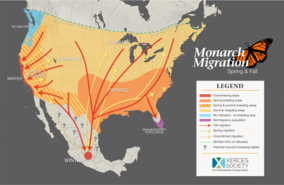
Help track monarchs and milkweeds in your watershed and across the west.
The Western Monarch Milkweed Mapper project is part of a collaborative effort to map and better understand monarch butterflies and their host plants across the Western U.S. Data compiled through this project will improve our understanding of the distribution and phenology of monarchs and milkweeds, identify important breeding areas, and help us better understand monarch conservation needs. Some of the key research questions that these data will help us answer include:
- Where are different milkweed species growing in the West?
- Where are monarchs occurring in the West?
- Where are monarchs breeding in the West?
- When is milkweed emerging and senescing (dying back) in the West?
- How does milkweed phenology (life cycle) differ by species?
- When is monarch breeding occurring in specific areas/regions of the West?
- What types of habitats are different milkweed species associated with?
How Can You Help?
Your help is critical to the success of this project! Because monarchs and their host plants are found all across the western U.S., the best way to document them is to engage a multitude of volunteers and their cameras. You can participate in this effort by using this website to:
- Upload your photos of monarchs and milkweeds;
- Identify milkweeds using our milkweed key, which profiles over 40 milkweed species found in the west;
- Submit data which will help researchers determine the distribution, phenology, and conservation needs of monarchs and milkweeds in the west; and
- Learn about monarchs, their host plants, and ongoing conservation efforts for these species.
Participating in our project is simple and you can get started now by creating an account via the “sign in” tab at the top of the page. Once you have an account, go out and start looking! Check your local parks, natural areas, gardens, and even roadsides. We’re looking for all stages of monarchs, so don’t forget to look at milkweed leaves and stems to see if caterpillars or eggs are present. Snap a few photos (learn more about how to photograph milkweeds and monarchs here) and then sign in and submit your data via our Milkweed and Monarch Sightings forms. Have fun while learning more about monarchs and the special habitats they use in your area!
|
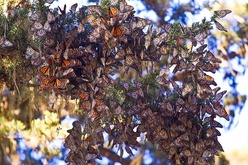
Western Monarch Count
The Western Monarch Count is an annual effort of volunteer community scientists to collect data on the status of the western monarch population along the Pacific coast from Mendocino to Northern Baja, Mexico, during the overwintering season, which occurs from approximately October through March.
Are you interested in joining this effort? We are looking for volunteers in California who can commit to visiting the same overwintering sites year after year. Most of what we know about the population trends of western monarchs is a result of the incredible work done by volunteers like you. Over 200 overwintering sites from Mendocino to San Diego County, California and Northern Baja, Mexico are monitored each year, but we know of over 400 sites that monarchs have either used in the past or are currently using to aggregate. With your help we can start monitoring more sites and get a better picture of the status of these sites. https://westernmonarchcount.org/
Southwest Monarch Study
The Southwest Monarch Study is researching the migration and breeding patterns of monarch butterflies in Arizona and the SouthWestern United States. It was once believed that monarch butterflies East of the Rocky Mountains flew to the mountains near Mexico City for the winter and monarchs West of the Rockies flew to the coast of California. Through Fall tagging in the Southwest (Arizona, Nevada, New Mexico, Utah and Western Colorado), we have learned that this is not always the case. There is much more to learn about the wild monarch migration throughout the Southwestern states. If you love monarch butterflies, consider joining our study. https://www.swmonarchs.org/
Monarch Migration - Tracking Monarch Butterfly Migration
Monarch migration is a science research tool for tracking the migration behavior of monarch butterflies. Its primary function is to allow users to quickly enter location information and flight characteristics (body direction and flight direction) for upload to a cloud-based server. The directional data is gathered from the mobile devices compass. Georeferencing and time is gathered from the devices OS.
- Migration Compasses: Dr. Chip Taylor of Monarch Watch (Kansas University) is interested in the compasses that monarchs use during their migration. This app will gather information on both the bearing of the butterfly’s body (body vector) and a separate measurement of the direction they are moving (the vanishing bearing or flight vector). Information on Monarch Watch can be found at http://monarchwatch.org/
|
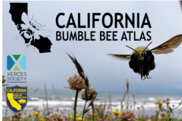
Need More Pollinator Science for Your Watershed?
The California Bumble Bee Atlas is a collaborative community science effort to track and conserve the state's native bumble bee species.This year's field work starts March 15, 2024!
Bumble bees are essential pollinators in our natural landscapes, as well as in gardens and on farms. California is home to at least 25 species of bumble bees, and several of them face an uncertain future. The western bumble bee has declined dramatically, with greatest losses observed in California and adjacent areas of the Pacific Coast. Other California species, including Crotch's bumble bee (B. crotchii) and Morrison’s bee (B. morrisoni), are also in decline. Conservation partners in California and the Pacific Northwest have joined forces to support bumble bee conservation through a region-wide project to collect information on bumble bee species distribution. The missing partner is you - become a community scientist and join us!
The project joins similar inventory efforts in Oregon, Washington, and Idaho, collectively, the Western States Bumble Bee Atlas. Our goal is to gain a better understanding of the distribution of bumble bees throughout the region. This will help us to more effectively enact conservation measures that will benefit these important native pollinators. We've divided the area up into priority grid cells to ensure a broad distribution of sampling in all of the unique habitats of the region. Your participation in this project will help the researchers gain a better understanding of where bumble bees are thriving in California, and glean information about what habitat features are contributing to productive bumble bee communities. Ultimately, we will better understand how to manage lands throughout the region that will help to support a more healthy ecosystem. https://www.cabumblebeeatlas.org/
The Bumble Bee Watch app enables users to track and conserve bumble bees. Bumble bees face many threats, including pesticide use, habitat loss, disease and climate change. By uploading images and sharing information helps researchers with their conservation efforts to help bumble bees. Users can also learn more about bumble bees and read about ongoing conservation projects. https://www.bumblebeewatch.org/
|
ADDITIONAL RESOURCES:
Pollinator Celebration Awareness Dates
- March 14th is National Learn About Butterflies Day! -https://wildlife.ca.gov/Data/CNDDB/News/national-learn-about-butterflies-day-2020#gsc.tab=0
- Pollinator Week 2024 will take place June 17-23, 2024 - https://www.pollinator.org/pollinator-week
Monarch Butterfly - https://wildlife.ca.gov/Conservation/Invertebrates/Monarch-Butterfly
Gardening for Butterflies - https://www.cnps.org/gardening/gardening-for-butterflies-3106
California’s Butterflies
The Field Guide for Lepidoptera
We are a community of enthusiasts and museums working to create the ultimate ID assistant and knowledge network: A free, universal field guide that learns. https://leps.fieldguide.ai/figures
|