|
|
Share / View as a webpage
 Issue #19: April 2026

Dear Equity Ally,
As we enter spring, the County is navigating a period of significant uncertainty for the communities we serve. The passage of HR 1 (the Federal bill that includes extensive reforms to federal policies) combined with California's failure to reimburse the County in full for millions of dollars in Vehicle License Fee (VLF) funding that support health care, public safety, and affordable housing, is putting real strain on the services our residents depend on. The State paid this obligation in full to 55 other counties but shortchanged San Mateo, and the County is now pressing the State to meet its full obligation. Join us for a gathering on April 7th to raise our collective voice to ask the State to give back the money it owes the County. See below for details.
These policies and practices translate directly into potential cuts to programs and changes to eligibility requirements that affect our most vulnerable neighbors. In moments like these, the County’s commitment to shared prosperity is a reminder that the fate of our neighbors, in particular the ones that are most vulnerable, is a shared concern and a call to action for all of us to work together to build collective prosperity.
|

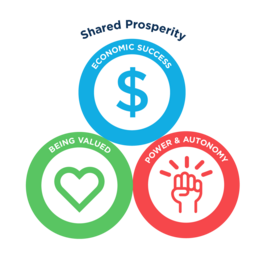
San Mateo County has a lot of prosperity, but that prosperity isn’t shared evenly across our population. The Shared Prosperity Coordinating Council, a multisector group of leaders from across the county that have been meeting for over two years to support economic mobility and shared opportunity, brings together cross-sector partners to align efforts, identify opportunities, and drive coordinated action toward equitable outcomes across San Mateo County. More details on the Council's structure, objectives, and more are in the newsletter below.
We are also proud to share that the Community Data Dashboard is live. This tool tracks key indicators across the areas that matter most to our shared prosperity work, including economic mobility, housing stability, healthcare access. It is designed to help our partners ground their work in data, identify where needs are greatest, and measure progress over time. We invite you to explore it and make it a resource for your own planning and advocacy.
To support partners in getting the most out of the Dashboard, we have two upcoming training courses scheduled for May 13th and May 18th. We encourage you to attend and bring colleagues who would benefit from understanding how to navigate and apply the data.
As always, we are grateful for your partnership in this work. The road is long, and it is built together.
In solidarity,
The Office of Racial and Social Justice
Shireen Malekafzali Taidi, Chief Equity Officer
Caline Salame, Equity and Belonging Associate
Belén Seara, Equity and Belonging Manager
|
|
|
 San Mateo County's Community Data Dashboard offers an interactive, data-driven look at economic mobility conditions across our county — and who is being left behind. Developed through the Shared Prosperity Coordinating Council (SPCC), a cross-sector coalition of county and local government, nonprofit, and private sector leaders, the dashboard puts key metrics at your fingertips and tracks trends over time.
Using a Targeted Universalism approach, data is disaggregated by race, jurisdiction, age, gender, and other factors — making visible the disparities that aggregate numbers can obscure and helping identify which communities experience the greatest barriers. This work is grounded in the national research of the Urban Institute's Upward Mobility Framework and supports the SPCC's Economic Mobility Action Plan, which outlines 11 strategies to advance shared prosperity across the county.
To support the integration of this tool, the County is offering two training sessions:
Explore the data. See the full picture.
The San Mateo County Board of Supervisors unanimously approved the Workforce Entry & Economic Growth Initiative, a $2 million wage-subsidy program connecting local job seekers with private-sector employers. The program covers up to 50 percent of a new hire's wages during their first three months, capped at the equivalent of a $65,000 annual salary.
Eligible workers must be county residents who recently completed a degree or trade certificate. Residents and businesses are encouraged to watch for upcoming announcements.
|
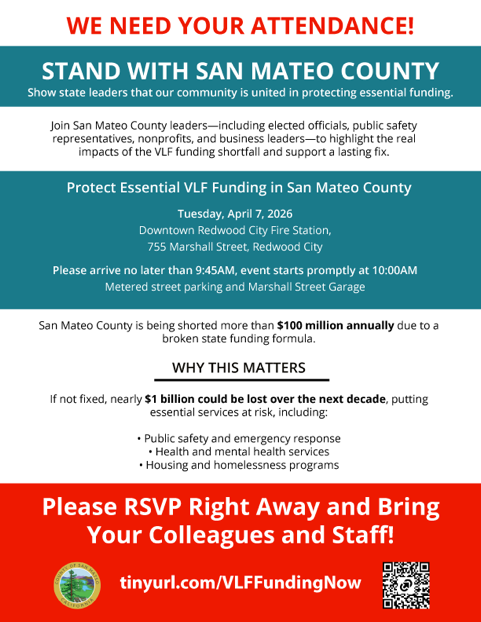 Join San Mateo County Leaders to highlight the real impacts of the VLF funding shortfall and support a lasting fix. We also encourage you to share this invitation with your colleagues and networks.
Protect Essential VLF Funding in San Mateo County
- Tuesday, April 7, 2026
- Redwood City Fire Station (755 Marshall Street)
- Arrival by 9:45 AM | Program begins at 10:00 AM
Significant changes to federal Medicaid policy are on the horizon for California residents. The 2025 budget reconciliation bill, H.R. 1, introduces a series of new eligibility and enrollment requirements for Medi-Cal that will roll out on a staggered schedule through 2028. California's Department of Health Care Services estimates these changes could negatively impact up to 1.8 million Medi-Cal members statewide. Here in San Mateo County, an estimated 36,000 to 53,700 people could potentially lose their medical coverage.
If you have questions or are unsure about your current benefits, call 1-800-223-8383 or visit one of our Human Services Agency offices.
Want to learn more? Join the League of Women Voters for a virtual community forum, featuring Claire Cunningham, Director of the San Mateo County Human Services Agency, for a deep dive into how HR 1 affects Medi-Cal, CalFresh, and local veteran services.
-
Tuesday, April 21 12:00 PM to 1:30 PM.
|
|
|
Miss Green Eyes rests in a foster home through San Mateo County Health’s Foster Wellness Program
Research shows people will forgo or delay treatment rather than leave their pets behind, especially those without the financial resources or support networks to arrange private care.
San Mateo County Health's new Foster Wellness Program addresses this directly by embedding pet foster care into the treatment system through a formal partnership between Behavioral Health and Recovery Services and Animal Control and Licensing. This is equity in action: redesigning infrastructure so that accessing care no longer requires sacrificing family bonds, for everyone, regardless of income or circumstance.
To volunteer as a foster caregiver, send an email to fosteringwellness@smcgov.org.
The County of San Mateo seeks to ensure that every resident has meaningful access to County services, programs, benefits, and information. To further this goal, the County strives to meet the language needs of residents to help them access County information, regardless of their proficiency in English. According to the 2018-2022 U.S. American Community Survey, 44.8% of San Mateo County residents speak a language other than English at home.
A moment of reflection:
- As the cost of living continues to rise, what does economic opportunity look like in your own community?
- What do you believe is your role in creating economic opportunities for those around you?
Have feedback? We would appreciate feedback about what information you most want to hear from us. For feedback, please email us at equitysmc@smcgov.org.
|
|
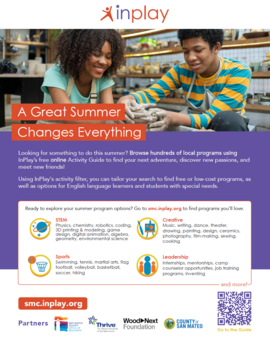
The San Mateo County Office of Education partners with @InPlayKids to share a FREE, one-stop Activity Guide with hundreds of local programs for kids TK–12th grade.
Find sports, arts, STEM, academic enrichment, and more — including free and low-cost options, weekly camps, and even one-day activities. Plus, filter by location, schedule, cost, and activity to save you time and energy!
In moments of national uncertainty, access to clear and trusted information matters. San Mateo County offers a centralized hub of immigrant rights resources, including Know Your Rights information, connections to legal assistance, rapid response support, and pathways to citizenship. These resources are available to help individuals and families navigate their options, understand their protections, and access support when it’s needed most.
Learn more through Immigrant Services at the County of San Mateo.
What is the LHMP?
The LHMP identifies natural hazard risks, such as floods, wildfires, earthquakes, and severe weather. The Plan outlines actions to reduce damage before disasters happen—protecting people, homes, and businesses.
Applications to serve on the 2026–2027 Civil Grand Jury close on March 30.
Eligible applicants must be:
- U.S. citizens
- San Mateo County residents
- Age 18 or older
- Able to understand English
- Elected officials are not eligible.
Applications are available by sending an email to grandjury@sanmateocourt.org and on the Court’s website.
|
|
|
|
|