Justice-Involved Initiative
As a reminder, the Justice-Involved Initiative provides services to justice-involved adults and youth while they are incarcerated and as they re-enter their communities. At BHRS, the design team for adult services has been chosen and has just had their kickoff meeting! The design team will be planning the workflow of newly released inmates receiving services from BHRS.
|

Contractor Incentive Program
The CalAIM Contractor Quality Improvement Program (CQIP) is underway! This incentive payment program will support Mental Health and Substance Use Disorder contracted providers as they prepare for changes in CalAIM implementation. Program contracts started out going on October 11. There will be a Q&A office hours on October 23 at 1pm. An invitation has been sent by Caprice Scott - check your inbox!
For questions about the incentive program, email: HS_BHRS_ASK_CALAIM@smcgov.org. Please note this email is intended for incentive plan questions only.
|
What else is being done to build a more coordinated, person-centered and equitable health system for Medi-Cal recipients?
Under CalAIM, members will have access to new and improved services and receive well-rounded care that goes beyond the doctor's office or hospital and addresses all of their physical and mental health needs. These bold changes include 11 initiatives that are part of the CalAIM waiver. Read about them below:
|
Behavioral Health Initiative
Strengthening mental health and substance abuse use disorder services and better
integrating them with physical health care.
|
Community Supports
Helps members address unmet basic needs that can impact their health, whether they're clinical or non-clinical. These include support to secure and maintain housing and access to medically tailored meals to support short term recovery.
|
Dental Initiative
Expanding dental benefits for children and those with conditions that are more likely to lead to dental disease.
|
|
Enhanced Care Management (ECM)
Providing high-need members with in-person care where they live.
|
Incentive Payment Program
Medi-Cal is supporting the implementation of ECM, Community Supports and other initiatives to Medi-Cal managed care plans to invest in improving the quality of care, reducing health disparities, and promoting health equity.
|
Integrated Care for Dual Eligible Members
Better integrating care for members who are dually enrolled in both Medicare and Medi-Cal.
|
|
Justice-Involved Initiative
Providing services to justice-involved adults and youth while they are incarcerated, and as they re-enter their communities.
|
Population Health Management
Medi-Cal is requiring managed care plans (MCPs) to use a concentrated approach to improving the health outcomes of a group of individuals.
|
Providing Access and Transforming Health (PATH)
PATH funds are an investment in the capacity and infrastructure of local community-based organizations to provide services to Medi-Cal members in their communities.
|
|
Statewide Managed Long-Term Care
Introducing a better way to coordinate care for those with very complex or long-term care needs.
|
Supporting Health and Opportunity for Children and Families
Improving the health of children in California, supporting their families, reducing disparities in care, and strengthening accountability and oversight of children's services.
|
|
Let's take a closer look at the Dental Initiative...
Why is this important?
While it may not be widely understood, there is a clear connection between a person’s dental health and their mental health and numerous studies have identified associations between mental health and oral health.
Oral health and mental health are interconnected, each having an impact on the other. Dental health problems can impact a person's quality of life and exacerbate mental health problems. For example:
- Symptoms of mental illnesses can contribute to poor nutrition which in turn contributes to poor dental health.
- People experiencing symptoms of serious mental illness, may have difficulty maintaining an effective daily dental care routine and accessing needed dental treatment.
- When a person has poor oral health, it can impact their eating, speech and self-esteem and lead to reduced social interactions, further harming mental well-being.
- Many people, including people with mental health conditions, have anxiety associated with dental care and procedures and avoid needed care, but chronic oral pain can contribute to poor mental health and make treating mental health conditions more difficult.
Because of the importance of dental health, we can remind BHRS clients of this service provided through HPSM.
What is this initiative about?
DHCS is committed to improving the accessibility of Medi-Cal dental services and improving oral health outcomes statewide for children and adults. DHCS set a goal to achieve at least a 60 percent dental utilization rate for Medi-Cal eligible children. In order to progress toward achieving that goal and based on lessons learned from the Dental Transformation Initiative (DTI), DHCS will implement the following reforms to be made statewide to provide better care and align with national dental care standards. The CalAIM dental initiatives include:
- Expanded pay-for-performance (P4P) payments that reward increasing the use of preventive services and establishing/maintaining continuity of care through a dental home;
- PFP: Preventative Services: The goal is to increase statewide utilization of preventive services for all Medi-Cal members.
- PFP: Continuity of Care: The goal of this initiative is to establish a dental home for all Medi-Cal members, to increase patients' return to the same dental office year-after-year for continuity of care, and improved health/dental outcomes.
-
Caries Risk Assessment (CRA) Bundle for young children;
- This CalAIM initiative added the Caries Risk Assessment (CRA) bundle as a new dental benefit in alignment with national dental care standards. The overall goal of this new benefit is to assess and manage caries risk and to emphasize the provision of preventive services in lieu of more invasive and costly procedures for children ages 0-6.
-
Silver Diamine Fluoride (SDF) for young children and specified high-risk and institutional populations
- This CalAIM initiative adds Silver Diamine Fluoride (SDF) as a new dental benefit in alignment with national dental care standards. The overall goal of this benefit is to provide an option for caries arresting treatment when restorative caries treatment may not be optimal.
We hope this newsletter will be a continued resource to learn about all CalAIM initiatives available to Medi-Cal recipients.
The CalAIM Assessment Training was on October 17. Please note that these trainings are mandatory, but in case you miss a training, they will be posted to LMS the following week.
Have feedback on the trainings so far? Leave feedback at the link here!
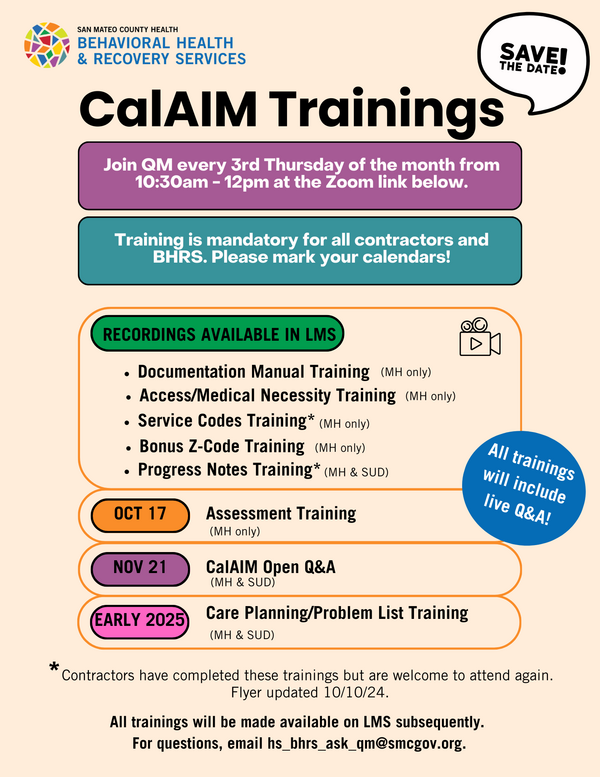 Attend trainings at the Zoom link here:
Be sure to check out the QM lightbulb which comes out the Friday before the Leadership meeting, which occurs on the third Wednesday of the month.
Please email Caprice Scott, CalAIM Project Manager, at cscott1@smcgov.org for any CalAIM questions.
For questions, feedback or to join this mailing list and receive this newsletter, please email Audrey Davis, BHRS Communication Specialist, at adavis2@smcgov.org.
|