|
Having trouble viewing this email? View it as a Web page.
 February 1, 2025

You’ve undoubtedly heard of people being scammed on dating apps. Still, according to the Federal Trade Commission (FTC), a more common way romance scams began was with an unexpected message on a social media platform.
Older adults who are lonely or have recently lost a spouse are especially vulnerable to romance scams. These scammers are unscrupulous and will exploit any vulnerability of their victims. In the end, these scammers have one thing in common. They want your money. The FTC states in 2022 the largest aggregate reported losses were in cryptocurrency, but more people reported paying the scammer with gift cards than any other method.
Here are some signs of romance scams as reported by the FTC:
-
Scammers say they can’t meet you in person. They might say they’re living or traveling outside the country, working on an oil rig, in the military, or working with an international organization.
-
Scammers will ask you for money. Once they gain your trust, they’ll ask for your help to pay medical expenses (for them or a family member), buy their ticket to visit you, pay for their visa, or help them pay fees to get them out of trouble. They may even offer to help you get started in cryptocurrency investing.
-
Scammers will tell you how to pay. All scammers, not just romance scammers, want to get your money quickly. And they want your money in a way that makes it hard for you to get it back. They’ll tell you to wire money through a company like Western Union or MoneyGram, put money on gift cards (like Amazon, Google Play, iTunes, or Steam) and give them the PIN codes, send money through a money transfer app, or transfer cryptocurrency.
Scammers do these things to pressure you into acting immediately by paying money. But it’s a scam.
If you’ve lost money to a romantic scammer or think they may have stolen your personal information, report it to the FTC (reportfraud.ftc.gov) and file a report with your local police department.
 Protect your personal information
Identity theft can happen to anyone. Once your personal information has been stolen, someone can open new accounts, steal your tax refund, or make fake insurance claims.
Here are a few tips from the State of California Department of Justice to lessen your chance of identity theft.
Be mysterious on social networks.
What you share on social networks (your home or email address; children’s names; birth date and so on) is what tech-savvy thieves use for scams, phishing, and account theft. Don’t overshare.
Click with caution.
When shopping online, check out a website before entering your credit card number or other personal information. Read the privacy policy and look for opportunities to opt out of information sharing. (If no privacy policy has been posted, beware! Shop elsewhere.) Only enter personal information on secure webpages with "https" in the address bar and a padlock symbol.
Stop pre-approved credit offers.
Stop most pre-approved credit card offers. They make a tempting target for identity thieves who steal your mail. Have your name removed from credit bureau marketing lists. Call 1-888-567-8688 or online at optoutprescreen.com.
Check your credit reports – for free.
One of the best ways to protect against identity theft is to monitor your credit history. You can get one free credit report every year from each of the three national credit bureaus: Equifax, Experian, and TransUnion. Request all three reports at once, or spread out your requests, ordering from a different bureau every four months.
Order your free annual credit reports at 1-877-322-8228, or online at annualcreditreport.com.
Ask questions.
Don’t be afraid to ask questions if a business asks for your personal information. Ask how it will be used, whether it will be shared, and how it will be protected. Explain that you’re concerned about identity theft. If you’re not satisfied with the answers, consider taking your business elsewhere.
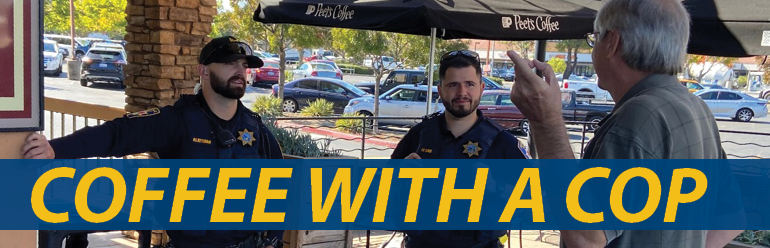 Join us for coffee and conversation, no agenda or speeches, from 9 - 11 a.m., Tuesday, February 11 at Peets at the Fountains, 1198 Roseville Pkwy #175. This is a great opportunity to ask questions, voice concerns, and get to know the officers that serve your community.
Interested in a career in law enforcement? A member of the recruitment team will be available to answer your questions.
 Coming soon
The Citizens Academy is held at the Roseville Police Department, 1051 Junction Blvd., and is a great opportunity to listen and learn in a classroom setting and engage in interactive presentations. For more information, visit roseville.ca.us/CitizensAcademy.
 People are losing big money to scammers
Residents in Roseville and across the country are losing money to scammers running elaborate scams. It starts with someone sending you a message, text, or email pretending to be from a government agency or a company you do business with.
The Federal Trade Commission says this is how the scam works:
- A scammer pretending to be from a company you know contacts you, saying they spotted fraud on one of your accounts and your money is not safe.
- Then, they connect you with someone else to supposedly help you move your money to “protect” it.
- The “helper,” who often claims to work for the government, is really a scammer trying to steal your money.
If someone tells you to do any of these things, it’s a scam.
- Put your money in a secure account to protect it.
- Transfer your money to a cryptocurrency account to protect it.
- Get cash and I’ll send a driver to pick it up.
- Deposit cash at a Bitcoin ATM to protect your money
- Buy gold and a driver will come get it.
No one from the government or a legitimate company will tell you to do these things. Only a scammer will.
Remember: Never transfer or send money, cryptocurrency, cash, or gold to someone you don’t know in response to an unexpected call or message.
Report scams to the Federal Trade Commission at ReportFraud.ftc.gov and file a report with your local law enforcement agency.
Beat: 3
Date: December 9
Neighborhood: Folsom Road
The victim received an email confirming a “successful change” to his banking password. Shortly after, his iPhone went into airplane mode. Unable to use his phone, he went to the bank, where a teller informed him that $4,800 had been transferred from his business account to a new account in his name. The victim used the teller’s office phone to contact the fraud department, which assured him the account would be closed. He then visited the Apple Store to check for viruses on his phone. The Apple employee found no issues and recommended contacting the phone provider. At the provider’s office, the victim learned that a new iPhone 15 Pro Max had been added to his account. The suspect had canceled the victim's phone number, added a new number to the iPhone, and transferred apps via the electronic SIM card. Returning to the bank, the victim discovered the fraud department had failed to close the new account, which was now overdrawn by an additional $4,000. There was also an $879.20 online purchase.
Beat: 4
Date: December 3
Neighborhood: Kaseberg/Kingswood
At approximately 6:41 a.m., the victim received a call from a man claiming to be a Comcast representative. Believing the call was legitimate due to prior connection issues, she followed his instructions to reset the modem by unplugging it. He then instructed the victim and her husband to grant remote access through a pop-up window on their laptop. When they noticed new software downloading, they shut down the computer. The caller immediately called back from a different number, asking why they interrupted the process. The victim accused him of being a scammer and hung up. At 9:30 a.m., the victim’s husband discovered $2,000 withdrawn from their checking account and $9,000 missing from their Bitcoin/PayPal account.
|