|
Having trouble viewing this email? View it as a Web page.
 January 1, 2025

Crime prevention resolutions for 2025
Resolutions that may stop you from becoming a victim of crime
It’s the beginning of a new year, and many people make resolutions to improve their quality of life. This year consider adding some crime prevention resolutions to your list. Here are a few resolutions that may stop you from becoming a victim of crime.
I resolve to:
Reduce my chances of becoming a victim of a vehicle break-in
Vehicle break-ins are a common crime in Roseville. Always lock your car doors, even when you’re inside. Lock packages and other valuables in the trunk. Do not leave them on the back seat or on the floor of the car where potential thieves can see them. When you return to your car, always check the front and back seat before you get in.
Remember: TAKE your valuables with you. LOCK your car. HIDE the things you cannot take before you arrive at your destination.
Keep doors closed and locked, even when at home
Property crime is also a common crime in Roseville. However, you can reduce your chances of becoming a victim by following some simple rules. Always keep your doors locked. It may seem nice to leave your doors open on a nice day, but thieves just love the easy access they get with an open, or even just an unlocked door. Simply getting into the habit of shutting and locking the door behind you. Not a habit now? Make it one!
Keep my garage door closed at all times when not in use
Property stolen from open garage doors also occurs frequently in Roseville. This can occur anytime if you leave your opened garage door unattended. So keep that garage door closed. Otherwise, someone can easily slip into your garage or house without your knowledge.
Be a good neighbor
If you see something suspicious in your neighborhood, call the police immediately. Join and become an active member of you Neighborhood Watch group. If you don’t have a Neighborhood Watch group, start one. By working together with your neighbors and law enforcement you can help deter crime in your neighborhood.
Ask for a valid ID or credential before letting anyone in my home I don’t know
Criminals are always looking for ways to gain entry into a home. If someone you don’t know shows up to your home unexpectedly, be suspicious.
Protect my money
Scams can happen to anyone and occur frequently in Roseville. Watch out for possible scams and frauds. If something sounds too good to be true, it’s probably a scam. There is no “Nigerian Money," “foreign lottery,” or “lost inheritance.” Check your credit report every year.
Criminals never rest. They are always out looking for their next victim. So, when you are making resolutions for 2025, include some on crime prevention. By incorporating safety tips into your everyday routine, you will make crime prevention part of your daily life.
The new year is upon us and with it comes some new laws that drivers need to be aware of. Here are a few to review with drivers in your household.
REAL ID compliant driver’s license or ID card
Starting May 7, 2025, California residents will need a REAL ID-compliant driver's license or ID card to:
- Board domestic flights
- Enter military bases
- Enter most federal facilities, such as federal courthouses
Other forms of federal compliant ID that can be used include a valid U.S. passport.
|
Citations for daylighting law will begin on January 1, 2025
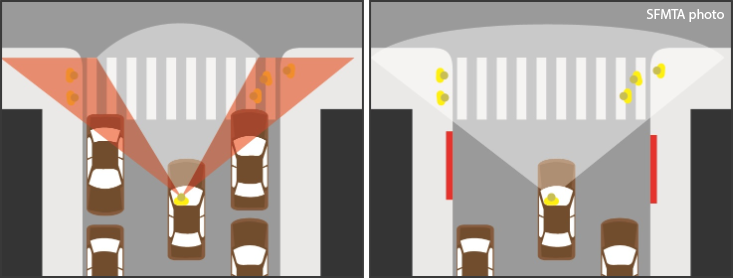 The "daylighting" law prohibits parking within 20 feet of any marked or unmarked crosswalk, aiming to improve pedestrian safety at intersections. This law is designed to increase visibility for pedestrians by preventing cars from parking too close to crosswalks.
Written knowledge test requirement eliminated for drivers 70-years-old or older
Drivers 70-years-old and older (without a traffic violation) will no longer be required to take a written knowledge test. This law took effect for those whose license expired beginning October 1, 2024. An office visit is still required for a vision exam and an updated photo.
 How to recover from identity theft
So, you just learned that someone used your personal information to open new credit accounts in your name. So now what? If you act fast, you can reduce the damage identity theft can cause.
The Federal Trade Commission (FTC) offers the following tips to get you started:
Step 1: Call the companies where you know fraud occurred
- Call the fraud department. Explain that someone stole your identity.
- Ask them to close or freeze the accounts. Then, no one can add new charges unless you agree.
- Change logins, passwords, and PINs for your accounts.
Step 2: Place a fraud alert and get your credit reports — even if you already have a credit freeze in place. (If you haven’t frozen your credit, do that, too.) When you have a fraud alert on your credit report, a business has to verify your identity before it opens a new credit account in your name. A fraud alert lasts one year, but you can renew it.
- Place a free, one-year fraud alert by contacting one of the three credit bureaus. That company must tell the other two.
Experian.com/help (888-397-3742)
TransUnion.com/credit-help 888-909-8872
Equifax.com/personal/credit-report-services 800-685-1111
To get your report, call Annual Credit Report at 877-322-8228, or go to AnnualCreditReport.com. Federal law gives you the right to get a free copy of your credit report every 12 months from each of the three nationwide credit bureaus. The three bureaus also let you check your credit report once a week for free at AnnualCreditReport.com. Review your reports. Look for accounts or transactions you don’t recognize.
Step 3: Report identity theft to the FTC at IdentityTheft.gov. You’ll get a free personal recovery plan with next steps.
Beat: 7
Date: November 20
Neighborhood: Westpark
On 11/18/2024, the victim received an email from a fake "PayPal" address, alleging fraudulent charges on her account. She called the provided number and was instructed to allow remote access to her computer. The suspect manipulated her account to appear as though she had a credit of $41,999.99 and demanded she withdraw $40,000 in cash to refund the overpayment. A man came to her home to collect the cash. Days later, a similar scenario occurred, resulting in another withdrawal of $21,000, followed by a $24,000 unauthorized transfer. Realizing the scam, the victim contacted her husband, but by then, the suspects had accessed her bank account through the remote connection.
Beat: 6
Date: November 11
Neighborhood: Foothills Junction
On 11/21/2024, at 10:02 a.m., the victim received a voicemail from an unknown number claiming her Amazon account was used to buy a MacBook Air. When she called back, a suspect posing as a U.S. Marshal claimed her identity had been stolen to create fraudulent accounts and implicated her in a drug-related crime in Texas. The victim was pressured to prove her innocence by purchasing gift cards from Lowe's and Walmart, totaling $500. The suspect promised the funds would be refunded, but communications ended after the money was sent.
Beat: 3
Date: November 23
Neighborhood: Folsom Road
At 11:30 a.m. on 11/23/2024, the victim received a call from a man pretending to be her grandson (Suspect 1), claiming he had been jailed for hitting a woman and needed bail money. He provided the contact information for his "public defender" (Suspect 2). The second suspect instructed the victim to use a Bitcoin kiosk for transactions and remained on the phone with her throughout. The victim made two payments, totaling $1,900, before realizing she had been scammed after confirming with her actual grandson that he was not in jail.
Beat: 2
Date: November 20
Neighborhood: Maidu
The suspect initiated contact with the victim, complimenting her appearance and expressing interest in a relationship, claiming to have recently moved to Sacramento from Texas. Following several phone calls, the suspect mentioned an urgent work trip to Europe and claimed to have accidentally left his belongings, including his wallet, outside the plane. The suspect then called frequently, sharing personal details and asking for the victim’s personal information. After developing a romantic connection and exchanging "I love yous," the suspect began requesting favors, including the victim's Social Security number and driver’s license information. He also persuaded her to open a bank account to transfer funds and purchase Apple gift cards. Over time, the suspect escalated requests, asking for new iPads and gaining access to her Cash App and Zelle accounts, which he used to funnel money into Bitcoin. The victim estimated her financial losses at over $22,000.
|