|
Having trouble viewing this email? View it as a Web page.
 November 1, 2024

 Protect your packages from thieves
Online shopping has grown over the past few years and this holiday season will be no exception. With increased purchasing comes heightened risk of theft. Package thefts from door stoops and front porches usually increase between the months of October and January. Therefore, before you shop online make sure to take precautions to protect your deliveries from package thieves.
-
Pick-up your packages promptly. If necessary, ask a trusted neighbor to do it for you.
-
Ship to another location. If possible, have your packages shipped to another location instead of your home, perhaps to your office or friend’s home. Many delivery companies also offer to hold your packages at their respective stores, such as FedEx Office or The UPS Store. Amazon has a similar feature called Amazon Locker.
-
Require a signature. While most signature requirements are designated by the sender, many delivery companies will allow you to require a signature for all your deliveries.
-
Track your package. Ask for a tracking number so you know when your package is delivered. Try to be home at the time of delivery. If you do not receive your shipment on time, check with the company of origin and confirm the delivery. If the item was delivered and you did not receive it, report the theft or loss to the original company.
-
Consider installing security cameras. Install cameras as a deterrent. Indoor cameras pointing out a window can be just as effective as outdoor cameras. Also, consider placing a sign indicating that the premise is under surveillance.
If you plan to do some online shopping, make a plan on how to reduce your chance of becoming a victim of package theft. Don’t let thieves ruin your holiday.
 Vacation house check
Making vacation plans for the holidays? Now you can add a little peace of mind to your travel agenda. Request a vacation house check.
The vacation house check program is a free service offered by the police department for Roseville residents and is meant to be supplemental to your primary home security arrangements. While you are away, volunteers in our Citizens on Patrol (COP) program will check your residence on a random basis, looking for signs of suspicious activity such as open doors, open or broken windows, unfamiliar cars, or other suspicious conditions. Any situation discovered by our COP volunteers that needs immediate attention will be addressed by Roseville Police Officers.
Visit our website at roseville.ca.us/VacationHouseCheck to enroll in the program.

Join us 9-11 a.m. on Thursday, November 28 for the City of Roseville Turkey Trot!
Come kick off a great Thanksgiving Day with a fun race, run, jog, walk, stroll, roll, or even crawl…before the parades…before the kickoffs…and before the feasting commences (and maybe even burn off a few calories). Be there - rain or shine.
Register early for the best prices at roseville.ca.us/events.
|
 It's the most wonderful time of year! Join us for the City's free Christmas tree lighting event from 6 - 8 p.m. on Thursday, December 5 at Vernon Street Town Square. Experience an old fashioned celebration and holiday cheer with cookie decorating, visiting Santa, kids’ activity zone, music, food, and celebration.
 Neighborhood Santa is back! This year, Santa is visiting neighborhoods on Tuesday, Wednesday and Thursday evenings December 10-19, 2024.
Santa will start his route at 6 p.m. each night and each route will run 1 to 1.5 hours. Routing information will be forthcoming on the City’s website.
 Avoid disaster donation scams
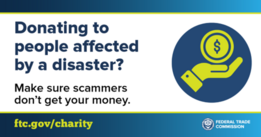
These tips from the Federal Trade Commission (FTC) provide valuable guidance to avoid scams when donating to disaster relief efforts, especially following the devastation caused by recent hurricanes. Scammers often exploit people's goodwill during times of crisis, so it's important to be cautious and do your research before donating.
Here’s a quick summary of the tips:
-
Donate to trusted charities with a history of effective disaster response.
-
Research organizations through sources like the Better Business Bureau's (BBB) Wise Giving Alliance, or Charity Watch.
-
Clarify how your donation will be used, ensuring it directly helps those in need.
-
Avoid high-risk payment methods like cash, gift cards, or cryptocurrency. Use a credit card for more protection.
-
Be cautious with crowdfunding donations, especially if you're unsure about the recipient. Crowdfunding donations usually aren’t tax-deductible.
-
Verify text-to-donate numbers by checking the charity’s website directly.
For more detailed information, you can visit ftc.gov/charity
|
Beat: 6
Date: September 10
Neighborhood: Blue Oaks
The victim said on 9/10/24 at about 0900 hours, he received an email from PayPal saying there was a $300 charge pending for a purchase of Bitcoin, and if he wanted to dispute the charge, he had to call the number in Los Angeles. The victim called the number and spoke with a male who spoke poor English. He told them he disputed the claim, and $20,000 was supposedly put into his banking account which the victim verified online. The male told the victim he was given too much money and that he needed to pay $19,600 back. The victim was told he needed to withdraw $19,600 in cash, go to a specified location, and buy Bitcoin. The victim got the cash from his bank and went to the location but did not know how to use the Bitcoin machine inside the store, so he waited outside for someone who was being sent over. A male pulled up and parked next to the victim and was instructed to give him the cash so he could make the Bitcoin purchase. The victim gave him the cash and the male drove away. When the victim checked his bank account again, the $20K deposit was gone. The victim attempted to call back multiple times, but it went to voicemail so he thinks this was a scam.
Beat: 7
Date: August 23
Neighborhood: Sun City
The victim had recently received an email advising her that her personal info had been leaked on the dark web. A couple of days later she received an email from “Geek Squad” telling her that she owed money. She attempted to pay, but the male she spoke with on the phone told her that something had gone wrong and that she had taken money from them. He then told her she needed to follow his instructions to solve the issue, or he would have to call the police. Over the next several weeks she was told to do the following: purchase gift cards and send him pictures of them, pull cash from her bank account and a member of their team would come to her house to pick up the money, make wire transfers to a given bank account, and give them access to her accounts by allowing them to change her passwords. From approximately August 23rd until September 12th, the victim gave them well over $100k between wire transfers, cash, and gift cards. At the beginning of September, she was advised not to access her bank accounts because it would cause an issue and her money would be lost. At one point they stated they had to deposit money into her account and then withdraw it as part of the solution. During this time, they changed her passwords and she no longer received emails from her banks.
Beat: 1
Date: Started November 1, 2023
Neighborhood: Stoneridge
An investigator for a financial advisory firm was notified by one of their advisors that their client had been sending money to an unknown person posing as a famous actor. The client had informed the advisor that she was married to the actor whom she met a year prior on Instagram. Since November 2023, the client had sent a total of $115,000 to this person from funds in her investment account via ACH deposits. The advisor reported the issue because they believed the client was likely the victim of a scam and that the person posing as the actor was defrauding the client. The client did not believe that she was being scammed and that the person she had met through Instagram was indeed the real actor and not an impostor. The client had the money direct deposited on eight (8) separate occasions for a total of $115,000. The client told the advisor that the funds she was sending were to help pay for taxes, properties, attorney’s fees, etc. The client told the advisor that the actor needed money from her because they married illegally, lived in England, and that an attorney in England was assisting them with this matter. The financial firm restricted client access from her investment account and was no longer able to make direct deposits. They also reported the possible fraud to the California Dept. of Financial Protection and Adult Protective Services (APS).
|



