|
Major outcomes of the adopted updates
-
Establishes more stringent allowance budgets to align with the 2030 and 2045 climate targets: Guarantees the removal of 118 million allowances from allowance budgets, resulting in an 11% cap decline year-over-year for this decade and an average of 7% from 2031 to 2045.
-
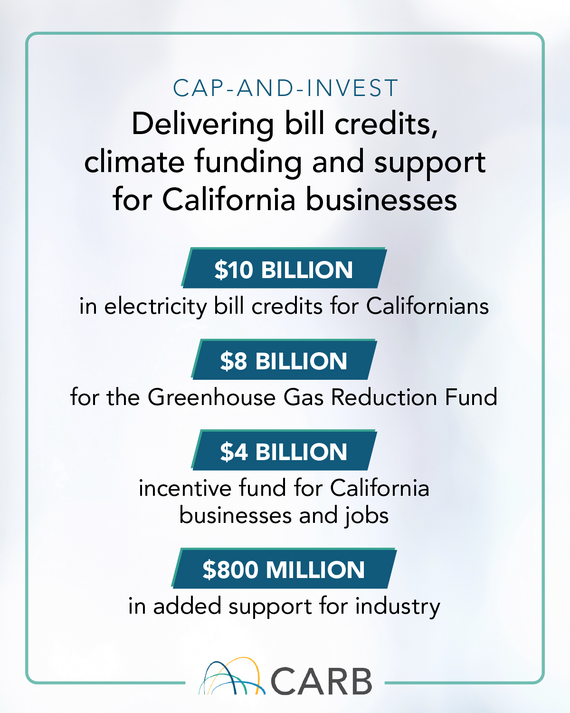
Dedicates 80% of allowances to directly benefit Californians: Provides $10 billion for electricity bill credits and maintains an estimated $8 billion for the Greenhouse Gas Reduction Fund.
-
Stronger support for California businesses and jobs: Doubles the Manufacturing Decarbonization Incentive Fund to $4 billion to support investment in California and help make up for the loss of federal incentives. Eligible entities include manufacturers – food processors, cement plants, and refiners, who make large investment upgrades that reduce emissions at their facilities and reduce future compliance costs.
-
$800 million in added compliance support for industry: Enhances near-term stability, supports California businesses and jobs, and ensures no additional cost passthrough at the pump for consumers.
Why it matters
California’s Cap-and-Invest Program remains the most cost-effective way for California to achieve its statutorily mandated climate goals. It establishes a declining limit on emissions from the largest polluters, including large factories, energy companies, and oil and gas suppliers, accounting for 80% of the state’s total climate emissions. The program encourages investment in cleaner technologies and is estimated to be 4–6 times more cost-effective than traditional prescriptive regulations. It is part of the larger suite of programs California has been deploying for two decades to address climate pollution.
To date, Cap-and-Invest has:
- Helped California reach its 2020 climate target six years early
- Generated $35 billion dollars for climate investments
- Funded more than half a million projects statewide
- Supported 30,000 jobs
- Cut millions of tons of carbon
- Delivered $16 billion in utility bill credits directly to Californians
The adopted updates build on this success while navigating today’s economic realities. They also ensure California continues to lead at a time when climate policy is facing increased opposition at the federal level.
How we got here
The Cap-and-Invest Program was first authorized by AB 32 in 2006, extended in 2017 when the legislature passed AB 398 with a two-thirds vote, and extended again in 2025 through 2045 by AB 1207 with another two-thirds vote. Over its 13 years of implementation, the program has undergone eight regulatory updates and has achieved nearly 100% compliance.
In January 2026, CARB staff released a draft proposal to align the program with new legislative direction extending the program through 2045 and to ensure California stays on track to achieve its climate goals.
The agency received extensive input from members of the public, businesses, environmental groups, utilities, legislators, and community members. In response, staff proposed additional revisions in April 2026 to strengthen affordability, support economic stability, enhance industry assistance, and incorporate public feedback, while maintaining program ambition and integrity.
These refinements were presented to the Board at its May 2026 hearing for adoption. They reflect careful balancing of environmental ambition, economic conditions, and energy affordability.
Next steps
Following today’s adoption, the updates are expected to take effect on September 1, providing regulatory certainty to continue investment in clean energy and technology. CARB will also host a workshop this summer to begin updating compliance offset protocols, as required under SB 840.
The Board also directed the Executive Officer to report back during a future meeting prior to the receipt of applications and issuance of any allowances through the Manufacturing Decarbonization Incentive.
|