|
SACRAMENTO – Opening a new chapter in California’s
fight against air pollution, the California Air Resources Board today took key
steps toward implementing the Community Air
Protection Program, a first-of-its-kind effort to improve air
quality in local communities that face the worst impacts of air pollution.
“This program
represents a completely new approach to improving air quality in California’s
most impacted communities. The State, working together with local pollution
control agencies and community-based organizations, will focus monitoring,
enforcement and regulatory activities on the sources of greatest concern to
residents.” said Chair Mary D. Nichols.
At its monthly
meeting, the Board adopted a blueprint
for the program describing how CARB will work with local residents, air districts and other
partners to identify local air quality problems, develop solutions and track
progress together. The new approach to improving air quality in heavily
impacted communities was established by Assembly Bill 617, signed
by Governor Brown in July 2017.
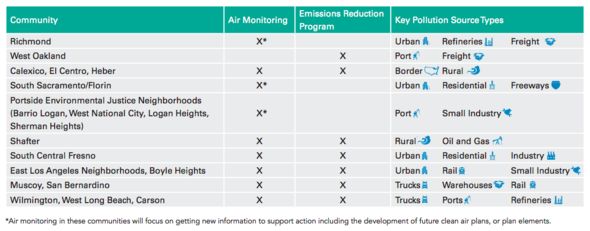
The Board also selected
the first 10 communities that will be the focus of additional targeted actions.
Located across the state and varying in size and population, these communities
have among the highest cumulative impacts from multiple air pollution sources
in California. More communities will be added to the program in the future.
"Today’s vote starts to repair the harm to communities like mine who are affected by emissions from railyards, trucks and more pollution sources," said CARB Board Member Senator Ricardo Lara. "CARB is delivering on the promise the Legislature made by passing AB 617 to help those most affected by pollution so they no longer have to accept dirty air as the cost of jobs and opportunity." Together, these actions are designed to deliver cleaner air to communities, provide accountability and transparency, and promote a collaborative process.
Blueprint for Community Air
Protection
The Board’s
action follows a 10-month public process that included community tours,
meetings with residents, and workshops around the state, in addition to feedback
received from hundreds of communities. The first draft blueprint was released
in February, and the final proposal was released on August 24.
“The blueprint sets in motion our plan to uplift California’s underserved, pollution burdened communities,” said CARB Board Member Assemblymember Eduardo Garcia, AB 617 joint author. “It is a great first step in establishing the foundation for AB 617 implementation in a diverse selection of regions, including Imperial County, a rural area in my district uniquely challenged by cross-border pollution, the Salton Sea and severe socioeconomic disparities. We look forward to being able to steer these investments towards community-led emission reduction and air monitoring programs.”
The blueprint
describes:
-
Steps
CARB will take to work with communities and air districts to improve air
quality in impacted communities statewide
- Process
for selecting communities for targeted clean air improvements
- Procedures
for air districts and communities to set up air pollution monitoring
- Better
data on pollution sources and making data more accessible
-
Required
elements to be included in community emission-reduction programs
-
Incentive
investments to help purchase cleaner vehicles and equipment
-
Metrics
to track and report progress in reducing emissions
Focused Action in 10
Initial Communities
The 10 communities
selected by the Board for focused action face disproportionate impacts from
multiple sources of air pollution, including freight facilities, ports, large
and small industrial facilities, freeways, oil and gas facilities, and busy border
crossings. Residents of these communities also experience high levels of
poverty and unemployment.
Under the Community
Air Protection Program, these communities will be targeted for focused actions
to improve air quality. These include setting up community air pollution
monitoring systems, developing community clean air programs focused on cutting
emissions from local pollution sources, or both.
Following
the blueprint adoption, regional air districts will develop community emissions
reduction programs in collaboration with local community steering committees. These programs must include new strategies to address air pollution
from stationary, mobile and area-wide sources that contribute to the burden on
impacted communities.
Strategies
required to be considered under the blueprint include new regulatory and
enforcement actions, facility risk-reduction audits, enhanced air quality
permitting requirements, incentive programs, and land use and transportation
planning.
The first
cohort will serve as a model for future efforts in other areas in coming years.
Related Community Action Efforts
Today’s actions
are part of the state’s ongoing commitment to address the disproportionate
impacts of air pollution on disadvantaged communities. Other recent actions
include the following:
-
In
June, CARB awarded $10
million in grants to help 25 community-groups and three Native
American Tribes reduce air pollution in their neighborhoods in support of AB
617 implementation
View an interactive map of these efforts including Supplemental Environmental Projects,
existing community monitoring and more.

|