CARB honors former
Governor Arnold Schwarzenegger, former U.S. EPA Administrator Gina McCarthy,
world-renowned scientist Mario Molina, and influential policymakers David
Hawkins and Henry Waxman
SACRAMENTO - The California Air Resources Board today
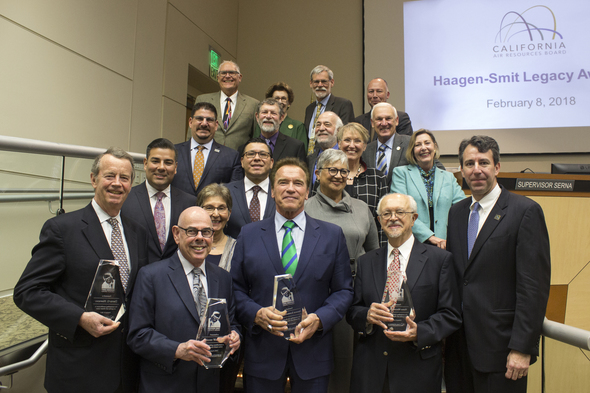
honored five recipients of the 2017 Haagen-Smit Legacy Awards, California’s
premier award recognizing individuals who have made outstanding contributions
to improving air quality. The contributions of this year’s award winners will
have lasting impacts not only for air quality and climate goals in California,
but on an international scale.
In honor of the California Air Resources
Board’s 50th anniversary, the state’s clean-air agency recognized
the outstanding contributions that each of the five winners made during a
specific decade since the inception of the California Air Resources Board. The agency was created
when Governor Ronald Reagan approved the Mulford-Carrell Act in 1967, and the
first Board meeting was held Feb. 8, 1968 — 50 years ago today.
“Our
honorees span the past 50 years of progress toward clean air. Each played a
leading role in this struggle for clean air and a healthy economy,” CARB Chair
Mary D. Nichols said. “Individually our honorees have conducted ground-breaking
research or shaped pioneering clean-air policies. Together, these five remarkable
individuals are being recognized for their leadership, courage, and innovation.
Californians owe them a debt of gratitude for their contribution to improved
public health in California, across our nation, and throughout the world."
Considered the “Nobel Prize” in air quality and
climate change achievements, the Haagen-Smit Clean Air Awards are given
annually to individuals who have made significant lifetime contributions toward
improving air quality and climate change science, technology and policy,
furthering the protection of public health. In honor of the 50th
Anniversary, this year’s awards are named the Haagen-Smit Legacy Awards.
The 2017 Award Recipients
David G. Hawkins, Director, Natural Resources Defense Council’s Climate Center
David Hawkins was one of the Natural Resources
Defense Council’s first staff members in 1971. He is a leader in the
development, advocacy and implementation of sustainable and science-based clean
air policies, notably the Clean Air Act, which improved the quality of life for
all Americans. With expertise in advanced coal technologies and carbon dioxide
capture and storage, Mr. Hawkins has worked with U.S. Congress, the Executive
Branch, and the business community to design policies that will slow, stop, and
reduce the emissions of global warming pollution. His legacy of advocating for
health-protective air quality policy will have positive effects on Americans’
health for years to come.
Henry Waxman, Chairman, Waxman Strategies
Representative
Henry Waxman, who continues his decades-long leadership for environmental
protection today, served 40 years in Congress where he was a leader in the
development of numerous legislative achievements on environmental matters. Mr.
Waxman’s legislative work and tenacity earned him wide recognition as an
accomplished legislator. President Obama described him as “one of the most
effective legislators of his or any era.” Mr. Waxman was the author of the
landmark 1990 Clean Air Act Amendments, the Safe Drinking Water Act, and
multiple laws to reduce greenhouse gas emissions and protect children from
toxic pollution. As Chairman of Waxman Strategies, a public affairs and
strategic communications firm, he continues to focus on the issues he
championed while in Congress, including health care, environment, energy,
technology, and telecommunications. He also serves as a Regent Lecturer at UC
Los Angeles and an advisor and lecturer at the Johns Hopkins Bloomberg School
of Public Health.
Mario Molina, Ph.D., Distinguished Professor of Chemistry and
Biochemistry, Scripps Institution of Oceanography, University of California,
San Diego
Professor Mario Molina’s
pioneering research on chlorinated gases in the atmosphere laid the foundation
for international efforts to curb growth of the ozone hole, and is now shaping
policy to curb short-lived climate pollutants. His ground-breaking research has
been widely recognized around the world, and the 1987 Montreal Protocol on
Substances that Deplete the Ozone Layer was one of the most successful treaties
of any kind thanks to research conducted by Professor Molina and his colleague
Dr. Sherwood Rowland, for which they both received the 1995 Nobel Prize for
Chemistry. Professor Molina also leads the “Centro Mario Molina,” a Mexican
nonprofit focused on finding solutions to environmental challenges including
climate change and air pollution. He is a pioneer in translating atmospheric
science research into scientifically sound policies that protect human health
and the environment.
Governor Arnold Schwarzenegger, Chairman, USC Schwarzenegger Institute for State and Global Policy
Among the most influential actions taken by
Governor Arnold Schwarzenegger was his support of the California Global Warming
Solutions Act of 2006 (Assembly Bill 32) where he worked with leaders of both
major political parties to pass this bold and historic state law. Continuing
his commitment to environmental leadership, in 2011 he co-founded R20, a global
nonprofit of subnational governments and regional leaders working together to
address climate change and build a green economy. In 2012 he partnered with the
University of Southern California to launch the USC Schwarzenegger Institute to
continue his work on the many policy initiatives he championed during his two
terms as Governor, 2003-2011.
Gina
McCarthy, Professor
of the Practice of Public Health, Department of Environmental Health, Harvard
T.H. Chan School of Public Health; Director, Harvard’s Center for Health and
the Global Environment
While serving as Administrator
of the U.S. Environmental Protection Agency from 2013 to 2017, Gina McCarthy’s
leadership on development and implementation of the Clean Power Plan and a
whole suite of climate policies are a long standing legacy that benefits the
nation and the world. Her tenure as EPA Administrator heralded a paradigm shift
in national environmental policy, expressly linking it with global public
health. In her new role at Harvard University, she will lead the development of
the School’s strategy in climate science, health, and sustainability;
strengthen its climate science and health curriculum; and interface with
climate science leaders across the University.
The Haagen-Smit
Awards
California’s premier
air quality award is named for the late Dr. Arie Haagen-Smit — known as the
"father" of air pollution science and control. The award recognizes
those who continue his legacy through perseverance, leadership and innovation
in the areas of research, environmental policy, science and technology, public
education and community service. Dr. Haagen-Smit’s breakthrough research, which
became the foundation upon which today's air pollution standards are based,
concluded that most of California's smog is the result of photochemistry — the
reaction of sunlight with industrial and motor vehicle exhaust to create ozone.
The selection committee is comprised of past award winners.
|