|
The Port of Oakland recorded its third-highest annual volume year ever with more than 2.3 million TEUs in calendar year (CY) 2012, though remained relatively flat for CY 2012 as compared to CY 2011. 2012 Cargo value was approximately $39 billion. Exports continue to represent the majority of trade at 54% versus 46% for imports.
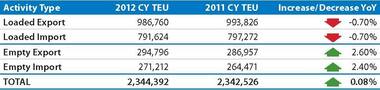
We remain the 3rd-highest volume port on the U.S. West Coast, and the 5th busiest in the nation. Oakland’s held steady at 11.5% market share of the overall containerized volume throughput on the U.S. West Coast.
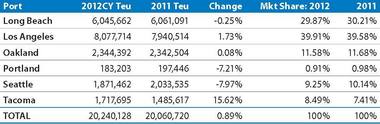
Oakland continues to remain a strong gateway for exports. Almost 18% of the total exports through the U.S. West Coast were shipped through the Port of Oakland in 2012 compared to 16.6% for 2011. Califorina agricultural commodities such as edible fruits and nuts, meats, and wine are the main drivers of these continued robust export volume.
For more statistics, visit our 2012 - 2013 Maritime Handbook.
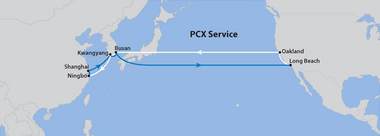
In July 2012, TraPac Inc. made an investment and initiated improvements for three of its quayside container cranes at the Port of Oakland. Paceco Corp from Hayward, CA was hired by TraPac Inc. to raise the lifting height and extend the boom outreach of the cranes. The cranes now have a lifting height of 124 feet and an outreach of 160 feet. As a large percentage of today’s trans-Pacific ships average between 16 and 18 containers wide, the modified cranes will increase TraPac’s operational capabilities to handle these wide vessels. The modifications were completed on March 25th, just in time to accommodate several 8,600 TEU vessles that will begin calling the Port of Oakland in May through the PCX service.
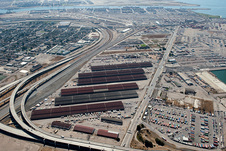
The Port of Oakland, in partnership with the City of Oakland are moving forward together on a $500 million Phase 1 redevelopment of the former Oakland Army Base (OAB) into a modern intermodal logistics cluster. Recall that the OAB site is approximately 360 acres split evenly between the City of Oakland and the Port of Oakland. Phase 1 includes new utilities across the entire site; a new bulk terminal, modern warehousing and cold storage facilities, a recycling facilities on the City side; and a new railyard on the Port side.
At the March 14th, 2013 Board meeting, the Port’s Board of Commissioners gave port staff authorization to begin negotiation of a contract with Balfour Beatty Rail and Gallagher & Burk (BBGB), a Joint Venture. The contract allows BBGB to design and build the Outer Harbor Intermodal Terminal Rail Yard. The Design Build project includes the construction of approximately 35 acres of freight rail yard for the storage and inspection of unit train and manifest train railcars, lead tracks, and signal equipment. The facility will connect the Port’s OHIT Rail Yard Phase 1 to Union Pacific Railroad’s existing mainline track system, the Port’s Joint Intermodal Terminal, and the City of Oakland’s Gateway rail development.
The Port also recently approved interim leases to ensure four warehousing companies currently operating at the OAB are able to remain for the next 30 months as the Port finalizes its plans for developing the remainder of its OAB land.
The Port will be conducting a community outreach meeting on the OHIT rail yard project on April 29, and will be breaking ground in late May, with construction expected to take two years.
Learn about the City's development of the former Oakland Army Base here.
|
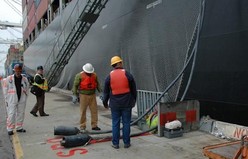
To ensure compliance with California's leading port emissions regulations and clean up the air for communities that neighbor the seaport, the Port is well on its way to installing shore power at all of its berths by the end of the year.
Shore power involves the construction of electrical infrastrcture that allows ships to turn off their diesel-fueled auxiliary engines while at dock. Vessel functions are instead powered by plugging into the electric grid, which dramatically reduces air pollutant emissions from docked vessels.
In 2012, the Port completed construction of shore power infrastructure serving Berths 56, 57 and 58 – Phase 1 of the Port’s Shore Power Program – and several vessels have already plugged into the system at these berths. The Port is approximately 80% complete on construction of shore power systems at Berths 25, 30, 32, 35, 37, 55, 59 and 68 (Phase 2). Plug-ins at these berths are anticipated to begin in Summer/Fall 2013. In addition to the Port’s Shore Power Program, two of the Port’s tenants have already installed or are in the process of installing shore power on their terminals (GGC Terminal, Berths 61/62 and PAOH Terminal, Berth 24).
As part of implementing the Program, the Port has developed initial rates and charges specific to the use of shore power infrastructure - on April 11, 2013, the Oakland Board of Port Commissioners adopted a rate of $267/ hour for shore power use, as well as a vessel commissioning flat charge of $4,430. These rates provide a predictable and competitive cost structure for terminal operators and vessel owners.
|
The Comprehensive Truck Management Program has achieved many milestones since its adoption in 2008. In partnership with the California Air Resources Board (CARB), the Bay Area Air Quality Management District (BAAQMD), the Environmental Protection Agency (EPA), and the local trucking community, the Port has successfully implemented a grant program and retrofitted or replaced 1,521 drayage trucks.
Along with improving truck engines for better air quality the Port has taken additional steps to reduce emissions. Improvements have been made at various seaport facilities to enable the use of Radio-frequency identification (RFID) technology to identify trucks at gates and in the yard. This facilitates truck transactions and reduces truck idling. The new warehouse development planned for the former Oakland Army base will reduce truck trips and particulate matter emissions. The Port moved the mandated truck parking operation to the Roundhouse resulting in more acres of truck parking and better access to the lot. The lot currently provides approximately 24 acres of truck parking versus the mandated 15 acres. Along, the way, trucker meetings and fairs have been held to keep truckers updated with the latest regulations and resources.
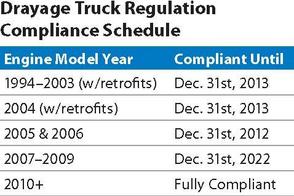
This has only been the first phase of the implementation of the Comprehensive Truck Management Program. The Port and its partners will continue the work on improving air quality through phrase two of the regulation which goes into effect on December 31, 2013. Phase two aims to support truckers in switching all truck engines to 2007-2009 model years or newer. See the table below for compliant deadlines.
As a result of the Maritime Transportation Security Act of 2002 and the Security and Accountability for Every Port Act of 2006, regulation required certain merchant mariners and individuals with unescorted access to secure areas of certain vessels and facilities to undergo a security threat assessment. Carriers of the TWIC are those who have cleared the security threat assessment. The TWIC readers are pending deployment, so the Department of Homeland Security has provided a one-time Extended Expiration Date option for the convenience and cost-saving of workers.
Effective August 30, 2012, TWIC holders who are U.S. citizens or U.S. nationals, and whose TWICs will expire on or before December 31, 2014, have two options to renew their TWIC. They may either replace their expiring TWIC with a 3-year Extended Expiration Date (EED) TWIC or obtain a standard 5-year replacement. For more TWIC information click here.
The San Francisco Bay is among some of the most difficult waterways to navigate in North America. During the winter and summer months when fog is more prevalent, visibility can be difficult. The need to improve visibility is crucial for safety measures. In collaboration with local and federal agencies the Port of Oakland will be the first port on the US West Coast to utilize the FS11 Vaisala visibility sensor.
Visibility sensors are widely used for aviation and are becoming more critical for maritime applications. The visibility sensor will be placed at the Ben E. Nutter Terminal (Berth 38), currently operated by Seaside Transportation Services, LLC and home to Evergreen Marine Corporation. The success of the visibility sensor will result in improved navigation safety and will facilitate decision-making for the SF Bar Pilots, tug boat operators, ferry operators and the sailing public in San Francisco Bay.
The visibility sensor will become part of the National Oceanic and Atmospheric Administration (NOAA) National Ocean Service (NOS) Physical Oceanographic Real-Time System (PORTS) which provides real time water level, currents and meteorological data for navigation aid in twenty major ports and harbors across the country.
Installation of this sensor is the culmination of a two year project completion that included collaboration between the Port of Oakland, SF Harbor Safety Committee, U.S. Coast Guard Sector SF, Marine Exchange of SF Bay, NOAA’s National Weather Service Office Monterey and NOAA’s Center for Operational Oceanographic Products and Services.
For a comprehensive overview of the Port of Oakland maritime assets and operations, please visit our website.
|