On June 14, 1950, William Rodgers found the “flying saucer” that had crashed onto his Roseville ranch a couple of days earlier. According to the June 14, 1950, Roseville Press Tribune: “Well, Roseville need no longer feel slighted because the ‘flying saucers’ have passed her by. In the Allen’s district, anyway, the residents are certain they have the answer to the much-publicized panic-stirring discs.”
The flying saucer craze began in the summer of 1947 with two highly publicized events: pilot Kenneth Arnold’s sighting of nine shiny, circular objects in the skies above Washington state June 24 and the “flying saucer” that crashed on a Roswell, New Mexico, ranch sometime around July 7.
Arnold had described the craft as “saucer-shaped,” and the press ran with it, forever linking the term “flying saucer” with what would later be known as unidentified flying objects, or UFOs. Feeling pressure from their constituents, politicians leaned on the U.S. Air Force to investigate the phenomenon, which led to Project Blue Book. Through this project, the Air Force investigated over 12,000 UFO sightings between 1947 and 1969.
In 2020, the U.S. government transitioned from using the term “UFO” to “UAP,” or unidentified aerial phenomena. While most sightings have been attributed to natural or known phenomena, a significant number remain unidentified.
It turns out that in 1950, William Rodgers had a close encounter with a weather balloon.
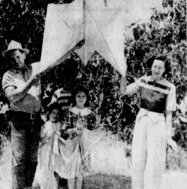
Photo: June 16, 1950, Roseville Press Tribune Photograph of the Rodgers family with the weather balloon that crashed on their ranch.
|