Welcome to the Plan Bay Area 2050 newsletter!
Here’s what is coming up this month...
Special Note: Long-Range Planning Continues Despite COVID-19
While the Bay Area has been hit hard by COVID-19 along with the rest of the country and world, Gov. Newsom’s March 4 Safer at Home, Stay at Home order provided guidance as California continues to prepare for its future. Just as much of the business of government continues, the Order did not waive key deadlines established by federal and state laws for either the Plan or for the RHNA process required by state law to take place every eight years. Addressing the Bay Area’s long-term housing, transportation, economic, and environmental challenges will remain a top priority after the current health emergency is over. The MTC/ABAG staff is working from home and is developing plans for remote participation in stakeholder meetings, as well as public engagement. Updates will follow as the situation progresses.
Highlights from May 2020 Presentation on COVID-19 & 2020 Recession Impacts
On May 8, the MTC Planning Committee and the ABAG Administrative Committee received a report on the potential regional impacts from the COVID-19 pandemic and a likely 2020 recession to Most of the anticipated impacts will primarily affect the early years of Plan Bay Area 2050 – due to a rapid change in baseline economic conditions. At the same time, select effects of the pandemic and recession – such as potential long-term growth in telecommuting – could have ripple effects in the years and decades ahead.
The Bay Area is fortunate to have recently completed the Horizon initiative, which explored strategies for an uncertain future. Key takeaways from Horizon remain relevant as MTC/ABAG move forward with Plan Bay Area 2050 as well:
Transportation. The current crisis may present opportunities to reinvent our transit system, leveraging strategies to create more seamless and more equitable mobility options through integrated fares, means-based fares, and more.
Housing. Many of the housing strategies being explored in the Draft Blueprint are low- or no-cost; these include redevelopment of aging malls into mixed-use developments, enabling more growth in walkable places across the Bay Area, and strengthening renter protections to reduce displacement risk.
Economy. Strategies explored early in the Horizon process related to workforce development, construction training, universal basic income, and more may be ripe for further discussion in the current context, which is significantly different than in recent years of economic prosperity.
Environment. Low-cost “quick-build” investments – such as home retrofits, wetland restoration projects, or land acquisition – cost a fraction of traditional infrastructure projects; these investments featured in the Draft Blueprint can serve as critical short-term priorities for stimulus and job creation.
Earlier this year, the MTC and ABAG boards approved the proposed Draft Blueprint Growth Geographies and Strategies for analysis across all four focus areas – transportation, housing, the economy, and the environment. That enabled analysis of the Plan Bay Area 2050 Draft Blueprint, now underway. This month, key environmental strategies are highlighted:
Adapt to Sea Level Rise. Protect shoreline communities affected by sea level rise, prioritizing areas of low costs and high benefits and providing additional support to vulnerable populations.
Modernize Existing Buildings with Seismic, Wildfire, Drought, and Energy Retrofits. Adopt new building ordinances and incentivize retrofits to bring existing buildings up to higher seismic, wildfire, water and energy standards, providing means-based subsidies to offset impacts.
Maintain Urban Growth Boundaries. Using urban growth boundaries and other existing environmental protections, confine new development within areas of existing development or areas otherwise suitable for growth, as established by local jurisdictions.
Protect High-Value Conservation Lands. Provide strategic matching funds to help conserve high-priority natural and agricultural lands, including but not limited to Priority Conservation Areas.
Expand MTC’s Climate Initiatives Program. Invest in transportation demand management and electrification incentive programs, while simultaneously working with the Air District and the State to reduce greenhouse gas emissions for other transportation sectors.
What’s Next This Summer: Public Workshops and the Release of the Draft Blueprint
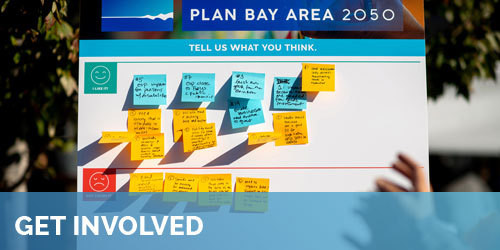
As the Bay Area continues to contend with the coronavirus (COVID-19) pandemic that requires residents to maintain physical distancing, digital alternatives for planned in-person public engagement activities are scheduled for this summer. While the means of conducting the public engagement will be different, feedback will be sought on the same critical milestone – the strategies and outcomes of the Draft Blueprint – as well as input on how to refine it further for the Final Blueprint. Your input is key. The Draft Blueprint is scheduled for release in mid-July 2020.
Public engagement to accommodate the limitations to in-person gatherings include replacing public workshops with digital workshops, in-person focus groups with digital focus groups, etc. The shift in strategy will allow for better reach to under-represented groups that have historically faced barriers to participation. Current plans include a digital interactive, promotional campaign to obtain online input on the Draft Blueprint strategies and promote summer events; digital focus groups with community-based organizations; digital coffee chats on specific topics; a random telephone poll for the nine county Bay Area; and digital public workshops that will take the place of the in-person workshops. Non-digital engagement options include detachable mail-in survey or comment cards in English, Spanish, Chinese and Vietnamese; text/SMS engagement with CBO communities; a voicemail “listening line” for public comments; and an outreach toolkit for partners to use in newsletters and other promotion.
Input from this round of public engagement will inform strategy revisions for the Plan Bay Area 2050 Final Blueprint, which will be presented for approval to the Commission and ABAG Executive Board in early fall 2020.
Receive the e-newsletter. Keep current on all that’s going on with MTC and ABAG’s ambitious planning initiative and sign up for updates.