|
Thank you for subscribing to the Marin County Sustainability Team newsletter.
Normally, we keep our newsletter schedule to once a quarter but this special edition homeowner highlight has too much great information to fit into a regular seasonal email.
This newsletter features the story of Fabrice and Phyllis Florin, two Marin residents who set out to electrify their home 5 years ago and just turned off the gas on their all-electric home!
We’d like to thank them for sharing their project information with us. We hope that it will provide some valuable insights into your home electrification projects.
Follow us:
Upcoming events:
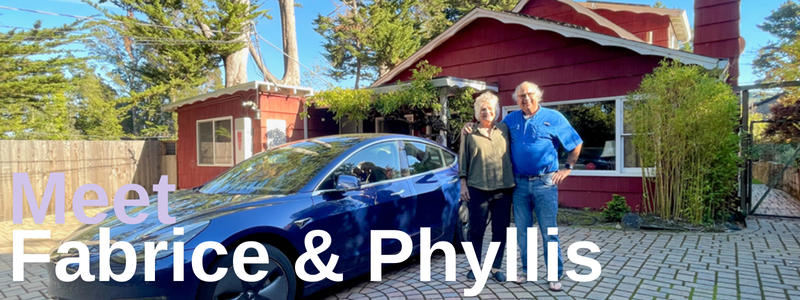 Fabrice Florin is a semi-retired multimedia innovator and social entrepreneur who has led a wide range of projects in education, news, and entertainment. Fabrice now runs Green Change, a climate action network that helps people go green and fight climate change together. It's a great resource for Marin residents to learn from each other about their home sustainability projects.
Fabrice and his wife Phyllis have lived in their Mill Valley home for 30 years.
They also participated in the 2023 Marin Green Home Tour. Visit their website to watch Fabrice's home tour video and read about their home improvements, along with other Marin Green Home Tour past participants.
The 2024 Marin Green Home Tour is coming up on October 24! Register here.
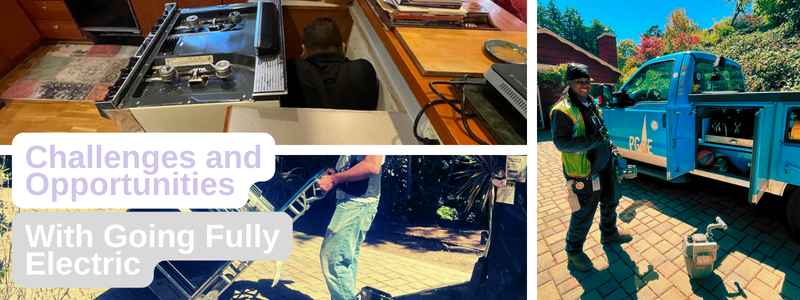 This year, the Florins completed their all-electric home by installing these 3 new appliances:
- Mitsubishi heat pump space heater/cooler
- GE Profile induction range and
- GE clothes washer/dryer
They replaced their remaining old gas appliances and had PG&E turn off their gas service, after a 5-year electrification journey to help reduce their home greenhouse gas emissions, as well as save energy and money.
One reason many Marin homeowners like the Florins are switching their gas appliances to efficient electric options is to reduce greenhouse gas emissions and fight climate change. 31% of the Marin Countywide emissions come from the building environment (buildings) and 85% of those emissions come from burning gas.
Other reasons residents are making the switch include:
- Wanting to lower utility bills
- To take advantage of an existing solar system
- Improving indoor air quality
- Taking advantage of rebate and tax incentive programs to replace old appliances
These resources can help homeowners who are interested in fully electrifying their homes:
 Fabrice and Phyllis live in a modest 1,850 square foot, 3 bed, 2 bath, single-family ranch home in Mill Valley was built in 1953. They decided to start their journey to a carbon neutral and all electric home in 2018.
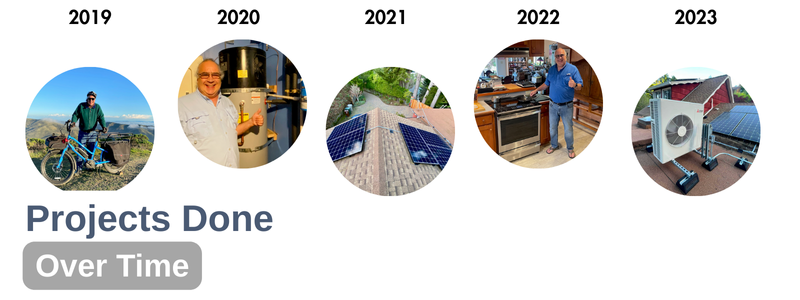
Here is their project timeline with more information and resources available to Marin residents:
Phase 1 (2019)
Electric Car, Home Energy Audit, 100% Renewable Electricity, Heat Pump Water Heater, First e-Bike
A home energy audit is a great way to start your electrification plan. You can use an energy audit like Home Energy Score, which comes with a custom recommendation report from your Home Score Assessor, to learn what upgrades to prioritize for your home. This webpage outlines different types of energy audits available to Marin residents.
MCE Clean Energy’s Deep Green is a quick and affordable way to make sure 100% of the electricity coming to your home is generated by renewable sources.
Visit the Switch is On heat pump water heater page for more information on heat pump water heaters. Rebates are available for switching from a gas water heater to a heat pump water heater.
The biggest source of greenhouse gas emissions in Marin County is from transportation. Driving less (walking, biking, taking transit) and making your next car an electric vehicle can make a big impact. Visit our eMobility page for more information.
Phase 2 (2020)
Roof Replacement, Solar Panels, Home Battery
It is fairly common to start a solar project with a roof replacement. In fact, many solar companies also have roofing contractors on staff. Visit our solar and battery page for tips and resources.
Upcoming webinar: Batter and Storage 101 webinar on November 13 from 6pm to 7:30. Register here.
Phase 3 (2021)
LEDs in all house lights, EV Charger (Level 2), Rainwater Tanks and Pump
LED light bulbs are 90% more efficient than incandescent bulbs, and they don’t produce as much heat, which can help keep your house cooler on hot days. LEDs have come a long way, you can find them in warm temperatures (colors) and work well with dimmers. The Rising Sun Center for Opportunity provides LED light bulbs and other water and energy-saving devices all at no-cost! Visit their website to sign up for their fall campaign.
Visit our Electric Vehicle Charging page for more information on the different charger types, setting a charging schedule to minimize cost, and more.
Visit MMWD’s Rain Catchment webpage for information on different rain water collection systems.
Phase 4 (2022-2023)
Second e-Bike, Portable Induction Cooktop, Electric Barbecue Grill
You can try induction cooking before you invest in replacing your gas oven, by using a portable induction cooktop, as described in this Green Change tip. PG&E has a free loaner program available to everyone in Marin.
Phase 5 (2024)
Heat Pump HVAC, Induction Range, Clothes Washer + Dryer, Electric Pane Improvements
Incentives for replacing gas units with heat pump space heaters and heat pump water heaters are available through Electrify Marin and through state and federal funding sources. Check the Switch is On for current rebate offerings.
Visit our Induction Cooking webpage for more information on the benefits of induction cooking.
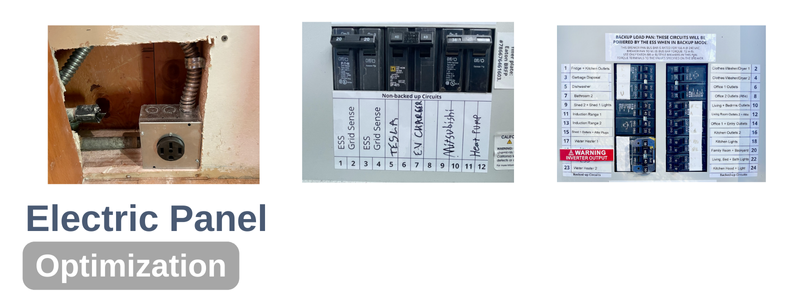 A common issue residents face when trying to fully electrify their homes is their existing electric panel capasity. Electric appliances require "space" on the panel, measured in amps. Most homes in Marin have a 100amp electric panel and some homeowner choose to "upsize" their panels to 200amps to accommodate the additional electrical loads from electric vehicle chargers, solar panels, and heat pump space and water heaters.
However, upsizing an electric panel adds significant cost to a home electrification project and has the possibility to trigger a neighborhood service upgrade from the utility, which can add even more cost and significant time to a project.
Fabrice’s project started with self-made electrification plan and an assessment from HomeIntel, which provided an electrification report based on 12 months of the home’s PG&E data. HomeIntel is a free service for residents in PG&E service territory. You can sign up here for that service, which was invaluable to Fabrice.
After identifying which gas appliances would be replaced and in what order, and going over the electrification report from HomeIntel, Fabrice used the WattDiet calculator and determined that the existing 100amp panel could accommodate all of the new electric appliances.
The only extra work that needed to be done to the electric panel was to optimize the existing panel by rearranging ports and creating two new 240V branch circuits to plug in the new induction range and combo washer/dryer.
These resources can help homeowners who are interested in optimizing their existing 100amp electric panel:
 Fabrice has done an excellent job documenting every step of his project in order to share his experiences with others who are looking to take on similar projects in their homes. You can read more into the details of his projects, including what contractors were used in these documents:
We want to end with Fabrice's own words of advice for anyone looking into similar projects for their home:
-
Plan Ahead. This electrification took a lot of planning, as there were many tricky challenges along the way. Here’s the electrification plan I put together to organize this transition, with the help of our advisors. This required me to analyze our energy use in great detail, but I’m glad I did. Learning how the technology works ahead of time will help you make more informed decisions, enabling you to drive the whole process. It’s worth the investment to become a knowledgeable all-electric homeowner.
-
Get Advice. A good energy advisor can help you make some the hard decisions that are unique to your household, as you can’t just rely on contractors to make those calls for you. Our energy advisor was HomeIntel, which prepared a helpful electrification report, based on our PG&E data. Their excellent service is free if you are a PG&E customer: sign up here and tell James I sent you!
-
Electrify Responsibly. For this project, we decided to optimize our existing 100A electric panel to power those new appliances – without upsizing our panel to 200A, which would have been costly, lengthy and unnecessary. Our goal was to avoid an electric upgrade and reduce our load on the grid by using the Watt Diet, which helps homeowners electrify responsibly with efficient appliances and load sharing practices. Based on our analysis, we concluded that we have sufficient capacity to power all our electric appliances with our current panel. We will use a home energy monitor to track our usage. If needed, we are open to adding a smart splitter and/or circuit pauser later on.
-
Find a good electrician. For this project, I talked to nearly a dozen electricians about this project over the years, and only a few of them seemed up to speed on the unique challenges of all-electric retrofits. Many of them tried to sell us a 200A upgrade, and only a few of them had experience installing energy monitors, smart panels, smart splitters and/or circuit pausers. To their credit, they all seemed overworked, as the need for electrical services appears to be on the rise. We ended up hiring Urban Energy for this job, as they shared our responsible electrification goals, were open to thinking outside the box, and seemed most familiar with new technology like energy monitors. The world needs more forward-thinking electricians like them!
-
Thanks to our partners!
Kudos to all the advisors and content providers who made our electrification possible: ElectrifyNow.net, GreenChange.net, HomeIntel, Marin County Sustainability Team, RedwoodEnergy.com, Resilient Neighborhoods, RewiringAmerica.com and The Switch Is On, to name but a few. These partners and resources were invaluable to guide us through our electrification journey.
Many thanks as well to our local contractors in Marin for taking us through the finish line:
And special thanks to our Green Change Team and partners who chimed in with advice along the way – and who created our Action Guides and Green Tips about electrification on our GreenChange.net site.
We couldn’t have done it without all of you!
We hope you garnered some valuable information that can help you with your home electrification and sustainability projects. As always, feel free to contact us with any questions about the programs and projects discussed in this newsletter.
Sincerely,
Kellen Dammann
Program Coordinator
Marin County Sustainability Team
3501 Civic Center Drive Room 308
San Rafael, CA 94903
kellen.dammann@marincounty.gov
(415) 473-2698
www.marinsustainability.gov
|