|
Thank you for subscribing to the Marin County Sustainability Team quarterly newsletter.
We're excited to share information on upcoming events including the Marin Green Home Tour on October 24, and updates on rebate programs, the County Electrification Road Map, and more.
You can find information on our programs at our website, or you can contact us with questions about our programs for your home sustainability projects.
Follow us:
 Have you registered yet for the Marin Green Home Tour? It's coming up fast on October 24 at 6pm.
DAVID'S NOVATO HOME looks out on oak woodlands. His EVs and E-bikes are powered by solar and batteries. Other features include heat pump HVAC and water heater, hot water recirculation pump, portable induction hob, Vulcan vents for fire hardening, and a DIY rainwater catchment system made from reused pickle barrels.
LUCINDA'S SAN RAFAEL HOME is 100 years old, with a whole home fan, new yet vintage-looking wood windows, radiant bathroom floor, permeable pavers, 36" induction range, rainwater barrels, and a cheap Mr. Cool heat pump for a backyard studio. As a Green Realtor, Lucinda pursued green certification for her home, which adds value.
TOM'S MARSHALL COTTAGE on Tomales Bay was updated with a passive house addition and an emphasis on insulation and electrification. See his heat pump, induction stove, electric hot tub, electric fireplace, passive house attributes, salvaged wood for siding and flooring, and hyper-local native plants.
SUE'S SAN ANSELMO HOME Sue retrofit her 1996 home to be all-electric, with a sleek induction cooktop and heat pumps. She removed the lawn with water district rebates and added rain barrels. A bidirectional charger allows them to use their EV for home back-up power. Sue's recommendations for contractors and rebates are golden.
FRANK'S TIBURON HOME with amazing views is powered by solar plus batteries, and heated/cooled by heat pumps and passive solar. Giant cisterns store rainwater, and Oto robots irrigate steep planted slopes. Frank uses apps to fine-tune his energy and water systems, and participates in a virtual power plant program.
ALEXIS' APARTMENT: Alexis has figured out an array of green home strategies to live more sustainably in her rental – a unique log cabin!
During our PROGRAM, you'll get a chance to ask these Marin neighbors questions about their green home features and upgrades. You'll also be able to ask questions of our featured experts, who will share up-to-date information on rebates, free planning services, and rooftop solar as an investment.
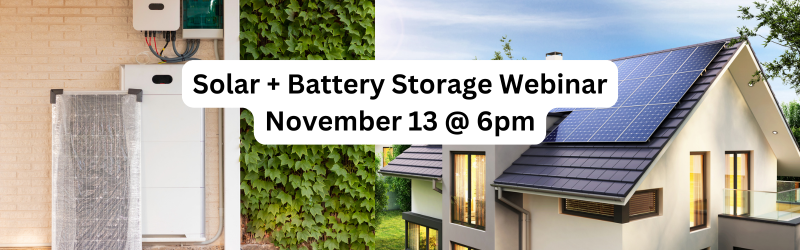 Should you go solar, and should you add battery backup if you do? Get all the information a homeowner needs to know before investing in solar and/or a battery storage system, including how the systems work, the economics and incentive landscape, how to choose and talk to a contractor about your project, and more.
This free informational webinar will feature Sean Armstrong from Redwood Energy. We're excited to bring Sean back this year to deliver his second Solar and Battery Storage webinar for Marin residents.
Register here:
 With solar panels and battery storage, you can maintain power during outages and Power Safety Shut Off events. Bay Area SunShares is offering a discount on home solar panels and home battery storage until November 15th. Learn more here.
You can also attend one of their upcoming informational webinars. Check out their webinar calendar or visit our events page.
Bay Area SunShares will also be presenting on our Solar and Battery Storage webinar on November 13.
 As we enter the holiday season, we’d like to remind you to put all food scraps in the compost bin and green cart. Not only is it the best thing to do for our environment – it’s the law. You may need to educate out-of-town guests on the proper disposal of food waste at your holiday celebrations.
Regardless of their condition, all food scraps belong in the compost. If food scraps go to the landfill, they create methane, a powerful heat-trapping greenhouse gas that contributes to climate change. By composting our food scraps, we can return nutrients to the soil and avoid methane emissions from landfills.
Whether it’s raw (such as banana peels and carrot tops), cooked (such as plate scrapings, meat, and bones), or rotten (such as expired leftovers and takeout) — it all belongs in the green cart.
Learn more at Zero Waste Marin.
 The statewide rebate programs for residential heat pump projects are taking shape. Keep an eye on our communications for updates, or you can follow Tech Clean CA for the latest information on rebate programs.
The HEEHRA rebate (High-Efficiency Electric Home Rebate Act) comes from the Federal Inflation Reduction Act (IRA). HEEHRA rebates for multifamily projects are currently available. HEEHRA rebates for single family homes will become available soon.
 If you did not sign up for the in-person Green House Call campaign this summer you can still sign up for the virtual program until the end of the month.
The Green House Call kit includes energy wand water saving devices like LED light bulbs, faucet aerators, smart power strips, and more. Sign up here to start your home survey, after completion of the survey, your kit will be sent to you in the mail.
The program is available at no-cost to Marin residents in apartments or single family homes. You cannot participate if you have already received this service within the last 5 years.
 Check out our new Electrify Marin Info Hub. We've curated these pages to provide valuable information for Marin residents who are looking to switch their homes from gas-fueled appliances to efficient electric alternatives, no matter from what point you are starting from.
Jump to these pages for specific information to help you complete your home electrification journey:
 County of Marin Sustainability Team and the Marin Climate and Energy Partnership have developed a Countywide Electrification Roadmap which includes recommended key actions to equitably transition to the electrification of Marin’s buildings. On Tuesday, October 20th, the Marin County Board of Supervisors adopted the Roadmap. Actions highlighted in the Roadmap include development of new building codes to encourage electrifying new construction and existing structures, creation of a central hub to assist residents in such projects, and promotion of stakeholder engagement.
 The Marin County Department of Agriculture released the 2023 Crop & Livestock Report in August. This year, the report shined a spotlight on climate-smart agriculture, a practice pioneered by Marin and neighboring Sonoma County. The article was developed by a cross-county project team and is the first shared article to be featured in both county’s 2023 Annual Crop & Livestock Reports. The collaboration between farmers, ranchers, scientists, and conservation organizations in these counties has been instrumental in advancing agricultural practices that reduce greenhouse gas emissions, store carbon in soils, and build resilience to climate change. The success of these initiatives is a testament to the dedication and innovation of Marin’s and Sonoma’s agricultural communities.
|